


Introduction to Data Interpretation
Data interpretation is a crucial aspect of the research process, serving as the method through which researchers analyze and derive meaning from collected data. In scholarly publications, data interpretation enables authors to transform raw numbers and observations into coherent narratives that resonate with readers. It serves to clarify findings, ensuring that the audience can easily grasp the implications of the research. Without effective data interpretation, the results could easily be misrepresented or misunderstood, undermining the overall integrity of the study.
The significance of data interpretation in scholarly articles cannot be overstated. It contributes to the credibility of research findings by providing a structured approach to understanding the underlying patterns, relationships, and trends that may not be immediately apparent. Researchers must present their results in a manner that not only reflects the accuracy of the data but also highlights their relevance to the broader academic community. By effectively interpreting data, researchers provide clarity and insight, allowing others to build upon their work, validate their conclusions, or challenge their findings.
Moreover, proficient data interpretation is essential for drawing meaningful conclusions and developing actionable recommendations based on the research outcomes. It leads to informed decision-making, fostering advancements in various fields. This introductory overview establishes the importance of understanding various data interpretation techniques, which will be explored further in subsequent sections. By appreciating the role of data interpretation in scholarly publications, readers can better understand how it enhances communication and contributes to the ongoing dialogue within academic discourse.
Qualitative vs. Quantitative Data Interpretation
Data interpretation in scholarly publications can primarily be categorized into two distinct approaches: qualitative and quantitative. Understanding these two types is essential for researchers as they decide how to analyze their data and draw conclusions from their research. Qualitative data interpretation often involves thematic analysis, where researchers explore non-numerical data, such as interviews, text, and other forms of visual information. This method allows researchers to identify patterns and themes that emerge from the data, thus offering deeper insights into the experiences and perspectives of participants.
For instance, in a study examining the experiences of patients with chronic illnesses, qualitative data might be gathered through interviews. Researchers would analyze these interviews for recurring themes, such as emotional challenges or coping strategies, which could lead to a nuanced understanding of the patients’ lived experiences. The conclusions drawn from such qualitative analyses can provide valuable context and depth that might be overlooked by purely quantitative approaches.
In contrast, quantitative data interpretation typically utilizes statistical analysis to uncover patterns and relationships within numerical data. This approach is grounded in the application of statistical tests to evaluate hypotheses and establish correlations between variables. For example, in a clinical trial assessing the effectiveness of a new medication, researchers would collect numerical data regarding patient outcomes and then apply statistical methods to determine whether the observed effects are significant.
The conclusions derived from quantitative analyses often provide generalizable results that can inform broader trends or causal relationships. However, it is crucial to recognize that while quantitative methods can offer powerful insights into strength and significance, they may lack the contextual depth that qualitative approaches can provide. Ultimately, the choice between qualitative and quantitative data interpretation depends on the research question, objectives, and the nature of the data being analyzed.
Common Statistical Techniques for Data Interpretation
In scholarly research, the interpretation of quantitative data relies heavily on various statistical techniques. These methods can be classified into descriptive and inferential statistics, both of which play a critical role in helping researchers summarize and understand their data.
Descriptive statistics serve as the foundation of data interpretation. They provide a summary of the main features of a dataset, often through measures such as mean, median, mode, standard deviation, and variance. By utilizing these measures, researchers can convey important information about the central tendency and variability of their data, helping to make sense of complex datasets.
On the other hand, inferential statistics are employed to draw conclusions about a population based on sample data. Techniques such as hypothesis testing, confidence intervals, and p-values aid researchers in determining if their results are statistically significant, allowing for generalizations to a larger population. This aspect of data interpretation is crucial as it attempts to extrapolate findings beyond the immediate data collected.
Correlation and regression analysis are additional powerful tools used in statistical interpretation. Correlation evaluates the strength and direction of a relationship between two variables, which can provide insights into potential associations. Regression analysis, meanwhile, goes further by modeling the relationship between a dependent variable and one or more independent variables, allowing researchers to make predictions based on their data. This technique is particularly valuable in understanding how various factors influence outcomes, adding depth to the analysis.
Overall, the judicious application of descriptive and inferential statistics, along with correlation and regression analysis, enhances the ability of researchers to interpret their quantitative data effectively, leading to more informed conclusions and recommendations.
Visual Data Representation and Interpretation
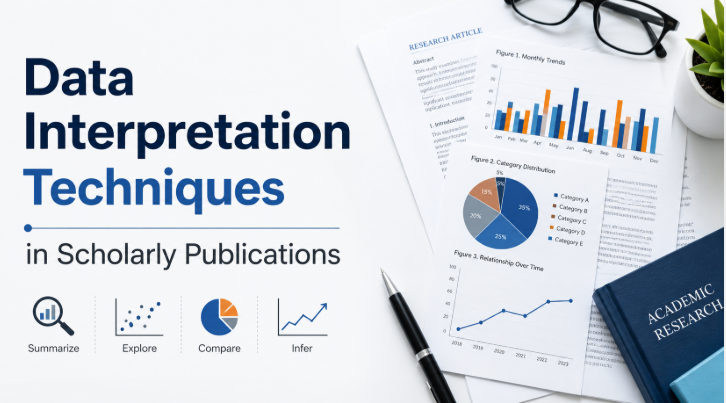
In scholarly publications, the clarity and accessibility of data are paramount. Visual data representation through charts, graphs, and tables plays a crucial role in achieving these objectives. These visualization techniques allow researchers to present complex data sets in a manner that is easily digestible for their audience. By transforming intricate numerical information into visual formats, authors can significantly enhance the reader’s understanding of the underlying trends, comparisons, and patterns.
Charts, for instance, provide a snapshot of relationships between different variables. Bar and line graphs are particularly effective for showcasing changes over time, making it simple to identify trends at a glance. Similarly, pie charts can illustrate proportions within a data set, offering a straightforward visual breakdown that highlights the parts of a whole. Tables, on the other hand, serve as a consolidated source of information, allowing for precise values to be compared directly. The strategic use of these visual tools can turn complex data into clear insights.
Moreover, effective visual data representation encourages interaction with the information. Readers are more likely to engage with content that utilizes visual aids, as these tools can spark interest and facilitate a deeper comprehension of the findings presented. It is essential, however, to employ these techniques thoughtfully. Overcomplication in design or excessive use of colors and patterns may distract rather than inform. Therefore, the effectiveness of visualization lies not just in its creation, but also in its thoughtful integration into the narrative of the scholarly work.
In essence, visual representations are integral to data interpretation in scholarly publications. They bridge the gap between complex datasets and reader comprehension, thereby fostering a more informed readership.
Narrative Techniques in Qualitative Data Interpretation
In qualitative research, narrative techniques play a pivotal role in the interpretation and presentation of data. These methodologies allow researchers to capture, analyze, and convey the complexities of human experiences and social phenomena. One fundamental approach is coding, which involves identifying and categorizing segments of qualitative data into distinct themes or concepts. This process aids in distilling vast amounts of information into manageable and interpretable units, facilitating deeper insights into the data.
Another prominent narrative technique is thematic analysis, which goes beyond mere coding to explore the underlying themes that emerge from the data. By recognizing patterns within the qualitative data, researchers can articulate significant findings that resonate with broader research questions. This approach allows for a systematic examination of data while yielding rich, detailed descriptions that enhance the credibility and relevance of the study.
Content analysis serves as a complementary technique within qualitative research. By systematically analyzing the content of various forms of communication, including texts and interviews, researchers can uncover the underlying meanings and intentions behind the data. This technique provides a framework for quantifying certain elements, such as the frequency of specific themes or phrases, which can be instrumental in drawing conclusions and making informed recommendations.
Employing these narrative techniques in qualitative data interpretation not only enhances the clarity and depth of findings but also engages the audience by presenting the data in a relatable and accessible format. By weaving together the experiences and perspectives of participants, researchers can construct a compelling narrative that reflects the richness of their qualitative inquiry. These methods, when applied judiciously, result in scholarly publications that significantly contribute to our understanding of various social phenomena.
Role of Context in Data Interpretation
The interpretation of data within scholarly publications is significantly influenced by the context in which the data is collected and analyzed. Several contextual factors, including cultural, social, and temporal elements, play a crucial role in shaping the understanding and presentation of research findings. Each of these factors contributes to how data is perceived and can affect the conclusions drawn from it.
Cultural context is particularly important as it dictates the norms, values, and beliefs that influence the interpretation of data. Researchers must recognize that data does not exist in a vacuum; rather, it is affected by cultural perceptions that may differ across geographic and demographic lines. For example, health-related data may be interpreted differently depending on the cultural attitudes towards health and wellness, which can lead to varying conclusions about the efficacy of treatments or interventions.
Social context also plays a vital role in data interpretation, especially in fields such as sociology and psychology, where social structures and relationships can illuminate or obscure the meanings of data points. Researchers must consider how societal variables, including economic status, education level, and social networks, impact the data. Ignoring these factors can lead to misinterpretations or an oversimplification of the results.
Temporal context is another critical aspect, as data collected during a specific period may reflect unique societal events or changes, influencing its significance. For example, economic data gathered during a recession will likely show different trends compared to data collected in a period of prosperity. Researchers should account for these temporal nuances to ensure accurate interpretation of findings.
In conclusion, the influence of context—cultural, social, and temporal—on data interpretation cannot be overstated. Researchers are urged to consider these factors diligently, ensuring that their findings are not only accurate but also relevant to the settings in which they are situated.
Common Pitfalls in Data Interpretation
Data interpretation is a vital component of research, yet it is often fraught with pitfalls and biases that can lead to inaccurate conclusions. One prominent issue is confirmation bias, where researchers may favor data that supports their initial hypotheses while disregarding evidence that contradicts them. This bias can mislead researchers to draw erroneous conclusions based on incomplete or skewed analyses. To mitigate confirmation bias, it is crucial for researchers to approach their data with an open mind and actively seek out contrary evidence that challenges their beliefs.
Another common pitfall is the phenomenon of data dredging, also known as p-hacking. This occurs when researchers manipulate data or selectively report findings to achieve statistically significant results. Data dredging not only undermines the integrity of the research but can also misinform subsequent studies in the field. To avoid this, it is essential to establish clear hypotheses before data analysis and adhere to pre-defined statistical methods, ensuring that the research is transparent and reproducible.
Overgeneralization presents yet another challenge in data interpretation, where researchers draw broad conclusions from specific findings. Such conclusions may not hold true across different contexts, populations, or settings. To guard against overgeneralization, researchers should consider the limitations of their studies, acknowledge the specific circumstances under which their findings apply, and advocate for further investigation before making sweeping assertions.
By remaining cognizant of these common pitfalls—confirmation bias, data dredging, and overgeneralization—researchers can enhance the rigor of their data interpretations. Employing systematic approaches and transparency in research processes encourages accuracy and reliability, contributing to the overall quality of scholarly publications.
Best Practices for Effective Data Interpretation
Effective data interpretation is a cornerstone of scholarly publications, ensuring that research findings are not only clear but also actionable. To maximize clarity in data presentation, researchers should utilize visual aids such as graphs and charts. These tools can transform complex data sets into easily digestible formats. By presenting data visually, scholars can highlight trends and correlational relationships that may not be immediately obvious in raw data, thus enhancing overall comprehension.
Rigor in data interpretation involves adhering to methodological standards throughout the analysis. This includes clearly outlining the analytical procedures employed and justifying the choice of statistical tools. Transparency in methodology allows for replication, which is crucial in the scientific community. Researchers should avoid cherry-picking data points that support their hypotheses while neglecting those that may contradict them, as this can lead to biased interpretations. A balanced interpretation incorporates context and recognizes the limitations of the data, fostering credibility.
Communicating findings effectively is also a vital aspect of data interpretation. Scholars must consider their audience, as different stakeholders may possess varying levels of expertise. Tailoring language and complexity to match the audience’s understanding is essential. For instance, academic peers may appreciate detailed statistical analyses, while non-specialist audiences would benefit from simplified explanations and implications of the data. Employing clear, concise language further ensures that interpretations resonate with a broader audience, thereby amplifying the reach and impact of the research.
In summary, implementing these best practices in data interpretation—utilizing visual aids, ensuring methodological rigor, and tailoring communication—can significantly enhance clarity, reliability, and overall effectiveness of scholarly publications. By adhering to these guidelines, researchers can convey their findings in a manner that is both enlightening and deserving of trust, ultimately contributing to the advancement of knowledge across disciplines.
Conclusion and Future Directions in Data Interpretation
Effective data interpretation is integral to producing robust and credible scholarly publications. Throughout this discussion, we have explored various techniques that enhance the clarity and accessibility of data analysis within academic work. From the utilization of visual aids to the application of statistical methods, these techniques serve to make complex information more interpretable, allowing researchers to convey their findings with precision and authority. Moreover, the importance of context in data interpretation has been emphasized, as it informs the reader’s understanding and analysis of the results presented.
As we look to the future, there are several important areas for development in data interpretation techniques. First, advancements in technology, particularly in artificial intelligence and machine learning, hold significant potential to refine data analytics processes. These technologies can help automate complex data interpretations, making them faster and potentially less prone to human error.
Moreover, the growing trend of interdisciplinary research emphasizes the need for improved collaborative tools that help researchers from different fields interpret data cohesively. Such collaboration could lead to innovative insights and methodologies that enhance the richness of scholarly publications. Additionally, more comprehensive training and resources on data interpretation for researchers at all levels will be essential in cultivating a more skilled and proficient academic community.
In conclusion, as the landscape of scholarly research continues to evolve, so too must our approaches to data interpretation. By staying abreast of technological advancements and adapting our methodologies, researchers can ensure that their contributions remain significant and impactful. Emphasizing the continuous development of data interpretation techniques will ultimately strengthen the integrity of scholarly research and foster greater understanding and communication of findings across disciplines.