


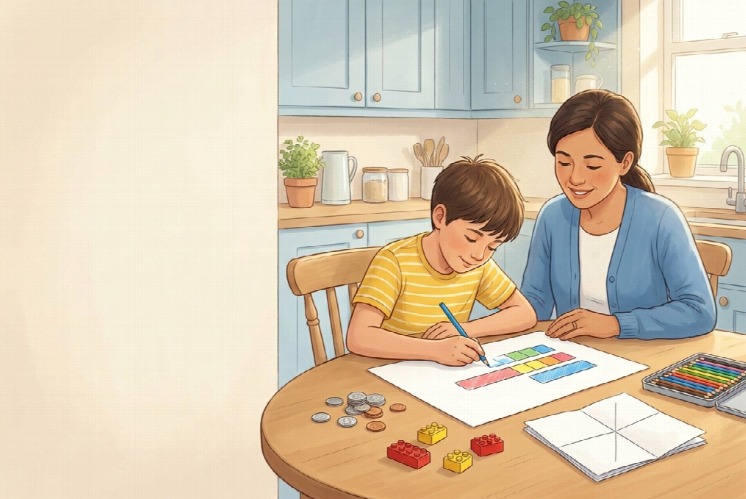
Your child brings home a worksheet covered in rectangles. Long bars, short bars, little brackets with question marks hanging over them. You never learnt maths like this, so you’re not quite sure where to start. Sound familiar?
If it does, you’ve already met Singapore Maths. Since 2014, a large number of primary schools in England have moved towards teaching for mastery, an approach shaped in large part by how children learn maths in Singapore. The nice part is that the core ideas are quite simple. You don’t need a maths degree to use them at the kitchen table.
Below, we’ll explain why the method works, walk through a quick bar model example, and share a few small habits that help children feel more at ease with numbers.
Why Everyone Keeps Talking About Singapore
Singapore has a long track record in international maths studies. In the most recent TIMSS results, East Asian countries led by Singapore again took the top places, while Year 5 pupils in England finished a very respectable 9th.
So what’s the secret? Honestly, there isn’t one big trick. It’s more a set of habits that build on each other. Children learn fewer topics at a time, they spend longer on each one, and they’re expected to show how they think, not just what they got.
It Starts With Things Children Can Touch
One of the key ideas is called CPA, which stands for Concrete, Pictorial and Abstract. It sounds technical, but you’ve probably done it without realising.
- Concrete: your child handles real objects, like counters, coins or slices of fruit.
- Pictorial: they draw what they did, using dots, boxes or bars.
- Abstract: only then do they write the numbers and symbols.
Take fractions. Fold a sheet of paper into four equal parts and colour three of them in. Next, draw that same shape on paper. After that, write 3/4. By the time your child sees the symbol, it already means something to them. That’s a big difference from memorising a rule they don’t understand.
The Bar Model, Explained Simply
Those rectangles on the worksheet are bar models. They turn a wordy problem into a picture, which makes it far less scary. Here’s a typical Year 5 style question.
Amy has 3 times as many stickers as Ben. Together they have 48 stickers. How many stickers does Amy have?
This is how your child might work it out:
- Draw one bar for Ben. Call it 1 unit.
- Draw Amy’s bar underneath, three times as long. That’s 3 units.
- Together that makes 4 units, and 4 units equal 48.
- So 1 unit is 48 ÷ 4 = 12.
- Amy has 3 units, which is 3 × 12 = 36 stickers.
No algebra needed. The drawing does most of the heavy lifting, and your child can see straight away why the answer makes sense. At Jimmy Maths in Singapore, we see this every week with our primary students. Once a child gets comfortable drawing the model, word problems that used to cause tears start to feel like puzzles instead.
Going Deep Before Moving On
In a mastery classroom, the whole class usually moves through a topic together. The aim is for every child to properly understand it before the next one begins, rather than racing ahead with half the picture.
This matters because maths builds on itself. A shaky grasp of place value in Year 3 tends to show up again with decimals in Year 5. Spending an extra week on the basics can save months of confusion later on.
At home, this simply means there’s no need to rush. If your child can do ten questions on a topic, try asking for one that’s a little different. Can they explain it to you? Can they make up their own question? That’s real understanding.
5 Simple Ways to Bring This Into Your Home
You don’t need workbooks or fancy kits. A few small changes in how you talk about maths can make a real difference.
- Ask “how do you know?” When your child gives an answer, ask them to talk you through it. Saying their thinking out loud helps them spot gaps on their own.
- Keep objects within reach. Coins, buttons, dried pasta and Lego bricks all work brilliantly for counting, grouping and sharing.
- Draw first, calculate second. For any word problem, encourage a quick sketch before reaching for the numbers. Even a rough bar helps.
- Praise the method, not just the answer. A comment like “I liked how you drew that out” builds far more confidence than “well done, that’s right”.
- Keep it little and often. Ten or fifteen relaxed minutes a few times a week tends to beat a long Sunday session that ends in frustration.
A Gentle Word on Mistakes
Every child gets things wrong, and that’s completely fine. In fact, a mistake is useful, because it shows exactly where the understanding broke down.
If your child keeps slipping up on the same type of question, go back one step. Pick up the counters again or draw the bar model together. It may feel like going backwards, but it usually helps things click much faster.
Small Steps, Big Confidence
Singapore Maths isn’t about turning children into human calculators. It’s about helping them see what’s going on behind the numbers, so they can tackle new problems with a calm head.
Start with just one idea this week. Maybe it’s drawing a bar model together, or simply asking “how do you know?” at dinner. Small habits like these add up quickly, and you might be surprised how much more willing your child becomes to have a go.