


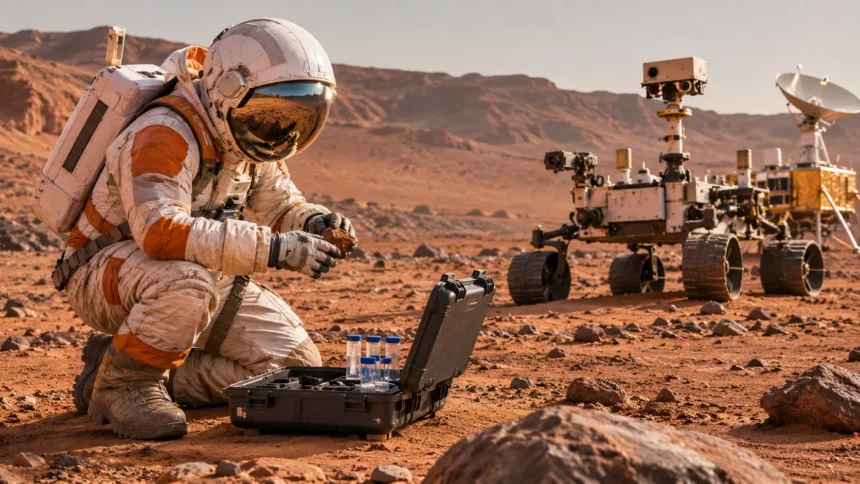
Mars has fascinated scientists for generations because it may hold clues about life beyond Earth. Its dusty landscapes, frozen poles, ancient river channels, and unusual rock formations reveal a planet with a complex history. Today, scientists use advanced spacecraft, robotic vehicles, and laboratory instruments to investigate whether Mars once supported living organisms.
Exploring Mars is challenging because the planet is millions of kilometers away and has an extremely harsh environment. Temperatures can fall far below freezing, its atmosphere is thin, and the surface receives significant radiation. Despite these difficulties, space agencies continue developing sophisticated technologies to study Martian geology, climate, water, and potential signs of ancient microbial life.
Understanding how scientists explore Mars and search for signs of life reveals the importance of modern space exploration. Researchers combine satellite observations, rover missions, chemical testing, and geological analysis to investigate the Red Planet. Their discoveries help answer important questions about planetary evolution, habitability, and whether life could have developed elsewhere in our solar system.
Why Are Scientists Searching for Life on Mars?
Mars is one of the most promising locations in our solar system for investigating the possibility of past extraterrestrial life. Scientific evidence indicates that liquid water once flowed across portions of its surface. Ancient rivers, lakebeds, and sedimentary deposits suggest that some Martian environments may have supported conditions suitable for simple microorganisms billions of years ago.
Scientists are particularly interested in understanding whether Mars possessed the essential ingredients associated with life on Earth. These include liquid water, useful chemical elements, and available energy sources. Although these ingredients do not guarantee that life existed, their presence helps researchers identify environments where biological activity might have been possible.
Discovering convincing evidence of past Martian life would transform our understanding of biology and planetary science. It could suggest that life can develop under different planetary conditions rather than being unique to Earth. Even if researchers never discover life, studying Mars provides valuable information about how planets evolve and why some environments become uninhabitable.
How Do Scientists Explore Mars Using Spacecraft?
Scientists explore Mars using robotic spacecraft designed to collect information from orbit and directly from the planet’s surface. These missions carry cameras, sensors, spectrometers, and other scientific instruments that measure physical and chemical conditions. Spacecraft transmit their observations to Earth, where researchers analyze the information and plan additional investigations.
Orbital spacecraft examine large areas of Mars from above, while landers and rovers investigate specific locations on the ground. Orbiters provide information about surface features, atmospheric changes, and possible water-related minerals. Surface missions collect detailed measurements that cannot always be obtained from hundreds of kilometers above the planet.
Operating spacecraft on Mars requires careful planning because communication signals take several minutes to travel between the planets. Engineers cannot control robotic vehicles instantly as they would ordinary remote-controlled machines. Instead, mission teams prepare commands in advance, while onboard computers handle navigation, safety checks, and certain decisions independently.
How Do Mars Rovers Investigate the Planet’s Surface?
Mars rovers are robotic vehicles equipped with scientific instruments that allow them to explore selected locations on the planet. Their wheels, cameras, robotic arms, and onboard computers help them travel across rocky terrain. Unlike stationary landers, rovers can investigate different geological formations and compare conditions across wider exploration areas.
NASA’s Curiosity rover studies Martian geology, chemistry, and environmental conditions that could have supported microbial life. The Perseverance rover explores Jezero Crater, an area that once contained an ancient lake and river delta. These missions help researchers understand how water, minerals, and environmental changes shaped Mars over billions of years.
Rovers examine rocks using cameras, lasers, drills, and specialized chemical instruments. Some tools identify minerals from a distance, while others analyze material collected from the surface. Scientists use these measurements to determine how rocks formed, whether water influenced their development, and which locations deserve closer investigation.
How Do Scientists Search for Water on Mars?
Water is central to Mars exploration because every known form of life depends on it. Scientists therefore investigate places where liquid water may have existed in the past or where frozen water remains today. Orbital images reveal ancient valleys, channels, and geological formations that resemble features created by flowing water on Earth.
Researchers also study minerals that form or change when exposed to water. Certain clay minerals and sedimentary deposits can preserve information about ancient environmental conditions. By examining their chemical composition and surrounding rock layers, scientists reconstruct possible lakes, rivers, and groundwater systems that existed during earlier periods of Martian history.
Modern Mars contains substantial water ice, especially near its polar regions and beneath portions of the surface. However, stable liquid water is difficult to maintain at the exposed surface because of low atmospheric pressure and cold temperatures. Scientists investigate underground environments to understand whether protected locations might preserve water-related conditions relevant to habitability.
How Do Scientists Identify Possible Signs of Life on Mars?
Scientists search for potential biosignatures, which are physical or chemical features that might indicate past or present biological activity. Examples include certain organic compounds, unusual chemical patterns, and structures resembling materials produced by microorganisms. However, many of these features can also develop through ordinary geological processes, making careful interpretation essential.
Researchers compare Martian findings with biological and geological examples from Earth. Ancient terrestrial rocks provide useful opportunities to study how microbial activity may leave chemical or mineral evidence behind. Scientists examine whether similar patterns appear on Mars while considering differences in planetary conditions and the possibility of nonbiological explanations.
A possible biosignature does not automatically confirm that life existed on Mars. Scientists must investigate alternative explanations, examine surrounding geological conditions, and ideally test multiple independent lines of evidence. Strong conclusions require reproducible measurements and convincing proof that known nonliving processes cannot adequately explain the observations.
How Do Mars Rovers Analyze Rocks and Soil?
Mars rovers use specialized instruments to investigate the composition, structure, and history of rocks and soil. Cameras capture detailed images of rock layers, textures, and surface features. Spectrometers identify chemical elements and minerals, helping scientists determine which materials formed through volcanic activity, sediment deposition, or interactions with water.
Some rovers collect powdered rock samples using onboard drills and transfer the material into scientific instruments. These instruments can heat samples, measure released gases, and identify selected chemical compounds. Such analysis helps researchers understand organic chemistry, mineral composition, and environmental changes that occurred during Mars’ geological history.
Perseverance also collects small cylindrical rock cores and stores selected samples in sealed tubes. This approach preserves scientifically valuable material for possible future investigation in laboratories on Earth. Studying carefully chosen samples could provide more detailed information about ancient environments and possible biosignatures than some rover instruments can obtain directly.
What Have Scientists Discovered About Ancient Mars?
Evidence gathered by spacecraft indicates that ancient Mars was significantly different from the cold, dry planet visible today. Geological formations reveal that rivers once transported sediment and that lakes occupied some impact craters. These discoveries suggest that portions of Mars maintained environments containing liquid water during important periods of its early history.
The Curiosity rover has found organic molecules in Martian rocks and investigated ancient lake deposits within Gale Crater. Organic molecules contain carbon, an essential element in life as we know it. However, these compounds can also form without living organisms, so their discovery does not establish that biological activity occurred.
Perseverance has examined sedimentary rocks and identified chemical and mineral patterns that scientists consider potentially relevant to ancient habitability. Some unusual features have been investigated as possible biosignatures. Nevertheless, researchers continue evaluating nonbiological explanations, and no discovery has yet provided universally accepted proof that life existed on Mars.
How Do Scientists Study the Martian Atmosphere?
Mars has a thin atmosphere composed mainly of carbon dioxide, with smaller quantities of nitrogen, argon, and other gases. Scientists study this atmosphere to understand planetary climate, surface conditions, and changes over time. Orbital spacecraft and surface instruments measure atmospheric composition, temperature, pressure, dust activity, and seasonal variations.
Researchers are particularly interested in trace gases such as methane because they can originate from several different processes. On Earth, living organisms produce some methane, but geological reactions can also generate it. Measurements from different Mars missions have produced questions about methane detection and variability, making continued investigation important.
Atmospheric research also helps explain how Mars lost much of the conditions that once allowed surface water to persist. Solar radiation, atmospheric escape, and changing planetary conditions contributed to its environmental evolution. Understanding these processes helps scientists determine how long potentially habitable environments may have existed and why Mars became so different from Earth.
How Do Scientists Search for Life Beneath the Martian Surface?
The Martian surface presents major challenges for living organisms because it is cold, dry, and exposed to radiation. Scientists therefore consider whether underground environments could offer greater protection. Beneath the surface, surrounding rock may reduce radiation exposure and create conditions that differ from those found in exposed surface materials.
Researchers investigate geological features that might indicate ancient underground water movement or protected habitats. Radar instruments, mineral measurements, and surface observations provide clues about buried ice and subsurface structures. However, interpreting these measurements can be difficult because different materials sometimes produce similar signals, requiring additional evidence before conclusions can be established.
Future exploration technologies may allow scientists to examine deeper materials than current surface sampling systems can routinely reach. Subsurface investigations could identify preserved organic compounds or geological conditions that remain hidden beneath surface dust. Such discoveries would help researchers better understand Mars’ potential habitability without assuming that underground life currently exists.
How Do Scientists Protect Mars Samples From Contamination?
Contamination control is essential when searching for possible evidence of extraterrestrial life. Spacecraft launched from Earth may carry trace amounts of terrestrial organic material or microorganisms despite extensive cleaning. If these contaminants enter scientific samples, they could complicate measurements and create misleading interpretations about the origin of discovered compounds.
Engineers use specialized cleaning procedures, controlled assembly environments, and carefully selected materials to reduce contamination risks. Scientific instruments may also include methods for identifying unwanted background compounds. Mission teams document relevant manufacturing and handling conditions so researchers can distinguish potential Martian signals from materials introduced during spacecraft preparation.
Returning Martian samples to Earth would introduce additional responsibilities for scientific integrity and biological safety. Samples would require secure containment, controlled handling, and careful testing before broader laboratory access. These measures help protect Earth’s environment while preventing terrestrial contamination from undermining the reliability of important scientific discoveries.
Why Are Scientists Planning to Bring Mars Samples to Earth?
Rovers carry impressive scientific instruments, but their size, weight, and power limitations restrict the complexity of experiments they can perform. Laboratories on Earth contain larger and more sensitive equipment that can examine tiny chemical differences. Returning carefully selected Martian samples could therefore improve scientists’ ability to investigate possible evidence of ancient life.
Earth-based researchers could analyze rock samples using advanced microscopes, chemical instruments, and multiple independent testing techniques. Different laboratories could study the same materials and compare their findings. This collaborative approach would make it easier to evaluate unusual chemical patterns, measure geological ages, and investigate competing explanations for potential biosignatures.
Perseverance has been collecting and storing samples that could support future return efforts. However, transporting these materials from Mars to Earth requires complex spacecraft operations, engineering systems, and careful safety planning. The timing and design of a sample-return mission depend on future program decisions, technical development, and available resources.
What Challenges Do Scientists Face When Exploring Mars?
Mars exploration involves extreme environmental conditions that create difficulties for spacecraft and scientific equipment. Dust storms can interfere with visibility and solar power generation, while cold temperatures affect electronic systems and mechanical components. Engineers must build equipment capable of surviving these conditions while operating reliably over extended missions.
The distance between Mars and Earth creates additional challenges for communication and mission management. Signals require time to cross interplanetary space, and spacecraft must often operate without immediate human assistance. Limited power, difficult terrain, and restricted equipment capacity also influence how many experiments a robotic mission can perform.
Scientific interpretation presents another important challenge because unusual chemical observations do not always have a single explanation. Researchers must distinguish biological possibilities from geological and atmospheric processes. This requires careful experiments, detailed comparisons, and independent verification rather than relying on one exciting measurement or unexpected discovery.
How Could Future Technologies Improve Mars Exploration?
Future Mars exploration may benefit from improved robotic navigation, more capable scientific instruments, and advanced autonomous systems. These technologies could help spacecraft investigate difficult terrain while using limited communication opportunities efficiently. Improved onboard analysis may also allow robotic explorers to identify interesting geological targets and prioritize measurements more effectively.
Scientists are developing instruments designed to study organic chemistry, subsurface materials, and potential biosignatures with greater sensitivity. More capable drilling systems could eventually reach protected geological layers that current missions cannot easily investigate. Combining underground measurements with orbital observations may provide a more complete picture of Martian environmental history.
Advanced communication systems, reliable energy technologies, and improved sample-handling methods could further expand scientific opportunities. Future missions may explore new regions that preserve different chapters of Mars’ history. Every technological improvement can help researchers collect stronger evidence while reducing uncertainty about whether the planet once supported living organisms.
Why Is Mars Exploration Important for Understanding Life Beyond Earth?
Mars provides a valuable natural laboratory for investigating how planetary environments change over billions of years. Comparing Mars with Earth helps scientists understand the importance of atmosphere, water, geological activity, and climate stability. These comparisons reveal why two neighboring rocky planets developed such different environmental conditions despite sharing certain early characteristics.
The search for Martian life also contributes to astrobiology, the scientific study of life’s potential throughout the universe. Researchers use discoveries from Mars to improve ideas about habitability and possible biological signatures. These lessons may influence investigations of icy moons, distant planets, and other environments where liquid water or useful chemical energy might exist.
Even without discovering life, Mars exploration produces important advances in engineering, robotics, chemistry, and planetary science. Space missions encourage scientists to develop instruments capable of operating under difficult conditions. More importantly, they help humanity investigate fundamental questions about life’s origins, environmental change, and the possibility that Earth is not the only inhabited world.
Conclusion
Scientists explore Mars using orbiters, landers, robotic rovers, and advanced scientific instruments designed to investigate the planet’s environment. These missions examine ancient water systems, mineral deposits, organic compounds, and unusual geological structures. By combining several methods, researchers gradually reconstruct Mars’ history and identify locations where life might once have been possible.
The search for signs of life on Mars remains an important scientific challenge because potentially biological evidence can have nonliving explanations. Discoveries involving ancient lakes, organic molecules, and intriguing chemical patterns provide valuable clues, but they do not confirm extraterrestrial life. Continued investigation and detailed sample analysis are necessary to distinguish possibilities from established discoveries.
Future missions and technological improvements may reveal new information about environments beneath the Martian surface and the preservation of ancient materials. Whether scientists eventually discover convincing evidence of life or not, Mars exploration will continue expanding our understanding of planetary evolution. Every mission brings researchers closer to answering one of science’s most fascinating questions.
Frequently Asked Questions
How do scientists explore Mars?
Scientists explore Mars using orbiting spacecraft, robotic rovers, stationary landers, cameras, and scientific instruments. These technologies collect information about the planet’s surface, atmosphere, rocks, and minerals, helping researchers investigate its geological history.
Have scientists found life on Mars?
No, scientists have not confirmed the existence of past or present life on Mars. However, discoveries of ancient water environments, organic molecules, and potentially interesting chemical patterns continue to motivate scientific investigations.
Why do scientists believe Mars may have supported life?
Scientists have discovered evidence that ancient Mars contained rivers, lakes, and chemical ingredients associated with habitable environments. These conditions could potentially have supported simple microorganisms, although there is currently no confirmed evidence that life developed.
How do Mars rovers search for signs of life?
Mars rovers investigate rocks, soil, minerals, and organic compounds using cameras, drills, and scientific instruments. They search for possible biosignatures and environmental conditions that could preserve evidence of ancient microbial activity.
Will humans ever explore Mars to search for life?
Human exploration of Mars is a long-term goal for space agencies, but its timing remains uncertain. Future astronauts could potentially conduct detailed geological investigations and collect samples, provided missions meet demanding safety and technological requirements.