


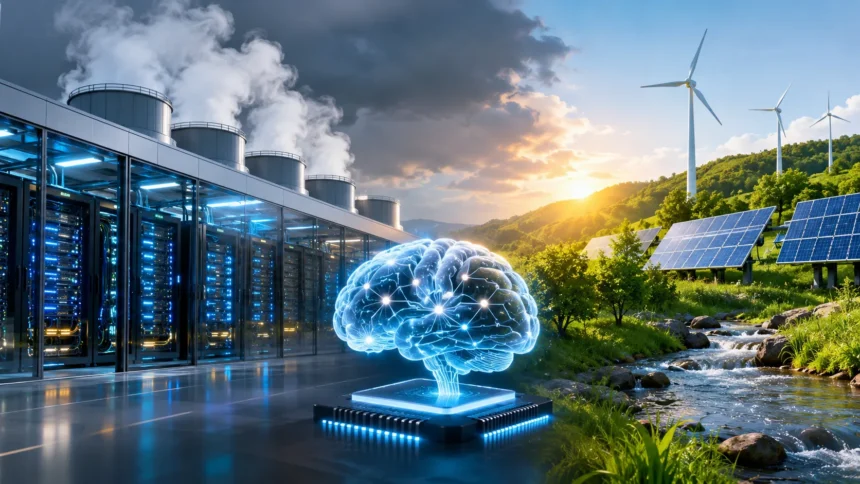
Generating an article, creating an image, or asking an AI chatbot a question takes only a few seconds. However, behind that simple interaction, powerful computers consume electricity and produce heat. These processes require physical resources that many users rarely consider.
The environmental impact of generative AI is becoming an important concern as businesses and individuals increasingly adopt artificial intelligence. Large AI models require computing infrastructure, cooling systems, and specialized hardware. Their growing popularity raises questions about long-term environmental sustainability.
Fortunately, technological progress and environmental responsibility do not have to work against each other. Energy-efficient models, cleaner electricity, and responsible resource management can help reduce environmental damage. Understanding these challenges is the first step toward using artificial intelligence more sustainably.
What Is the Environmental Impact of Generative AI?
The environmental impact of generative AI refers to the effects that developing, training, and operating AI models have on the natural environment. These effects include electricity consumption, carbon emissions, water usage, and electronic waste. Their severity depends on the technology and infrastructure involved.
Generative AI systems learn patterns from large datasets to produce text, images, audio, and other content. Training these models requires powerful computing resources, particularly when dealing with complex architectures. Operating them also consumes resources whenever users request new content.
The primary environmental concerns include:
- High electricity consumption.
- Greenhouse gas emissions.
- Water consumption for cooling.
- Natural resource extraction.
- Electronic waste generation.
- Expansion of data center infrastructure.
- Pressure on local electricity networks.
Understanding these environmental effects helps businesses and developers make more responsible decisions about artificial intelligence.
Why Do Large AI Models Consume So Much Energy?
Large AI models require extensive mathematical calculations to learn relationships within training data. These calculations can involve thousands of specialized computing processors working together. Depending on the model, training may continue for weeks or longer.
Graphics processing units, commonly called GPUs, can perform many calculations simultaneously. However, operating large numbers of these processors requires considerable electricity. Additional power is needed to support networking equipment, storage systems, and cooling infrastructure.
Energy consumption depends on several factors:
- Model size and architecture.
- Training dataset size.
- Number of training experiments.
- Hardware efficiency.
- Length and complexity of generated responses.
- Number of users accessing the model.
Selecting an efficient model that matches the intended task can help reduce unnecessary computing demands.
8 Major Environmental Impacts of Large AI Models
Artificial intelligence offers numerous advantages, but its environmental consequences deserve careful attention. Many of these effects occur outside the user’s immediate experience. The following eight areas explain how large AI models can influence environmental sustainability.
1. High Electricity Consumption
Electricity consumption is one of the most significant environmental concerns associated with generative AI. Training and operating large language models requires powerful computing infrastructure. Growing demand for AI-generated content increases the need for these resources.
Consider a popular AI platform serving millions of users throughout the day. Each individual request requires computing resources, and those requests accumulate over time. Even relatively efficient systems can consume substantial electricity when used at scale.
Reducing electricity consumption requires improvements in hardware, software, and infrastructure. Developers can select smaller models for straightforward tasks and optimize computing workloads. Data centers can also adopt energy-efficient equipment and power management systems.
Potential solutions:
- Use energy-efficient AI hardware.
- Select appropriately sized models.
- Optimize training and inference processes.
- Reduce unnecessary computing operations.
- Monitor electricity consumption regularly.
Improving energy efficiency can help organizations manage operational costs while reducing environmental pressure.
2. Increased Carbon Emissions
The AI carbon footprint includes greenhouse gas emissions associated with developing and operating artificial intelligence systems. Electricity generation is an important contributor, particularly when power comes from fossil fuels. Hardware manufacturing also contributes to overall emissions.
Two identical AI models may produce different carbon footprints depending on where they operate. A data center powered by low-carbon electricity may generate fewer operational emissions than one relying heavily on coal. Location and electricity sources therefore influence environmental performance.
Technology companies can reduce emissions by using cleaner energy and improving computing efficiency. Scheduling flexible workloads during periods of lower grid emissions may also help. Measuring emissions throughout the technology’s lifecycle supports better environmental decisions.
Potential solutions:
- Increase access to low-carbon electricity.
- Improve data center energy efficiency.
- Track operational and manufacturing emissions.
- Schedule flexible workloads responsibly.
- Establish measurable emissions reduction targets.
Reducing carbon emissions requires addressing both electricity consumption and the sources of that electricity.
3. High Water Consumption
Many people associate artificial intelligence with electricity but overlook its water footprint. Computing equipment generates heat during operation, creating a need for effective cooling. Some data center cooling systems consume significant amounts of water.
Water consumption may also occur during electricity generation and semiconductor manufacturing. These indirect effects make the complete AI water footprint more difficult to calculate. Environmental consequences can become particularly concerning in regions experiencing water scarcity.
Businesses should evaluate water availability when planning AI infrastructure. Alternative cooling technologies may reduce freshwater demand, although some approaches involve higher electricity consumption. Finding an appropriate balance between water and energy efficiency is essential.
Potential solutions:
- Monitor data center water consumption.
- Use recycled water where appropriate.
- Evaluate efficient cooling technologies.
- Consider regional water scarcity.
- Improve water management practices.
Responsible water management helps protect local resources while supporting the continued development of artificial intelligence.
4. Increased Electronic Waste
Large AI models depend on specialized processors, servers, networking equipment, and storage devices. Rapid technological development encourages organizations to upgrade computing hardware frequently. Older equipment may eventually become electronic waste.
Discarded electronic devices contain materials that require careful handling and recycling. Improper disposal can contribute to environmental contamination and unnecessary resource loss. Frequent equipment replacement also increases demand for manufacturing new hardware.
Technology companies can address this problem by extending equipment lifespan and improving recycling practices. Older hardware may remain useful for less demanding computing tasks. Responsible disposal should become part of every infrastructure replacement strategy.
Potential solutions:
- Extend the useful life of computing equipment.
- Repair hardware when practical.
- Repurpose suitable older processors.
- Use certified electronic waste recyclers.
- Consider durability when purchasing equipment.
Better hardware management can reduce waste without preventing necessary technological improvements.
5. Natural Resource Extraction
AI infrastructure requires raw materials used in processors, circuit boards, batteries, and other electronic components. Extracting and processing these resources can affect ecosystems and natural habitats. Manufacturing specialized equipment also requires energy and water.
The environmental impact begins before an AI model processes its first request. Semiconductor manufacturing involves complex production processes and resource-intensive facilities. These manufacturing effects are part of AI’s overall environmental footprint.
Responsible sourcing and efficient hardware utilization can help reduce demand for newly extracted materials. Manufacturers can also improve production processes and recover valuable components from discarded equipment. These practices support a more circular technology economy.
Potential solutions:
- Improve transparency across hardware supply chains.
- Support responsible material sourcing.
- Increase electronic component recycling.
- Reduce unnecessary equipment replacement.
- Encourage resource-efficient manufacturing.
Considering the complete hardware lifecycle provides a clearer understanding of generative AI’s environmental consequences.
6. Growing Data Center Infrastructure
Increasing demand for generative AI requires additional computing capacity. Technology companies may respond by expanding existing facilities or constructing new data centers. These developments require land, construction materials, electricity, and supporting infrastructure.
Large data centers can also influence surrounding communities. Increased demand for electricity and water may create competition for local resources. The severity of these effects depends on facility design, location, and available infrastructure.
Responsible data center development requires careful environmental planning. Organizations should evaluate local resource availability and consider potential community impacts. Efficient facility designs can help reduce pressure on surrounding environments.
Potential solutions:
- Conduct environmental assessments before construction.
- Select locations with suitable infrastructure.
- Improve server utilization.
- Adopt efficient building designs.
- Engage with affected local communities.
Thoughtful infrastructure planning helps balance technological growth with environmental and community needs.
7. Environmental Impact of Repeated AI Usage
Training a large AI model receives considerable attention because of its computing requirements. However, operating that model after deployment also consumes resources. This ongoing process is known as inference.
Every generated response, image, or other output requires computational work. The environmental impact of an individual request may be relatively small, but widespread usage increases overall demand. Depending on the model and its popularity, lifetime inference consumption can exceed training consumption.
Developers can improve inference efficiency through optimized software and appropriate model selection. Businesses should also examine whether every automated task genuinely requires generative AI. Simpler tools may provide equally useful results for certain activities.
Potential solutions:
- Use smaller models for straightforward tasks.
- Reuse suitable previously generated results.
- Optimize response lengths.
- Improve inference efficiency.
- Avoid unnecessary automated requests.
Responsible AI usage focuses on obtaining useful results while minimizing unnecessary resource consumption.
8. Pressure on Electricity Networks
Large AI facilities require dependable electricity supplies to maintain continuous operations. Rapid infrastructure expansion can increase demand on local power networks. In some regions, existing electricity systems may need significant upgrades.
Growing power requirements can create challenges for utilities and surrounding communities. Additional generation capacity may be necessary to support expanding data centers. When cleaner electricity is unavailable, increased demand may contribute to greater fossil fuel consumption.
Technology companies and electricity providers need coordinated infrastructure planning. Flexible computing schedules, energy storage, and efficient facilities can help manage demand. Investment in cleaner electricity generation may also support more sustainable expansion.
Potential solutions:
- Coordinate development with electricity providers.
- Improve computing workload management.
- Invest in appropriate energy storage.
- Support clean electricity infrastructure.
- Monitor peak electricity demand.
Managing electricity requirements responsibly helps reduce conflicts between technological development and broader energy needs.
AI Training vs. Inference: Environmental Impact
Understanding the difference between training and inference helps explain why measuring AI sustainability is complicated. Training involves teaching a model to recognize patterns within data. Inference occurs when the trained model processes a request and generates an output.
Training usually requires more computing resources than a single inference request. However, popular models may process millions of requests throughout their operational lifetimes. The accumulated environmental impact of inference can therefore become substantial.
| Factor | AI Training | AI Inference |
|---|---|---|
| Main purpose | Teaching the model | Generating responses |
| Frequency | Initial training and updates | Every user request |
| Energy consumption | Often intensive per training run | Varies by individual request |
| Water requirements | Depends on infrastructure | Accumulates with usage |
| Environmental impact | Concentrated during development | Continues throughout operation |
| Optimization methods | Efficient training techniques | Efficient response generation |
Both stages require attention when assessing the environmental impact of large language models.
How Much Energy Does Generative AI Use?
Finding an exact figure for AI energy consumption can be challenging. Different models use different hardware, architectures, and computing methods. The complexity and length of an individual request also affect electricity requirements.
The International Energy Agency reported that global data center electricity demand increased by 17% in 2025. This figure covers data centers broadly, rather than generative AI alone. Nevertheless, it highlights the growing importance of computing infrastructure within global energy systems.
There is no universal electricity consumption figure for every AI request. Comparisons must consider the model, hardware, task, and measurement methods involved. Transparent reporting is essential for understanding these differences accurately.
How to Measure the Environmental Footprint of AI
Businesses cannot effectively improve sustainability without understanding their existing environmental footprint. Focusing exclusively on electricity bills may overlook important effects such as hardware manufacturing and water consumption. A broader assessment provides more useful information.
Developers and infrastructure providers can collect measurements across different stages of the AI lifecycle. These measurements help identify where improvements could provide the greatest environmental benefits. Consistent reporting also makes comparisons between different technologies more meaningful.
Important environmental measurements include:
- Energy consumption: Electricity used during training and operation.
- Carbon footprint: Greenhouse gas emissions associated with AI activities.
- Water consumption: Water consumed through cooling and related processes.
- Power usage effectiveness: The relationship between total facility energy and computing equipment energy.
- Water usage effectiveness: Water usage relative to computing energy consumption.
- Hardware lifecycle impact: Environmental effects associated with manufacturing and disposal.
Organizations should measure both total environmental impact and resource consumption per useful task.
How to Reduce the Environmental Impact of Generative AI
Reducing environmental damage does not necessarily require abandoning artificial intelligence. Many sustainability improvements involve making existing systems more efficient. Developers, businesses, and individual users can contribute in different ways.
Organizations should begin by identifying unnecessary computing operations and inefficient infrastructure. Selecting suitable models and improving resource utilization can reduce environmental pressure. Cleaner electricity and responsible hardware management provide additional opportunities.
Consider these practical strategies:
- Select the smallest model that meets your performance requirements.
- Improve software and hardware efficiency.
- Use low-carbon electricity where available.
- Avoid unnecessary model training.
- Optimize AI-generated responses.
- Improve data center cooling systems.
- Extend computing equipment lifespan.
- Monitor environmental performance regularly.
- Encourage transparent sustainability reporting.
- Reuse existing solutions when appropriate.
Small improvements can become meaningful when applied across large computing systems and repeated workloads.
Can Generative AI Help Protect the Environment?
Although artificial intelligence creates environmental challenges, it may also support sustainability efforts. AI-powered systems can help organizations analyze complex information and identify opportunities to improve resource efficiency. These applications extend across several industries.
For example, generative AI may assist researchers in exploring new materials or developing more efficient engineering designs. It can also help summarize environmental research and support sustainability planning. However, these benefits should be evaluated against the resources required to achieve them.
Potential environmental applications include:
- Supporting renewable energy research.
- Improving industrial process planning.
- Assisting sustainable product development.
- Analyzing environmental reports.
- Supporting resource management decisions.
- Helping researchers explore material alternatives.
Generative AI can contribute to environmental solutions when its measurable benefits justify its resource consumption.
The Future of Sustainable Generative AI
The growing popularity of artificial intelligence makes sustainable development increasingly important. Continued reliance on inefficient computing infrastructure could increase environmental pressure. Future progress requires improvements in model design, energy systems, and resource management.
Green artificial intelligence focuses on developing useful AI systems while considering computational and environmental costs. Smaller specialized models, efficient processors, and improved software may support this approach. More transparent environmental reporting could also help businesses compare available technologies.
However, efficiency improvements alone may not guarantee lower total environmental impact. Increasing adoption can offset resource savings if overall computing demand continues growing. Sustainable AI development requires balancing efficiency, responsible usage, and measurable environmental goals.
Conclusion
The environmental impact of generative AI extends beyond electricity consumption and carbon emissions. Water usage, electronic waste, natural resource extraction, and infrastructure expansion also deserve careful attention. Understanding these effects helps organizations make more responsible technology decisions.
Fortunately, sustainable AI development provides opportunities to reduce unnecessary environmental damage. Efficient models, cleaner electricity, responsible hardware management, and transparent reporting can support meaningful improvements. Businesses should evaluate environmental performance alongside accuracy and operational costs.
Start by reviewing how artificial intelligence fits into your everyday activities or business operations. Identify where simpler tools or more efficient models could deliver equally useful results. Responsible decisions today can contribute to a more sustainable technological future.
Frequently Asked Questions
Is generative AI harmful to the environment?
Generative AI can contribute to environmental damage through electricity consumption, carbon emissions, water usage, and hardware manufacturing. Its overall impact depends on model efficiency, electricity sources, infrastructure, and usage patterns.
Why do large language models consume so much electricity?
Large language models perform extensive mathematical calculations during training and inference. Specialized processors, networking equipment, and supporting cooling infrastructure contribute to their overall electricity requirements.
How does generative AI consume water?
Water is consumed through some data center cooling systems, electricity generation, and semiconductor manufacturing processes. Actual consumption varies depending on facility design, geographical location, and computing workloads.
How can companies reduce the carbon footprint of AI?
Companies can reduce AI-related emissions by improving computing efficiency, using low-carbon electricity, selecting suitable models, and optimizing infrastructure. Measuring emissions across the entire technology lifecycle also supports informed decisions.
Can generative AI become environmentally sustainable?
Generative AI can become more environmentally sustainable through efficient hardware, optimized models, cleaner energy, and responsible resource management. However, sustainability also depends on controlling overall environmental impacts as demand increases.