


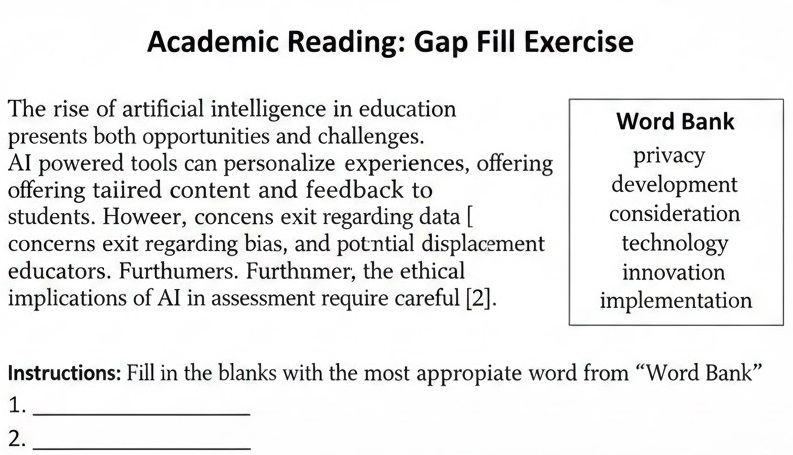
The PTE Academic test can be a game-changer for students aspiring to study abroad. With various sections designed to evaluate your English proficiency, the Reading Fill in the Blanks question type stands out as both challenging and rewarding. Imagine navigating through passages where key words are missing, and your task is to identify the correct ones that fit seamlessly into context. This section tests not just your vocabulary but also your understanding of language nuances, which can significantly impact your overall score. Whether you’re gearing up for this exam or simply looking to refine your skills, mastering Academic Reading Fill in the Blanks will elevate your reading comprehension and boost confidence on test day. Let’s dive deeper into what this question type entails!
How is it different from other question types?
PTE Academic Reading Fill in the Blanks stands out from other question types due to its unique focus on vocabulary and contextual understanding. Unlike multiple-choice questions, where you select an answer from given options, this format requires you to actively recall or deduce the missing words.
Another key difference lies in the integration of reading comprehension skills. You must analyze surrounding text and infer meanings rather than simply recognizing correct answers. This encourages a deeper engagement with the material.
Additionally, while some questions may test specific knowledge or facts, Fill in the Blanks challenges your ability to synthesize information across sentences and paragraphs. It’s not just about knowing but also about how well you can connect ideas using appropriate language.
This type of question demands both precision and intuition, making it a true test of your English proficiency in real-world contexts.
Strategies for approaching PTE Academic Reading Fill in the Blanks
To tackle the PTE Academic Reading Fill in the Blanks, start by reading the entire passage first. This gives you context and helps you anticipate what type of words might fit in each blank.
Next, focus on keywords within the sentence structure. Look for clues like conjunctions or prepositions that indicate relationships between ideas. These can guide your choices effectively.
Then, consider word forms. If a blank requires a noun, look for surrounding verbs or adjectives to identify potential options.
Also, practice makes perfect. Familiarize yourself with different topics and writing styles since this will enhance your adaptability during the test.
Manage your time wisely. Don’t spend too long on any single question—move on if you’re uncertain and return later if time permits.
Tips for improving performance on this question type
To enhance your performance on Academic Reading Fill in the Blanks, start by expanding your vocabulary. A rich lexicon helps you fill gaps more accurately.
Practice skimming and scanning techniques. These skills allow you to grasp the main ideas quickly while identifying key details that can guide your answers.
Familiarize yourself with various text structures. Understanding how different types of texts are organized will help you predict what kind of words might fit into blank spaces.
Time management is crucial; allocate specific time frames for each question. This keeps you focused and prevents last-minute rushes that could lead to errors.
Review any mistakes made during practice sessions. Analyzing where things went wrong provides insight into areas needing improvement, reinforcing learning for future attempts.
Common mistakes to avoid
When tackling Academic Reading Fill in the Blanks, many candidates fall into common pitfalls. One frequent mistake is not reading the entire passage carefully. Skimming can lead to missing key context and subtle clues that are essential for selecting the correct words.
Another issue is ignoring grammatical cues. Words must fit both semantically and grammatically within the sentence structure. Watch out for subject-verb agreement or tense inconsistencies; they can easily derail your answer.
Also, avoid relying solely on prior knowledge of a topic. While familiarity can help, it shouldn’t replace careful consideration of all options presented in the question.
Don’t rush through practice sessions. Time management is critical during tests, but consistent practice helps you recognize patterns and enhances accuracy over time. Taking shortcuts now may cost you valuable points later!
Sample questions and explanations
Sample questions for Academic Reading Fill in the Blanks can vary widely, but they all test your comprehension skills.
For example, you might encounter a sentence like: “The research indicated that climate change is _____ to biodiversity.” Here, options such as “detrimental,” “beneficial,” or “irrelevant” would be provided. The correct answer hinges on grasping the context of the passage about environmental impacts.
Another type may present a more complex structure: “Despite his efforts, the project was ultimately considered ______ due to unforeseen challenges.” Choices could include words like “successful,” “failed,” or “promising.” Understanding nuanced meanings and how each word fits into the overall message is crucial here.
These examples highlight essential reasoning skills. Each blank invites you to engage with vocabulary while considering broader themes within the text. This way, you’re not just filling in blanks; you’re unraveling deeper insights from what you read.
Conclusion:
Mastering PTE Academic Reading Fill in the Blanks is crucial for achieving a strong overall test score. This question type not only assesses your reading comprehension skills but also tests your vocabulary and understanding of context. The ability to fill in missing words effectively can significantly enhance your performance across various sections of the exam.
Success in this part of the PTE will allow you to showcase your language proficiency, which is essential for academic and professional opportunities. By practicing regularly and implementing effective strategies, you can improve both speed and accuracy. This improvement reflects positively on your test results, ultimately opening doors to new possibilities.
As you prepare for the PTE Academic exam, prioritizing these skills will pay off immensely. Embrace this challenge as an opportunity to grow linguistically while boosting that all-important score that could shape your future endeavors.