


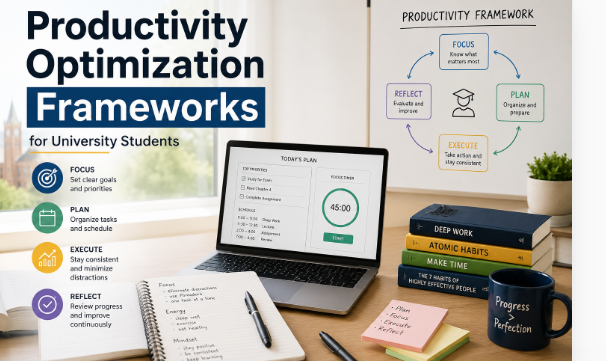
Introduction to Productivity Optimization
In the academic environment, university students are often confronted with a myriad of responsibilities, including class attendance, rigorous assignments, and extracurricular activities. These obligations can create significant challenges in effectively managing their time and energy. Thus, the need for productivity optimization becomes paramount. Productivity optimization refers to strategies and frameworks designed to enhance the efficiency and effectiveness of completing tasks. For students, this means not only improving academic performance but also maintaining a balanced lifestyle.
Numerous factors can hinder a student’s ability to optimize their productivity. Challenges such as procrastination, distractions from social media, and the overwhelming pressure to perform can lead to inefficient time management. Students often find themselves juggling academic deadlines while also participating in various clubs, sports, or part-time jobs, which further complicates their schedules.
Implementing productivity frameworks can help mitigate these issues. By adopting specific strategies that encourage organization, focus, and prioritization, students can navigate through their responsibilities with greater ease. For instance, methods like the Pomodoro Technique or Eisenhower Matrix can help students allocate their time effectively, manage their workloads, and minimize stress. These frameworks serve as essential tools that allow students to break down complex projects into manageable tasks, making the academic journey less daunting.
Furthermore, enhanced productivity not only leads to better academic outcomes but also promotes personal growth and wellbeing. By understanding their unique challenges and adopting tailored productivity optimization strategies, university students can develop skills that will benefit them long after their educational pursuits are complete. Ultimately, the pursuit of productivity optimization is not merely about achieving higher grades but fostering a sustainable approach to personal development and life management.
Understanding Productivity Frameworks
Productivity frameworks are structured methodologies that help individuals manage their time and tasks effectively. For university students, these frameworks are particularly beneficial as they offer practical solutions for organizing workloads, prioritizing assignments, and managing deadlines. The application of a productivity framework enables students to break down complex tasks into manageable components, enhancing overall efficiency and focus.
One primary significance of productivity frameworks lies in their ability to instill discipline and a sense of direction. By utilizing a systematic approach, students can allocate their time and resources more judiciously. This method not only aids in keeping track of academic responsibilities but also encourages a well-balanced routine that integrates study, extracurricular activities, and personal time.
Moreover, productivity frameworks can be tailored to meet individual needs. Different students have unique study styles and preferences; thus, frameworks like the Pomodoro Technique, Getting Things Done (GTD), and Eisenhower Matrix allow for customization. These strategies emphasize breaking tasks into interspersed intervals, creating actionable lists, and prioritizing tasks based on urgency and importance. Such flexibility ensures that students can adopt the framework that resonates most with their approach to learning and productivity.
In the context of academic achievement, productivity frameworks serve as powerful tools for fostering motivation and accountability. By establishing clear goals and benchmarks within a framework, students can monitor their progress and celebrate small victories along the way. This approach not only enhances productivity but also promotes a sense of accomplishment, which is essential in sustaining motivation throughout the academic year.
Key Productivity Frameworks for University Students
University students often face a multitude of tasks and deadlines, which can make effective time management challenging. Adopting specific productivity frameworks can help students enhance their focus and efficiency. Here are three notable methodologies: the Pomodoro Technique, GTD (Getting Things Done), and the Eisenhower Matrix.
The Pomodoro Technique is a time management system that encourages students to work in short bursts, typically 25 minutes, followed by a 5-minute break. After completing four cycles, students are encouraged to take a longer break, usually 15 to 30 minutes. This framework cultivates a sense of urgency while also preventing burnout, making it easier for students to maintain high levels of concentration over extended periods. The structured intervals promote sustained attention and allow for regular rest, which is essential for cognitive effectiveness.
GTD (Getting Things Done) is another framework designed to enhance personal productivity by organizing tasks and commitments efficiently. The core principle of GTD lies in capturing everything that needs to be done in a trusted system, allowing students to free their minds from constant worrying about tasks. The method involves five key steps: capturing, clarifying, organizing, reflecting, and engaging. By systematizing tasks into actionable steps, students can focus more on the actual work rather than on planning, thereby improving their overall productivity.
Lastly, the Eisenhower Matrix focuses on prioritizing tasks based on urgency and importance. This framework divides tasks into four quadrants: important and urgent, important but not urgent, urgent but not important, and neither urgent nor important. Students can use this matrix to classify their tasks, enabling them to allocate time effectively and focus on what truly matters. By distinguishing between what is essential and what can wait, students can better manage their schedules and reduce feelings of overwhelm.
Implementing the Pomodoro Technique
The Pomodoro Technique is a time-management method developed by Francesco Cirillo in the late 1980s. This strategy divides work into intervals, traditionally lasting 25 minutes, separated by short breaks, usually lasting 5 minutes. The primary goal is to enhance focus and productivity while reducing mental fatigue. For university students who often juggle numerous assignments, projects, and studying, properly implementing the Pomodoro Technique can serve as an effective productivity optimization framework.
To begin, students should identify a specific task or project they intend to work on, ensuring it is clearly defined. Next, utilize a timer to set a 25-minute interval. During this phase, the goal is to concentrate solely on the selected task, avoiding distractions such as phone notifications or social media. This focused work period, referred to as a “Pomodoro,” allows students to engage deeply with the material, fostering greater retention and understanding.
Once the 25 minutes elapse, students should take a 5-minute break. This short respite is critical as it permits the brain to recover, ultimately helping to maintain high levels of concentration. During the breaks, it is advisable to stand, stretch, or even engage in quick physical activity instead of succumbing to distractions. After completing four Pomodoros, a longer break of 15 to 30 minutes can be taken, which further enhances productivity and creativity in subsequent sessions.
For a more effective implementation, students may consider tracking their Pomodoros to assess their productivity levels over time. Staying aware of which tasks take longer can help in planning study schedules more effectively. Additionally, customizing the length of the Pomodoros and breaks may better suit individual preferences and tasks. Ultimately, the Pomodoro Technique, when applied correctly, can lead to significant improvements in academic performance and overall time management for students.
Applying the GTD (Getting Things Done) Method
The Getting Things Done (GTD) method, created by David Allen, is a productivity approach particularly beneficial for university students striving to manage their academic and personal responsibilities effectively. This framework revolves around five key steps: capture, clarify, organize, reflect, and engage.
Initially, the first step, capture, encourages students to jot down all tasks, commitments, and ideas into a trusted system. This could range from digital tools like note-taking apps to traditional notebooks. The primary objective here is to relieve the mind from holding onto various responsibilities, allowing students to focus better on their studies.
The second step, clarify, involves processing each captured item. Students should ask themselves what action is required for each task. If a task takes less than two minutes to complete, it is advisable to do it immediately. For tasks needing more time, identifying next actions and breaking them down into manageable steps can alleviate overwhelm and promote a clear action plan.
Next, students move to the organize phase. In this phase, users categorize tasks by project and context, enabling more straightforward retrieval. For example, grouping assignments by courses or separating tasks into categories like “urgent” and “can wait” can streamline workflow during busy periods, such as exam preparation.
Subsequently, regular reflection on captured tasks enhances productivity. A weekly review can help students assess their progress and realign their tasks with changing priorities or deadlines. Finally, the engage step emphasizes focusing on executing the selected tasks based on the organized lists, ensuring that students are consistently aware of what needs immediate attention.
By applying the GTD method, university students can gain greater control over their task management, leading to increased productivity and reduced stress, ultimately facilitating a more successful academic journey.
Utilizing the Eisenhower Matrix for Task Prioritization
The Eisenhower Matrix, attributed to former U.S. President Dwight D. Eisenhower, serves as an effective framework for prioritizing tasks based on their urgency and importance. This approach categorizes tasks into four distinct quadrants, thereby assisting university students in managing their workloads more efficiently. By adopting this matrix, students can not only enhance their productivity but also allocate their time more effectively across assignments, projects, and daily activities.
The first quadrant focuses on tasks that are both urgent and important. For instance, a student facing an impending deadline for a crucial project must complete the necessary research and write-up promptly. This quadrant comprises tasks that require immediate attention and have significant consequences. Identifying these high-priority assignments enables students to avoid procrastination and maintain academic integrity.
The second quadrant contains tasks that are important but not urgent. Examples may include preparing for upcoming exams or working on long-term projects. Although these tasks do not require immediate action, establishing a routine to address them positively influences a student’s overall success. Allocating specific times in a weekly schedule to focus on these tasks ensures they remain manageable and reduces last-minute stress.
The third quadrant is dedicated to tasks that are urgent but not important, such as responding to certain emails or attending meetings that do not contribute significantly to academic goals. While these activities may seem pressing, they should not consume valuable study time. Textbook strategies involve delegating or scheduling these tasks to free up time for more meaningful work.
Finally, the fourth quadrant includes tasks that are neither urgent nor important, like casually browsing social media. Students should strive to minimize or eliminate these distractions, reserving their focus for more impactful endeavors. By applying the Eisenhower Matrix, university students can enhance their time management skills and prioritize effectively, fostering a more organized approach to their academic responsibilities.
Setting SMART Goals to Enhance Productivity
In the realm of productivity optimization, the establishment of clearly defined goals is indispensable for university students. The SMART criteria, which stands for Specific, Measurable, Achievable, Relevant, and Time-bound, provides a framework that encourages effective goal-setting.
Beginning with the first element, Specificity requires that goals are clear and precise. For instance, instead of setting a vague goal such as “I want to study more,” a better approach might be “I will study for two hours every Tuesday and Thursday after class.” This specificity not only clarifies the intended outcome but also focuses the student’s efforts.
Next, the Measurable aspect allows students to track their progress. Incorporating metrics into goals, such as “I aim to complete three chapters of my textbook by the end of the month,” facilitates accountability. This ensures students can objectively assess their productivity and make necessary adjustments to their study habits.
The Achievable criterion emphasizes the importance of setting realistic expectations. Goals should stretch capabilities but remain attainable. A student might set a goal to improve their grades in calculus by attending tutoring sessions twice a week, rather than aiming for an unrealistic jump in their GPA.
Relevance is crucial; the goals set should align with broader academic and career aspirations. For example, a student pursuing a career in environmental science might focus on projects or internships related to sustainability, thereby enhancing their educational experience while contributing to their professional journey.
Lastly, Time-bound goals incorporate deadlines, creating urgency and prompting action. A well-structured goal might be, “I will finish my research paper by April 15th, allowing ample time for revisions before submission.” This not only enhances focus but also develops time management skills, vital for any successful university student.
In summary, utilizing the SMART criteria equips university students with an effective method for setting goals that foster productivity. By crafting specific, measurable, achievable, relevant, and time-bound objectives, students can enhance their academic performance and overall efficiency in their educational journeys.
Technology and Tools for Productivity Optimization
In today’s fast-paced academic environment, university students are increasingly turning to technology and various tools to enhance their productivity and efficiency. A plethora of applications and platforms cater specifically to the needs of students looking to optimize their study habits and manage their tasks effectively. This section explores notable apps and tools that align with popular productivity frameworks, ensuring students can maximize their potential.
One essential category of tools is task management applications. These apps help students organize their assignments, projects, and daily tasks in a clear and structured manner. Commonly used platforms such as Todoist and Asana allow users to create to-do lists, set deadlines, and prioritize tasks, ensuring that no important deadlines are missed. Additionally, these tools integrate with calendars, making it easier for students to visualize their schedules and allocate time appropriately.
Another vital aspect of productivity is effective note-taking. Digital note-taking applications like Evernote and Notion provide versatile solutions for students. These platforms enable users to capture and organize lecture notes, research findings, and ideas in a centralized location. Many offer features such as tagging, multimedia integration, and collaborative editing, which significantly enhance the learning experience. By keeping all notes organized and accessible, students can improve their revision strategies and retain information more effectively.
Furthermore, time-tracking tools like RescueTime and Toggl offer insight into how students spend their study hours. By monitoring time spent on various tasks and activities, users can identify distractions and optimize their work habits. This data-driven approach aligns well with productivity optimization frameworks, allowing students to make informed decisions regarding their time management strategies.
Conclusion and Future Steps
In conclusion, this discussion highlights various productivity optimization frameworks that university students can utilize to enhance their academic performance. We explored several effective methods, such as the Pomodoro Technique, time-blocking, and the Eisenhower Matrix, each offering unique benefits. By understanding and implementing these frameworks, students can better manage their time and workload, ultimately leading to improved focus and reduced stress.
Each student possesses distinct needs and circumstances; therefore, it is crucial for individuals to experiment with different productivity strategies. A one-size-fits-all approach does not apply when it comes to productivity. Some may thrive under rigid schedules, while others may excel with more flexible frameworks. It is advisable for students to take the initiative to adapt and tailor these techniques to find what combinations work best for their individual learning styles and personal lives.
Moreover, regular assessment of one’s own productivity levels is vital for sustained academic success. Students should consider keeping a journal or using digital tools to track their progress and reflect on their productivity habits. Over time, they can identify patterns that either hinder or enhance their outputs.
Ultimately, the goal of integrating these productivity optimization frameworks is not just to complete academic tasks efficiently, but also to foster a greater sense of balance and well-being. As students continue their educational journey, embracing the importance of adaptability in productivity will serve them well not only in their studies but throughout their future careers.