


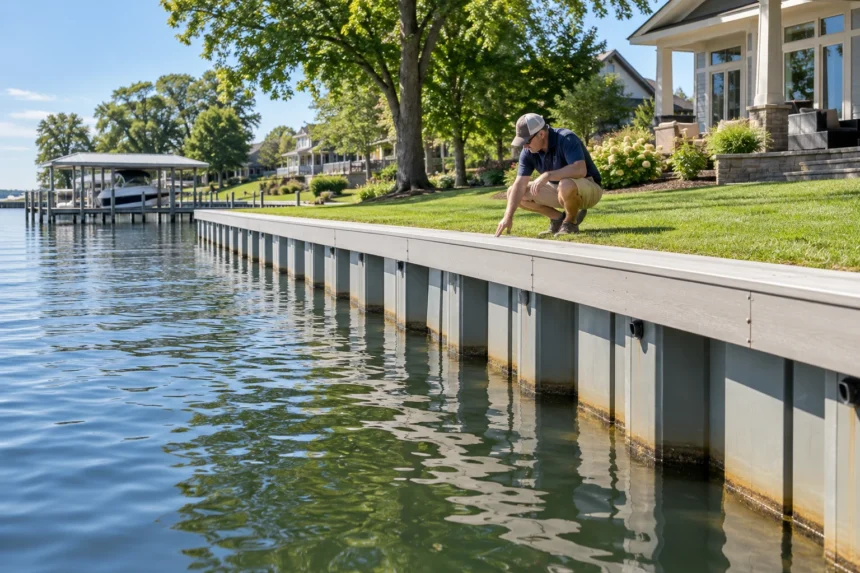
Bulkhead material selection is partly an engineering decision and partly an ownership decision. Shoreline exposure and soil determine what the structure must handle, while maintenance preferences influence which suitable material is practical for the property owner over time.
Shore Protect Team’s Shore Protect Team marine services include both construction and repair, which is useful when thinking about ownership beyond installation day. The best material for a particular site should also fit the level of routine care the owner is prepared to manage.
The bulkhead page describes treated wood as a cost-effective option with a 40-50 year service life when properly maintained. Vinyl is presented as durable and requiring no additional maintenance. Riprap is described as requiring no maintenance while naturally protecting the shoreline from erosion.
Concrete is positioned for exceptional durability in demanding Gulf Coast and hurricane-zone conditions. Gabions combine rock fill with natural drainage and flexibility. Each system therefore creates a different maintenance conversation.
Maintenance should not be confused with structural inspection. A low-maintenance material does not remove the need to review the condition of the foundation, anchors, drainage, connections, and surrounding shoreline.
The bulkhead material and maintenance details helps separate material care from the broader structure. Owners can use those distinctions to choose among materials that already meet the site’s exposure and structural requirements.
Wood includes an active maintenance expectation
Treated lumber is positioned as a balance of cost and quality for calm freshwater lakes and rivers. The page ties its 40-50 year service-life statement to proper maintenance, which means the ownership plan is part of the material decision.
Wood may therefore fit an owner who prefers its appearance and initial cost profile and is comfortable with an ongoing maintenance responsibility.
Vinyl shifts the maintenance profile
Vinyl is described as durable, resistant to moisture and sun, and requiring no additional care. That makes it relevant when routine maintenance is a leading concern, provided the material also fits the water body and structural requirements of the site.
The lower maintenance burden of the wall face does not eliminate the need to inspect anchors, drainage, alignment, or other structural components.
Rock systems create different inspection questions
Riprap is presented as a no-maintenance shoreline stabilization option that uses natural stone and boulders to absorb wave energy. Gabions use stone fill within a flexible system and provide natural drainage.
These systems do not have the same wall face or maintenance profile as wood, vinyl, or concrete. Owners should compare them according to shoreline function and site conditions rather than appearance alone.
- Wood – Proper maintenance is part of the stated 40-50 year service-life expectation.
- Vinyl – Presented as requiring no additional maintenance.
- Concrete – Selected primarily for high durability in demanding coastal applications.
- Riprap – Presented as requiring no maintenance and absorbing wave energy.
- Gabions – Combine rock fill, natural drainage, and structural flexibility.
Maintenance preference comes after site suitability
An owner may prefer the lowest-maintenance option, but that preference should be applied only among materials suitable for the site’s wave load, soil, water level, and use. The structural requirement comes first.
This sequence avoids selecting a material solely because it sounds convenient. The final system still has to work with the foundation, anchors, drainage, and access conditions of the property.
- Assess the water body and shoreline exposure.
- Identify materials that fit the structural and environmental conditions.
- Compare the routine maintenance expectations of those materials.
- Review foundation, anchor, and drainage inspection needs separately from surface maintenance.
- Consider repairability of the complete structure rather than only the wall face.
- Select the option that fits both site requirements and the owner’s maintenance plan.
Low maintenance should not mean low attention
Even when the wall material itself needs little routine care, the shoreline remains an active environment. Soil conditions, water levels, and structural connections can change over time. Periodic observation of the full system remains useful.
The most practical material choice is therefore not simply the one with the fewest maintenance tasks. It is the one that meets the site’s physical demands while matching the owner’s realistic plan for inspection, upkeep, and future repair.
Maintenance planning should be written into ownership expectations
Owners benefit from asking what routine attention is expected during the years after construction. The answer may differ by material, but it should also address the complete structure. A low-maintenance wall face can still be attached to anchors, piles, caps, or connections that deserve periodic observation.
This is especially relevant when a property changes hands. A future owner may see a finished bulkhead without knowing which components need care. Keeping the material, foundation, drainage, and anchor information together gives the property a more useful maintenance record than a simple note about the wall material.
Repair history should be kept with that record as well. If anchors were replaced or damaged sections restored, that information can help a later inspection focus on the parts of the system that have already required work rather than treating the wall as if every component were the same age and condition.
Maintenance expectations can influence resale and management planning
A property manager or future owner may inherit the bulkhead long after the original material decision was made. Recording the selected material, maintenance expectations, and previous repairs helps preserve that context. This is especially useful on shared or commercial properties where responsibility for routine care may change over time.
