


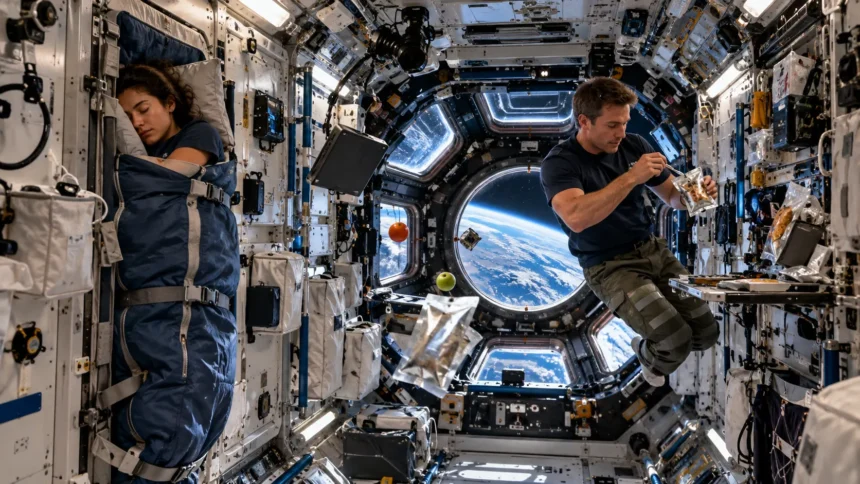
Living in space is one of the most extraordinary experiences a human can have, but everyday activities become surprisingly complicated without normal gravity. Astronauts aboard the International Space Station must eat, sleep, exercise, work, and maintain personal hygiene while floating in microgravity. Even simple routines, such as drinking water or getting into bed, require special equipment and careful preparation.
The International Space Station serves as both a scientific laboratory and a temporary home for astronauts from different countries. Crew members follow structured schedules that balance research, spacecraft maintenance, physical fitness, meals, and personal time. Although the environment is very different from Earth, astronauts still need comfortable sleeping arrangements, nutritious food, clean surroundings, and opportunities to relax.
Understanding how astronauts live and sleep in space reveals the challenges of maintaining everyday life beyond Earth. Scientists have developed innovative technologies that make long-duration missions possible while protecting astronaut health and safety. This guide explores the daily routines of astronauts, including sleeping conditions, food preparation, personal hygiene, exercise, scientific work, and the experience of living hundreds of kilometers above Earth.
What Is Daily Life Like for Astronauts in Space?
Daily life aboard the International Space Station follows a carefully organized schedule designed to support scientific research and crew well-being. Astronauts spend much of their working day conducting experiments, maintaining equipment, and completing assigned responsibilities. Even though they float through the spacecraft, their activities require concentration, coordination, and consistent communication with mission control teams on Earth.
A typical day includes waking up, completing personal hygiene routines, eating breakfast, and reviewing scheduled tasks. Crew members then begin scientific activities, maintenance work, or operational checks before taking breaks for meals and exercise. Their schedules also include time for conferences with ground teams, medical monitoring, and preparation for upcoming experiments or spacecraft operations.
Despite the demanding workload, astronauts have opportunities to enjoy personal activities and communicate with loved ones. They may read books, watch movies, take photographs, or admire Earth through the station’s windows. Maintaining a balance between work and relaxation is important because astronauts live in a confined environment for extended periods while remaining far from familiar surroundings.
How Do Astronauts Sleep in Space Without Gravity?
Sleeping in space is different from sleeping on Earth because astronauts do not experience the usual sensation of lying on a mattress. In microgravity, their bodies float instead of resting against a bed. Astronauts typically sleep inside specially designed sleeping bags secured to the walls or other suitable surfaces within the spacecraft.
On the International Space Station, crew members may use small private sleeping quarters that provide space for personal belongings and sleeping equipment. These compact compartments help reduce distractions and offer a degree of privacy. Sleeping bags are secured to prevent astronauts from drifting around while they rest, although floating itself does not create the same discomfort as falling on Earth.
Astronauts can technically sleep in different orientations because there is no normal sense of up or down in microgravity. Some prefer a position resembling upright sleeping, while others adjust their sleeping arrangements for comfort. The most important considerations include proper airflow, manageable noise levels, suitable temperatures, and enough uninterrupted rest to support demanding daily activities.
How Many Hours Do Astronauts Sleep Each Day?
Astronaut schedules generally provide approximately eight to eight and a half hours for sleep, although actual sleeping time can vary. Adequate rest is essential for concentration, physical recovery, and emotional well-being during demanding missions. Astronauts must remain alert when operating scientific equipment, performing maintenance, and responding to unexpected situations aboard the spacecraft.
Getting enough sleep can be challenging because the space station experiences frequent changes between sunlight and darkness. Traveling around Earth approximately every 90 minutes, the station witnesses around sixteen sunrises and sunsets during a typical 24-hour period. Artificial lighting and structured daily schedules help astronauts maintain a regular sleep-wake cycle despite these unusual conditions.
Noise from ventilation systems, equipment, and other crew activities can also affect sleep quality. Astronauts may use eye masks, earplugs, and personal routines to create a more comfortable sleeping environment. Mission planners monitor rest schedules carefully because ongoing sleep problems can influence performance, decision-making, and overall health during long-duration space missions.
How Do Astronauts Eat and Drink in Space?
Eating in space requires special food packaging because ordinary plates and open containers are difficult to manage in microgravity. Food particles and liquids can float away if they are not properly contained. Astronaut meals therefore use carefully designed packaging that allows food to be stored, prepared, and consumed without creating unnecessary debris inside the spacecraft.
Space food includes a variety of options such as vegetables, fruits, meat dishes, tortillas, rice, and packaged desserts. Some meals are ready to eat, while others require water to restore their original texture. Astronauts can also warm certain foods using specialized equipment, making mealtimes more enjoyable during extended missions away from Earth.
Drinking water presents another challenge because liquids form floating droplets rather than remaining in open cups. Astronauts commonly use sealed drink containers with specially designed straws or valves. Their food selections are planned to provide appropriate nutrition, sufficient calories, and familiar flavors that support health and make everyday life feel more comfortable.
How Do Astronauts Use the Bathroom in Space?
Using the bathroom in microgravity requires specially designed equipment because waste does not naturally fall into a toilet. Space toilets use airflow to guide and collect waste while keeping the surrounding environment clean. Astronauts receive training before their missions so they understand how to operate these systems safely and correctly.
The International Space Station has toilet systems equipped with airflow devices, collection containers, and positioning supports. Crew members use restraints or handholds to maintain the correct position during use. These systems are designed to manage waste hygienically while preventing materials from floating through the cabin or interfering with important spacecraft equipment.
Waste management is also connected to resource conservation aboard the station. Certain wastewater streams, including urine, can be processed through specialized recycling equipment to recover usable water. Solid waste is collected and managed separately, demonstrating how everyday sanitation requires advanced engineering when people live in an environment without normal gravity.
How Do Astronauts Shower and Maintain Hygiene?
Astronauts cannot take ordinary showers aboard the International Space Station because water behaves differently in microgravity. Instead of falling through a showerhead and flowing into a drain, water tends to form droplets that cling to surfaces. These droplets could float into equipment or electronics if they were not carefully controlled.
To stay clean, astronauts use damp washcloths, rinseless cleansing products, and specially formulated hygiene supplies. They can wash their hair with rinseless shampoo and remove excess moisture using towels. These methods allow crew members to maintain personal cleanliness while conserving water and avoiding the complications associated with conventional bathing equipment.
Brushing teeth, shaving, and changing clothes are also part of everyday space hygiene. Astronauts use familiar personal care items, although some routines require small adjustments to contain water and other materials. Clothing is generally worn for several days before replacement because conventional laundry facilities are not available aboard the station.
Why Do Astronauts Exercise Every Day in Space?
Exercise is an essential part of astronaut life because microgravity changes how the human body uses muscles and bones. On Earth, gravity creates resistance during everyday movements such as standing, walking, and climbing stairs. In space, astronauts experience much less mechanical loading, which can contribute to muscle weakness and reduced bone density over time.
To help counter these effects, astronauts aboard the International Space Station generally exercise for about two hours each day. Their equipment includes specialized treadmills, stationary exercise bicycles, and resistance-training machines. These devices allow crew members to perform physical activities while remaining securely positioned inside the spacecraft despite the absence of normal gravity.
Regular exercise supports muscle strength, cardiovascular fitness, and bone health during extended missions. Scientists also monitor astronaut health to understand how the body responds to prolonged exposure to microgravity. The information helps improve training programs and develop protective strategies for future missions to destinations such as the Moon and Mars.
How Do Astronauts Work and Conduct Experiments?
Scientific research is one of the primary reasons astronauts live aboard the International Space Station. The microgravity environment allows researchers to investigate physical and biological processes under conditions that cannot be maintained easily on Earth. Experiments examine subjects such as human health, materials science, fluid behavior, plant growth, and technological performance.
Astronauts receive detailed training before participating in experiments and operating specialized scientific equipment. During their missions, they collect samples, record observations, and communicate findings to research teams on the ground. Some studies require regular monitoring over several weeks, while others involve shorter procedures designed to answer specific scientific questions.
Space station crews also perform maintenance tasks to keep life-support systems, communication equipment, and scientific instruments functioning correctly. These responsibilities may include inspections, repairs, equipment replacements, and preparation for visiting spacecraft. Balancing scientific work with spacecraft maintenance requires careful scheduling because both activities are essential for successful long-duration missions.
How Do Astronauts Get Oxygen and Drinking Water?
The International Space Station uses advanced life-support systems to provide breathable air and safe drinking water. Unlike buildings on Earth, the station cannot simply rely on the surrounding atmosphere for fresh oxygen. Its environmental control equipment helps maintain appropriate cabin conditions while monitoring gases, temperature, humidity, and other important factors.
Some oxygen aboard the station is generated through electrolysis, a process that separates water into hydrogen and oxygen using electricity. Additional oxygen supplies and backup systems help maintain reliable life support. Carbon dioxide must also be removed from cabin air because astronauts continuously produce it through normal breathing and metabolic activity.
Water recycling is another important part of maintaining life in space. Specialized systems recover moisture from cabin air and process wastewater, including urine, into water that undergoes extensive treatment and quality checks. Recovering these resources reduces dependence on frequent deliveries from Earth and supports research into more sustainable life-support systems for future exploration.
How Do Astronauts Communicate With Family and Earth?
Staying connected with Earth helps astronauts maintain personal relationships and manage the emotional demands of spaceflight. Communication systems allow crew members to exchange information with mission control and, when arrangements permit, contact family members. These connections are especially meaningful during missions lasting several months because astronauts spend extended periods away from familiar people and places.
Astronauts can use scheduled video conversations, voice communication, and electronic messages depending on available systems and operational requirements. Mission control teams also communicate regularly with the crew to coordinate experiments, review technical conditions, and provide assistance. Reliable communication is essential for both everyday activities and situations that require immediate operational decisions.
Personal conversations and supportive relationships contribute to psychological well-being during long-duration missions. Astronauts may share special occasions remotely, exchange updates with loved ones, and participate in educational communication activities. Although technology cannot completely replace being physically present with family and friends, these opportunities help reduce feelings of separation during spaceflight.
How Do Astronauts Relax and Have Fun in Space?
Living in space involves demanding work, but astronauts also receive personal time for relaxation and entertainment. Recreational activities can include reading, listening to music, watching movies, playing games, or taking photographs. These familiar pastimes help provide variety and allow crew members to disconnect temporarily from their daily scientific and operational responsibilities.
One of the most memorable recreational experiences is looking at Earth from orbit. Astronauts can observe oceans, mountains, clouds, cities, and dramatic weather patterns through spacecraft windows. The International Space Station’s Cupola observation module provides particularly impressive views, making Earth photography and quiet observation popular activities during available free time.
Crew members may also enjoy shared meals, celebrations, or informal conversations with colleagues. Positive relationships are important because astronauts live and work together in a relatively confined environment. Maintaining hobbies, social connections, and personal routines supports morale while helping astronauts manage the unusual experience of spending months away from Earth’s surface.
What Challenges Do Astronauts Face While Living in Space?
Living in space introduces physical challenges that do not occur in ordinary daily life on Earth. Microgravity can affect balance, fluid distribution, muscle strength, and bone health, particularly during longer missions. Astronauts may experience space motion sickness during initial adaptation, although many become more comfortable as their bodies adjust to the unfamiliar environment.
The spacecraft environment also creates practical and psychological challenges. Limited privacy, equipment noise, structured schedules, and separation from family can influence everyday comfort. Astronauts must work cooperatively with people from different professional and cultural backgrounds while following strict safety procedures designed to protect everyone aboard the station.
Space radiation presents another concern because astronauts experience greater exposure than people protected by Earth’s atmosphere. Mission planners consider radiation monitoring, spacecraft shielding, and exposure limits when developing crewed missions. Continued research into these challenges helps scientists improve astronaut protection and prepare for exploration missions that extend farther beyond Earth.
Conclusion
Astronauts live remarkably organized lives aboard the International Space Station, where ordinary activities require specialized equipment and thoughtful preparation. Sleeping in secured bags, eating packaged meals, maintaining hygiene without conventional showers, and exercising in microgravity are all part of daily life. These routines help astronauts remain healthy and comfortable while carrying out important scientific missions.
Advanced technology makes extended human spaceflight possible by providing breathable air, clean water, temperature control, and reliable communication. Astronauts also depend on carefully planned schedules that balance scientific research, equipment maintenance, physical activity, and personal relaxation. Understanding these systems reveals how much engineering and teamwork are required to support everyday life beyond Earth.
Life in space continues to teach scientists valuable lessons about human adaptability, health, and survival in challenging environments. The knowledge gained from current missions contributes to preparations for future journeys to the Moon, Mars, and beyond. Although living away from Earth presents unique difficulties, astronaut experiences demonstrate how innovation and cooperation can make extraordinary exploration possible.
Frequently Asked Questions
How do astronauts sleep in space without floating away?
Astronauts sleep inside specially designed sleeping bags secured to spacecraft surfaces or sleeping quarters. These attachments keep them from drifting while allowing comfortable rest in microgravity without traditional mattresses.
How many hours do astronauts sleep in space?
Astronaut schedules generally allow approximately eight to eight and a half hours for sleep. Actual rest can vary because of equipment noise, mission responsibilities, individual sleep patterns, and environmental conditions.
Do astronauts shower while living in space?
Astronauts do not take conventional showers aboard the International Space Station. Instead, they use damp washcloths, rinseless shampoo, and specialized personal hygiene products to remain clean while conserving water.
What do astronauts eat every day in space?
Astronauts eat specially packaged meals that may include vegetables, fruits, meat dishes, rice, tortillas, and desserts. Some foods require water or heating before consumption, while others are ready to eat.
Can astronauts exercise and walk normally in space?
Astronauts can exercise using specialized treadmills, stationary bicycles, and resistance equipment, but they generally float instead of walking normally. Daily workouts help maintain muscle strength, cardiovascular fitness, and bone health.
