


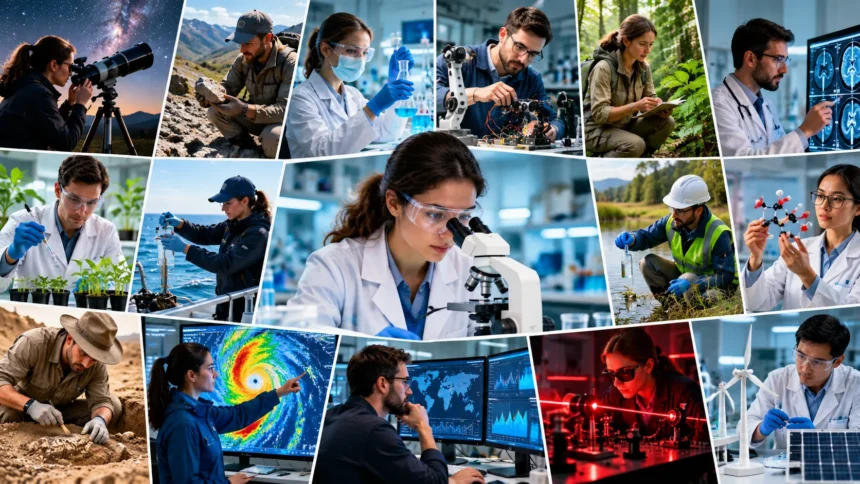
What Are the 12 Types of Scientists?
Scientists are professionals who study the natural world, investigate problems, and develop new knowledge through research, observation, and experiments. Different types of scientists specialize in fields such as biology, chemistry, physics, astronomy, and environmental science. Their discoveries help people understand how the universe works while contributing to advances in technology, healthcare, agriculture, and everyday life.
There are many branches of science, each focusing on particular questions and research methods. Some scientists investigate living organisms, while others study matter, energy, weather, oceans, or the Earth’s structure. Understanding the 12 types of scientists provides a useful introduction to the different careers available in science and the important work these professionals perform.
The 12 types commonly introduced in educational discussions include biologists, chemists, physicists, astronomers, geologists, meteorologists, oceanographers, ecologists, microbiologists, geneticists, botanists, and zoologists. This is a practical selection rather than an official or exhaustive classification of scientific careers. Each profession involves specialized knowledge, research techniques, and scientific questions that contribute to understanding the world.
1. Biologists: Scientists Who Study Living Organisms
Biologists study living organisms, including plants, animals, microorganisms, and humans. Their work focuses on understanding how organisms grow, reproduce, interact, and respond to their environments. Biology is a broad scientific field that includes subjects such as physiology, evolution, ecology, and molecular biology, making it one of the most diverse areas of scientific research.
Some biologists investigate how cells function, while others study entire ecosystems or the behavior of specific species. Their research may involve laboratory experiments, field observations, and the analysis of biological samples. Biologists also contribute to healthcare, agriculture, wildlife conservation, and biotechnology by improving scientific understanding of living systems.
Becoming a biologist usually involves studying biology or a related subject at university. Research positions may require advanced education and practical experience with scientific methods. Students interested in nature, living organisms, and biological processes may find this field particularly rewarding because it offers many opportunities to explore different aspects of life.
2. Chemists: Scientists Who Study Matter and Chemical Reactions
Chemists investigate the composition, structure, properties, and behavior of substances. They study how atoms and molecules interact and how chemical reactions transform materials into different substances. Chemistry plays an important role in understanding everyday products, industrial processes, medicines, food, environmental systems, and many other aspects of modern life.
Chemists work in laboratories, universities, manufacturing facilities, and research organizations. Their responsibilities may include analyzing samples, developing chemical compounds, testing materials, and improving manufacturing processes. Some specialize in organic chemistry, analytical chemistry, physical chemistry, or biochemistry, depending on the types of substances and reactions they investigate.
A career in chemistry generally requires strong knowledge of mathematics, scientific principles, and laboratory techniques. Chemists must follow established safety procedures when handling chemicals and equipment. Their discoveries contribute to innovations in pharmaceuticals, materials science, environmental protection, and numerous industries that depend on understanding chemical properties.
3. Physicists: Scientists Who Study Matter and Energy
Physicists study the fundamental principles that govern matter, energy, motion, forces, and interactions throughout the universe. Their research helps explain phenomena ranging from the movement of everyday objects to the behavior of subatomic particles. Physics provides an important scientific foundation for technologies used in transportation, electronics, communication, medicine, and energy production.
Some physicists conduct experiments using advanced scientific instruments, while others develop mathematical models to explain natural processes. Their specializations include theoretical physics, particle physics, nuclear physics, condensed matter physics, and astrophysics. These branches investigate different questions while relying on shared scientific methods and fundamental physical laws.
Students interested in becoming physicists typically need a strong foundation in mathematics and scientific reasoning. Advanced research positions often require postgraduate study and specialized training. Physics careers can involve academic research, engineering-related industries, computer technology, and scientific organizations working to understand complex physical systems.
4. Astronomers: Scientists Who Study Space and the Universe
Astronomers investigate celestial objects and phenomena beyond Earth’s atmosphere, including stars, planets, galaxies, and black holes. Their work helps explain how the universe formed, how celestial objects evolve, and how different astronomical systems interact. Astronomy combines observational research, mathematics, physics, and advanced technology to explore questions about the cosmos.
Modern astronomers use telescopes, satellites, computer simulations, and scientific data to study distant objects. Some focus on planets outside our solar system, while others investigate galaxies or the evolution of stars. Their research can contribute to understanding planetary systems, cosmic radiation, gravitational interactions, and the history of the observable universe.
A career in astronomy usually requires education in astronomy, physics, mathematics, or a closely related discipline. Many professional research positions require advanced degrees because astronomical investigations often involve specialized scientific methods. Students fascinated by space exploration and the universe may find astronomy an exciting field that combines discovery with technological innovation.
5. Geologists: Scientists Who Study the Earth
Geologists study Earth’s materials, structure, processes, and geological history. They investigate rocks, minerals, fossils, tectonic activity, and the natural forces that shape the planet. Their research helps explain how mountains form, why earthquakes occur, and how Earth’s surface changes over millions of years.
Geologists may work outdoors collecting geological samples or in laboratories analyzing rocks and minerals. Some specialize in earthquakes, volcanoes, groundwater, geological mapping, or natural resources. Their work contributes to environmental management, infrastructure planning, natural hazard assessment, and understanding the processes responsible for Earth’s changing landscapes.
Studying geology generally involves learning about Earth science, chemistry, physics, and geological field methods. Careers may be available in research institutions, environmental consulting, government agencies, and engineering-related organizations. People interested in mountains, fossils, natural landscapes, and Earth’s history often find geology an engaging scientific discipline.
6. Meteorologists: Scientists Who Study Weather
Meteorologists study Earth’s atmosphere and the processes responsible for weather conditions. They investigate temperature, humidity, air pressure, winds, precipitation, and atmospheric circulation to understand how weather develops. Their research supports weather forecasting, climate analysis, aviation safety, agriculture, and public preparation for severe weather events.
Meteorologists collect and analyze information from weather stations, satellites, radar systems, and atmospheric models. Some specialize in predicting daily weather conditions, while others research hurricanes, thunderstorms, atmospheric pollution, or long-term climate patterns. Their findings help communities understand changing atmospheric conditions and make informed decisions about weather-related risks.
A career in meteorology generally requires education in atmospheric science, mathematics, physics, and computer-based analysis. Professionals often work for weather services, research centers, universities, or private forecasting companies. Meteorology is particularly suitable for students interested in understanding clouds, storms, rainfall, and the scientific processes influencing everyday weather.
7. Oceanographers: Scientists Who Study Oceans
Oceanographers investigate the world’s oceans, including their physical properties, chemical composition, biological communities, and geological features. Their research helps explain ocean currents, marine ecosystems, underwater landscapes, and the relationship between oceans and Earth’s climate. Oceanography is an interdisciplinary science that combines knowledge from biology, chemistry, physics, and geology.
Different oceanographers specialize in particular aspects of marine environments. Physical oceanographers study currents and waves, while chemical oceanographers investigate seawater composition and chemical processes. Biological oceanographers examine marine organisms and ecosystems, and geological oceanographers explore the seafloor and its underlying structures.
Oceanographers may conduct research aboard scientific vessels, analyze samples in laboratories, or study satellite observations and computer models. Their work contributes to marine conservation, climate research, coastal management, and understanding ocean-related environmental changes. Students interested in marine environments and scientific exploration may find oceanography an appealing career choice.
8. Ecologists: Scientists Who Study Ecosystems
Ecologists study relationships between living organisms and their environments. They investigate how plants, animals, microorganisms, and environmental conditions interact within ecosystems. Their research helps explain biodiversity, food webs, population changes, habitat relationships, and the effects of natural or human-caused disturbances on living communities.
Ecologists frequently conduct field research in forests, wetlands, grasslands, oceans, and other natural environments. They may monitor wildlife populations, examine plant communities, or investigate how pollution and habitat changes affect ecosystems. Their findings support conservation planning, habitat restoration, environmental management, and broader efforts to understand ecological processes.
A career in ecology generally involves studying biology, environmental science, or another related discipline. Ecologists often use statistical analysis, geographic information systems, and scientific observation to interpret environmental data. Students who enjoy nature and want to understand how ecosystems function may find ecology a meaningful scientific field.
9. Microbiologists: Scientists Who Study Microorganisms
Microbiologists investigate microscopic organisms and biological entities, including bacteria, archaea, fungi, and certain microscopic algae. Many also study viruses, although viruses are not usually classified as living organisms. Their research helps explain microbial growth, interactions, genetics, and the roles microorganisms play in human health and natural environments.
Microbiologists work in laboratories, hospitals, universities, pharmaceutical organizations, and food production facilities. Some study microorganisms associated with infectious diseases, while others investigate microbes that contribute to fermentation, agriculture, and environmental processes. Their work can support medical testing, vaccine research, food safety, and the development of useful biotechnology applications.
Becoming a microbiologist typically involves studying microbiology, biology, biochemistry, or a related scientific subject. Laboratory experience and an understanding of biological safety procedures are important for professional research. This field appeals to students interested in microscopic life and its significant influence on health, industry, and the environment.
10. Geneticists: Scientists Who Study Genes and Heredity
Geneticists study genes, heredity, and the biological mechanisms through which characteristics are passed between generations. Their research explores how genetic information influences the development, function, and variation of living organisms. Genetics contributes to understanding inherited conditions, evolutionary relationships, agriculture, and many processes occurring within cells.
Some geneticists investigate the relationship between specific genes and biological traits, while others study entire genomes. Their work may involve analyzing genetic data, studying laboratory samples, and developing research models. Genetic discoveries support advances in medical research, agricultural breeding, biotechnology, and understanding biological diversity across different species.
A career in genetics generally requires education in biology, genetics, molecular biology, or related fields. Research-focused positions often require postgraduate training and experience with laboratory techniques or computational analysis. Students interested in DNA, heredity, and the molecular processes of life may find genetics especially fascinating.
11. Botanists: Scientists Who Study Plants
Botanists are scientists who study plants, including their structures, growth patterns, reproduction, classification, and environmental relationships. Botany is a specialized branch of biology that helps explain the importance of plants in natural ecosystems and human societies. Their research contributes to agriculture, conservation, forestry, medicine, and understanding plant diversity.
Some botanists investigate how plants respond to sunlight, water, temperature, and soil conditions. Others study plant genetics, classification, diseases, or relationships with insects and microorganisms. Research may take place in laboratories, botanical gardens, forests, agricultural fields, and other environments where plants naturally occur.
A career in botany usually involves studying plant science, biology, ecology, or a related subject. Botanists may work for universities, agricultural organizations, environmental agencies, and conservation institutions. Students interested in trees, flowers, forests, and plant biology can explore numerous professional opportunities within this scientific discipline.
12. Zoologists: Scientists Who Study Animals
Zoologists study animals, including their anatomy, behavior, classification, evolution, and relationships with surrounding environments. Zoology is a branch of biology that covers a wide range of animal groups, from insects and fish to birds and mammals. Their research improves scientific understanding of animal life and supports wildlife conservation efforts.
Zoologists may observe animals in natural habitats, examine biological samples, or analyze population data. Some specialize in particular animal groups, such as birds, mammals, reptiles, or insects. Their research can help explain animal migration, reproduction, feeding behavior, habitat requirements, and the effects of environmental change on wildlife populations.
Becoming a zoologist generally requires education in zoology, biology, wildlife science, or another related subject. Field research, data analysis, and scientific communication are valuable professional skills. Students who enjoy learning about animals and their behavior may find zoology a rewarding career with opportunities in research, conservation, and education.
How Different Types of Scientists Work Together
Although scientists specialize in different subjects, many scientific questions require collaboration across multiple disciplines. For example, understanding climate change involves atmospheric scientists, oceanographers, ecologists, geologists, and other researchers. Each field contributes different observations, analytical methods, and scientific knowledge that help create a more complete understanding of complex problems.
Medical research also demonstrates the importance of scientific collaboration. Geneticists, microbiologists, chemists, physicists, and biologists may work together to investigate diseases, diagnostic technologies, and treatments. Combining expertise allows researchers to approach challenges from multiple perspectives rather than relying on the methods of one scientific discipline.
Collaboration is equally important in environmental protection, space exploration, and technological development. Scientists regularly share findings, evaluate evidence, and contribute to research projects involving multiple institutions. This cooperative approach helps improve the reliability of scientific knowledge and supports discoveries that would be difficult to achieve independently.
What Skills Do Scientists Need?
Scientific careers require a combination of subject knowledge, analytical thinking, and practical research abilities. Scientists must be able to ask meaningful questions, examine evidence, and interpret results carefully. Strong observation skills and curiosity are particularly valuable because scientific discoveries often begin with identifying patterns or problems that require further investigation.
Mathematics, data analysis, and computer skills are increasingly important across many scientific disciplines. Researchers frequently use specialized software, statistical methods, and advanced instruments to analyze information. Communication skills are also essential because scientists must explain findings through reports, presentations, academic publications, and collaboration with other professionals.
Patience, attention to detail, and ethical responsibility are additional qualities that support effective scientific work. Experiments and investigations may take considerable time, and unexpected results often require researchers to reconsider their assumptions. Developing these skills through education and practical experience can prepare students for a wide range of scientific careers.
How to Become a Scientist
Becoming a scientist usually begins with developing an interest in scientific subjects during school. Biology, chemistry, physics, mathematics, and environmental science provide useful foundations for different research careers. Students can explore their interests through classroom experiments, science projects, educational activities, and opportunities to learn about real-world scientific discoveries.
After completing secondary education, aspiring scientists commonly pursue university degrees in their chosen disciplines. Some professional roles are available with undergraduate qualifications, while advanced research positions may require master’s degrees or doctorates. Practical experience through university laboratories, research placements, and supervised projects can help students develop specialized skills.
The educational pathway depends on the type of scientist someone wants to become. A person interested in astronomy may focus on physics and mathematics, while an aspiring botanist may study biology or plant science. Exploring different branches of science early can help students choose academic subjects that align with their interests.
Which Type of Scientist Has the Best Career Opportunities?
Career opportunities vary considerably across scientific fields, industries, and geographical locations. Biologists, chemists, physicists, environmental scientists, and other researchers can work in universities, government organizations, private companies, and specialized research institutions. Demand for particular scientific skills depends on technological developments, research funding, and the needs of different industries.
Fields connected with biotechnology, environmental research, data analysis, and advanced materials offer interesting possibilities for scientific careers. Microbiologists may work in pharmaceutical or food-related industries, while physicists may contribute to technology development. Ecologists and geologists can pursue roles connected with environmental management, conservation, and natural resource assessment.
The best scientific career depends on individual interests, abilities, educational goals, and employment conditions. Students should explore professional responsibilities rather than choosing a field based only on expected salaries or popularity. Researching educational requirements and career pathways can help them identify opportunities that match their long-term interests.
Why Scientists Are Important to Society
Scientists contribute to society by improving knowledge and helping address complex challenges. Their research supports medical advances, technological innovation, environmental protection, and improvements in food production. Scientific discoveries also influence transportation, communication, energy systems, and other essential parts of modern life.
Different scientists contribute in distinct but interconnected ways. Meteorologists help communities prepare for weather hazards, while microbiologists investigate microorganisms that affect health and industry. Geologists provide knowledge about Earth’s processes, and ecologists study environmental relationships that inform conservation and resource management.
Scientific progress also depends on careful testing, independent evaluation, and continued investigation. Researchers may revise explanations when new evidence becomes available, helping scientific understanding improve over time. Supporting science education and responsible research can encourage future discoveries while helping people make better-informed decisions about the world.
Conclusion
Understanding the 12 types of scientists provides a useful introduction to the diverse fields that make up modern science. Biologists, chemists, physicists, astronomers, geologists, meteorologists, oceanographers, ecologists, microbiologists, geneticists, botanists, and zoologists study different aspects of the natural world. Their research contributes valuable knowledge that supports scientific progress and practical improvements in everyday life.
Although these 12 categories are commonly used to introduce scientific careers, many additional scientific specializations exist. Researchers frequently collaborate across disciplines to investigate complex problems involving health, technology, the environment, and the universe. Each branch of science offers unique opportunities for learning, discovery, and professional development.
Students interested in scientific careers can begin by exploring the subjects they enjoy most and developing strong research and analytical skills. Learning about different scientists and their responsibilities can help guide future educational decisions. With curiosity, dedication, and appropriate training, aspiring scientists can contribute to discoveries that expand human understanding.
Frequently Asked Questions
What Are the 12 Main Types of Scientists?
Twelve examples are biologists, chemists, physicists, astronomers, geologists, meteorologists, oceanographers, ecologists, microbiologists, geneticists, botanists, and zoologists. These represent important scientific specializations rather than an official complete classification.
Which Scientist Studies the Human Body?
Biologists specializing in human physiology, anatomy, and related disciplines study the human body. Medical researchers and other specialists also investigate human biological processes, health conditions, and the functioning of different organs.
What Type of Scientist Studies Space?
Astronomers study stars, planets, galaxies, and other celestial objects. Astrophysicists use principles of physics to investigate how objects and processes in the universe behave and interact.
Which Type of Scientist Studies Animals?
Zoologists study animals, including their behavior, anatomy, evolution, and habitats. Some specialize in particular animal groups or conduct wildlife research to support conservation and environmental management.
What Is the Difference Between a Biologist and a Chemist?
Biologists primarily study living organisms and biological processes, while chemists investigate substances, molecular structures, and chemical reactions. Their work can overlap in fields such as biochemistry and molecular biology.
