
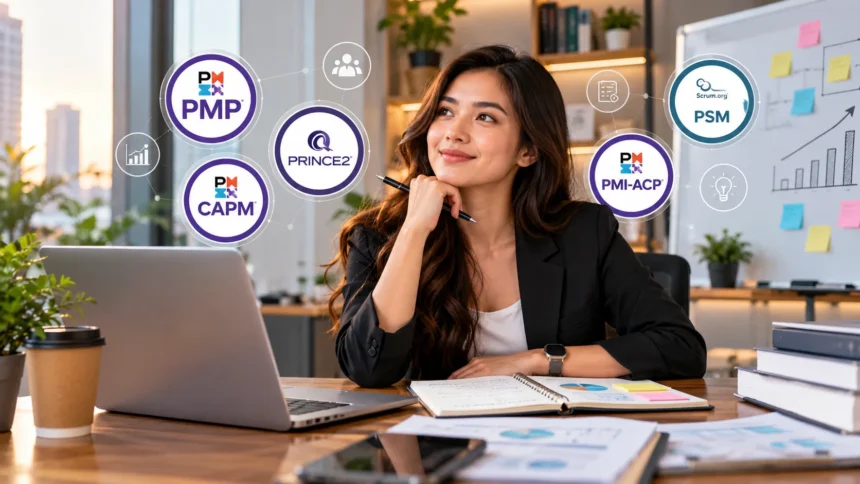
Project management has become an essential skill for professionals working in technology, construction, healthcare, finance, and many other industries. Organizations need qualified project managers who can coordinate teams, manage resources, control budgets, and deliver successful results. Earning one of the best project manager certifications for 2026 can help demonstrate your knowledge and strengthen your professional credentials.
Whether you are starting your career or already managing complex projects, professional certifications offer structured learning opportunities. Popular options include Project Management Professional (PMP), Certified Associate in Project Management (CAPM), PRINCE2, and Agile certifications. Each credential focuses on different skills, experience levels, and project management methodologies.
Choosing the right certification depends on your career goals, professional experience, preferred industry, and available budget. Some programs introduce project management fundamentals, while others validate advanced leadership and delivery capabilities. This guide explores the leading project management certifications in 2026, their benefits, eligibility considerations, and how to select the most suitable option.
Why Project Management Certifications Matter in 2026
Project management certifications help professionals demonstrate their understanding of planning, scheduling, budgeting, risk management, and team coordination. Employers may use recognized credentials to evaluate candidates for project management positions, particularly when comparing applicants with similar experience. Certification can also provide a structured learning path for individuals transitioning from technical or administrative roles into project leadership.
Modern projects increasingly involve remote collaboration, artificial intelligence, digital tools, and changing business requirements. Project managers must understand traditional planning methods alongside Agile and hybrid project management approaches. Professional certification programs can help candidates develop relevant knowledge while learning how to respond to uncertainty and changing stakeholder expectations.
However, certifications should complement practical experience rather than replace it. Employers also value communication, leadership, problem-solving, and the ability to deliver measurable results. Combining recognized project management credentials with hands-on experience can strengthen your professional profile and support long-term career development across different industries.
Project Management Professional (PMP) Certification
The Project Management Professional certification, offered by the Project Management Institute (PMI), is one of the most recognized credentials for experienced project managers. It validates knowledge of leading teams, managing project processes, and delivering business outcomes. PMP certification is particularly relevant for professionals seeking greater responsibility in project delivery, operations, consulting, and organizational leadership.
In July 2026, PMI introduced an updated PMP examination emphasizing business value, stakeholder engagement, artificial intelligence, and sustainability. The revised exam covers People, Process, and Business Environment, with greater attention given to strategic decision-making. Candidates generally need three to five years of qualifying project leadership experience, depending on their educational background and eligibility pathway.
PMP candidates must also meet the applicable project management training requirement, generally involving 35 hours of education or an accepted alternative. Certification holders maintain their credential by earning professional development units during each three-year renewal cycle. This certification is particularly suitable for experienced professionals pursuing project manager, senior project manager, or program leadership opportunities.
Certified Associate in Project Management (CAPM)
The Certified Associate in Project Management certification is designed for individuals beginning their project management careers. Offered by PMI, CAPM introduces fundamental concepts such as project planning, scheduling, requirements management, and delivery approaches. It can be a useful starting point for students, recent graduates, project coordinators, and professionals moving into project-related responsibilities.
Unlike PMP certification, CAPM does not require previous professional project management experience. Candidates must meet PMI’s education and eligibility requirements, including a secondary degree, a minimum age of 18, and 23 hours of project management education. The examination covers project management fundamentals, predictive methodologies, Agile frameworks, and business analysis concepts.
CAPM certification can help demonstrate foundational knowledge when applying for entry-level positions such as project coordinator or project management assistant. It also provides preparation for professionals who eventually plan to pursue PMP certification. However, practical experience remains important, so candidates should look for opportunities to participate in real projects while developing their skills.
PRINCE2 Project Management Foundation and Practitioner
PRINCE2 is a structured project management methodology used by organizations across different industries and regions. Its certification pathway includes Foundation and Practitioner qualifications, allowing professionals to progress from understanding the methodology to applying it. The current PRINCE2 Project Management Version 7 emphasizes principles, practices, processes, roles, and responsibilities involved in managing projects effectively.
PRINCE2 Foundation is suitable for beginners and professionals who want to understand structured project delivery. The Foundation examination evaluates knowledge of the methodology without requiring extensive previous project management experience. Successful candidates learn how projects are organized, controlled, monitored, and aligned with business objectives through clearly defined management processes.
PRINCE2 Practitioner focuses on applying and adapting the methodology to practical project scenarios. Candidates must satisfy an accepted prerequisite before attempting this advanced examination. These qualifications can be particularly useful when targeting organizations that use PRINCE2, especially in structured corporate, government, and consulting environments.
Certified ScrumMaster (CSM) Certification
Certified ScrumMaster, offered by Scrum Alliance, is a popular certification for professionals interested in Agile project delivery. It focuses on Scrum principles, team collaboration, iterative development, and continuous improvement. The credential is particularly relevant for people working with software teams, product development groups, and organizations using Scrum to manage complex work.
To earn CSM certification, candidates generally complete an approved Scrum Alliance training course and pass the associated examination. The training introduces Scrum roles, events, artifacts, and practical techniques for supporting effective teamwork. Participants also learn how Scrum Masters help teams address obstacles, encourage collaboration, and understand the responsibilities defined by the Scrum framework.
CSM certification can benefit aspiring Scrum Masters, Agile team members, project coordinators, and professionals supporting product development. Scrum Alliance certifications require periodic renewal, including applicable continuing education requirements and fees. Before enrolling, consider whether your target employers use Scrum and whether the instructor-led training format matches your learning preferences.
Professional Scrum Master I (PSM I) Certification
Professional Scrum Master I, offered by Scrum.org, provides another recognized pathway for professionals interested in Scrum. The certification validates understanding of the Scrum framework, including its accountabilities, events, artifacts, and underlying principles. It is suitable for aspiring Scrum Masters, software professionals, Agile practitioners, and project managers working with iterative delivery methods.
Unlike Certified ScrumMaster, PSM I does not require candidates to attend an official training course before taking the assessment. Individuals can prepare through self-study, practice questions, and optional professional training. The examination emphasizes a clear understanding of Scrum rather than simply completing a particular classroom program.
One practical advantage of PSM I is that Scrum.org certifications do not expire or require renewal fees. However, candidates should still continue learning as professional practices and organizational needs evolve. PSM I may be a suitable option for self-directed learners seeking an assessment-based Scrum credential without mandatory instructor-led training.
PMI Agile Certified Practitioner (PMI-ACP)
The PMI Agile Certified Practitioner certification is designed for professionals working with Agile methodologies and adaptive project delivery. Unlike certifications focused exclusively on Scrum, PMI-ACP addresses a broader range of Agile principles and practices. This makes it relevant for professionals working with Scrum, Kanban, Lean, and other approaches used to manage changing project requirements.
PMI-ACP emphasizes effective teamwork, stakeholder communication, continuous improvement, and delivering value through adaptive processes. Candidates must meet PMI’s current requirements for Agile experience and education, which may include alternative qualifying pathways. Professionals considering this certification should carefully review eligibility criteria before purchasing preparation courses or scheduling an examination.
This credential is particularly suitable for experienced Agile practitioners, project managers, and professionals managing cross-functional teams. It can complement broader project management knowledge by demonstrating competence in adaptive delivery methods. Organizations adopting Agile or hybrid approaches may find these skills useful when managing changing priorities, evolving products, and complex stakeholder needs.
Google Project Management Professional Certificate
The Google Project Management Professional Certificate is an accessible learning program for individuals exploring project management careers. Available through Coursera, it introduces planning, project documentation, stakeholder communication, budgeting, risk management, and Agile concepts. The program is designed for beginners and does not generally require previous project management experience or a university degree.
Students complete online learning modules that explain common project management responsibilities through videos, activities, and practical assignments. The curriculum introduces tools and documents used to organize work, communicate progress, and coordinate project teams. Because the learning is delivered online, participants can generally progress through the material according to their available study time.
This certificate can be useful for students, career changers, and professionals seeking foundational project management knowledge. However, it is a course-based professional certificate rather than the same type of examination-based credential as PMP or CAPM. Candidates should consider using the practical knowledge gained through the program to support further training and real-world experience.
CompTIA Project+ Certification
CompTIA Project+ is a project management certification aimed at professionals handling smaller or less complex projects. It is particularly relevant for individuals working in information technology, business operations, and technical support environments. The certification covers essential concepts related to project planning, resource management, communication, documentation, and project delivery.
Unlike some advanced project management certifications, CompTIA Project+ is intended for professionals with foundational project management responsibilities. Candidates learn how to define objectives, manage schedules, communicate with stakeholders, and respond to changes throughout the project lifecycle. Understanding these concepts can be useful for technical employees who coordinate projects alongside their primary responsibilities.
Project+ may appeal to IT specialists, team coordinators, and professionals who need practical project management knowledge without pursuing an advanced leadership credential immediately. Its value depends on employer expectations and the type of projects involved. Candidates should check the current examination version and certification policies before beginning their preparation.
Lean Six Sigma Green Belt Certification
Lean Six Sigma Green Belt certification focuses on improving processes, reducing defects, and solving organizational problems through data-driven methods. It is especially relevant to professionals working in manufacturing, healthcare, quality management, operations, and business improvement. Although it is not exclusively a project manager certification, it supports professionals who lead process improvement initiatives.
Green Belt training typically introduces Lean principles, process mapping, root cause analysis, performance measurement, and the DMAIC improvement framework. Candidates learn how to identify inefficiencies, evaluate performance problems, and develop measurable improvements. These skills can complement traditional project management practices when the primary objective involves improving operational quality or efficiency.
Different organizations offer Lean Six Sigma credentials, and their examination requirements can vary significantly. For example, the American Society for Quality requires relevant work experience for its Certified Six Sigma Green Belt qualification. Before enrolling, review the certification provider’s credibility, eligibility standards, assessment process, and recognition within your intended industry.
How to Choose the Best Project Manager Certification
Choosing the right project management certification begins with understanding your current experience and professional goals. Beginners may benefit from CAPM, PRINCE2 Foundation, or an introductory Google certificate. Experienced project managers may find PMP more appropriate, while professionals interested in Agile delivery might consider CSM, PSM I, or PMI-ACP.
Your industry should also influence your decision because employers value different methodologies and credentials. Technology organizations may emphasize Scrum and Agile knowledge, while structured organizations may prefer PRINCE2 or PMP. Professionals specializing in quality improvement may benefit from Lean Six Sigma, while technical coordinators could find CompTIA Project+ more directly relevant.
Before selecting a program, compare entry requirements, course content, examination difficulty, costs, renewal obligations, and employer preferences. Reviewing relevant job descriptions can help identify which certifications appear most frequently in your target roles. Choose a credential that develops useful skills and supports your intended career direction rather than collecting certifications without a clear purpose.
Project Management Certification Costs and Preparation
Project management certification costs depend on the provider, examination fees, training format, membership discounts, and required learning materials. Some credentials allow independent preparation, while others require approved instructor-led training. Candidates should consider the complete investment, including examination attempts, practice tests, course materials, and future renewal expenses, before making their decision.
Preparation time also varies according to experience and the complexity of the examination. Beginner programs may be manageable alongside regular studies or work, while advanced credentials often require a more structured preparation schedule. Creating a study plan with realistic milestones, topic reviews, and practice assessments can help candidates understand difficult concepts and identify knowledge gaps.
Practical application is an important part of successful project management training. Instead of memorizing terminology alone, practice creating project schedules, identifying risks, preparing communication plans, and evaluating project scenarios. Since certification requirements and fees can change, always verify the latest examination policies and training rules directly with the issuing organization before registering.
Conclusion
The best project manager certifications for 2026 provide different opportunities depending on professional experience, career interests, and industry requirements. PMP is a strong option for experienced project managers, while CAPM and PRINCE2 Foundation provide accessible pathways for developing foundational knowledge. Agile certifications such as CSM, PSM I, and PMI-ACP are valuable considerations for professionals working with adaptive teams.
Selecting a suitable certification requires more than comparing popularity or potential career benefits. Consider the knowledge you want to develop, the projects you hope to manage, and the credentials recognized by your target employers. A carefully chosen program can help strengthen your professional qualifications while providing practical concepts that support project delivery.
Ultimately, certification works best when combined with communication skills, leadership abilities, practical experience, and continuous professional development. Begin with a credential that matches your current career stage and build additional expertise as your responsibilities expand. With consistent learning and hands-on experience, project management certification can become a useful investment in your long-term professional growth.
Frequently Asked Questions
Which Project Management Certification Is Best in 2026?
PMP is a strong choice for experienced project managers seeking broad professional recognition. Beginners may prefer CAPM or PRINCE2 Foundation, while Agile professionals can consider CSM, PSM I, or PMI-ACP.
Can Beginners Get a Project Management Certification?
Yes, beginners can pursue options such as CAPM, PRINCE2 Foundation, and the Google Project Management Professional Certificate. Each program has different requirements, so candidates should review eligibility and learning objectives before enrolling.
Is PMP Certification Worth It in 2026?
PMP can be valuable for experienced professionals seeking project leadership opportunities and recognized credentials. Its usefulness depends on employer expectations, career objectives, preparation costs, and relevant professional experience.
What Is the Difference Between PMP and PRINCE2?
PMP validates broader project leadership knowledge across different delivery approaches. PRINCE2 focuses on understanding and applying a structured project management methodology, making the better choice dependent on industry and employer preferences.
How Long Does It Take to Get Project Management Certified?
Completion time depends on the credential, previous knowledge, training requirements, and examination preparation. Introductory programs may take several weeks or months, while advanced certifications require qualifying experience and more extensive preparation.