


Gen AI vs AI: What Is the Difference Between Generative AI and AI?
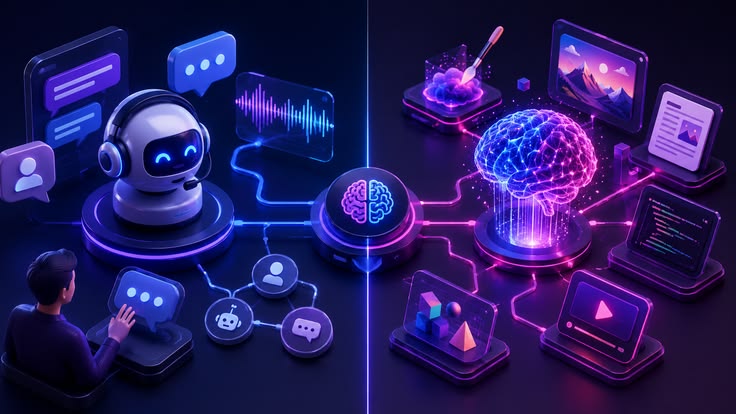
Artificial intelligence has been part of technology for decades, but the rise of generative AI has introduced a new way of thinking about what machines can accomplish. While traditional AI systems are often designed to analyse information, recognise patterns, make predictions, or automate decisions, generative AI can create new content based on an input or instruction. Understanding this distinction is becoming increasingly important for businesses, students, developers, and professionals considering gen ai training.
Although the terms AI and Gen AI are sometimes used interchangeably, they do not mean exactly the same thing. Generative AI is actually a subset of artificial intelligence. The difference becomes clearer when you look at what each technology is designed to do, how it produces results, and where organisations use it.
This guide compares AI and Gen AI in simple terms and explains their differences, similarities, applications, advantages, limitations, and future significance.
What Is Artificial Intelligence?
Artificial intelligence is a broad field of computer science focused on developing systems that can perform tasks that traditionally require aspects of human intelligence.
These tasks can include:
- Recognising patterns
- Understanding language
- Classifying information
- Making predictions
- Detecting anomalies
- Recommending products
- Supporting decisions
- Interpreting images
- Controlling automated systems
AI does not necessarily need to generate something new. A system that identifies whether a transaction is potentially fraudulent is using AI even though it is not creating an article, image, or piece of music.
This broad definition is important because it shows that generative AI is only one part of the larger artificial intelligence landscape.
What Is Generative AI?
Generative AI is a category of AI designed to produce new content.
Depending on the underlying model, it can generate:
- Text
- Images
- Computer code
- Audio
- Video
- Summaries
- Synthetic data
A generative AI system receives an input, processes the available context, and produces an output based on patterns learned during training.
For example, a traditional AI system might determine whether an email is spam. A generative AI system could draft a response to an email.
Both involve artificial intelligence, but their purposes are different.
AI vs Gen AI: The Basic Difference
The simplest way to understand the relationship is:
Artificial Intelligence is the broader field, while Generative AI is a specialised area within it.
Think of AI as a large umbrella that includes many different technologies and approaches. Generative AI sits underneath that umbrella alongside other areas such as computer vision, robotics, recommendation systems, predictive modelling, and speech recognition.
| Aspect | Artificial Intelligence | Generative AI |
| Meaning | Broad field of intelligent computing | AI focused on generating new content |
| Primary purpose | Analyse, predict, classify, recommend or automate | Create content based on learned patterns |
| Typical output | Prediction, classification or decision | Text, image, code, audio or video |
| Examples | Fraud detection, recommendations, forecasting | AI assistants, image generators, code generators |
| Common models | Classification and prediction models | Language models, diffusion models and other generative architectures |
| Human interaction | Can operate automatically | Often works through prompts or other inputs |
The distinction is useful, but the boundaries are not always rigid. Some AI systems can perform both analytical and generative tasks.
How Traditional AI Works
Traditional AI systems can be designed using different approaches depending on the problem.
A simplified predictive AI workflow might look like:
Data → Training → Pattern recognition → Prediction → Decision
Suppose a bank wants to identify potentially fraudulent transactions. The system can be trained using historical examples and then assign a risk score to new transactions.
The output might be:
Transaction → 92% fraud risk
The system has analysed information and made a prediction. It has not generated an essay or image.
Other examples include systems that predict customer churn, recommend products, detect manufacturing defects, or estimate demand.
How Generative AI Works
Generative AI follows a different type of workflow.
A simplified example is:
Training data → Model learning → Prompt/input → Generation → Output
During training, the model learns patterns from large amounts of information.
When a user provides an instruction, the model uses the input and available context to generate a response.
For language models, this involves predicting sequences of tokens based on the context provided.
For image-generation systems, the underlying process is different, but the broader concept remains similar: the model has learned patterns that allow it to generate new outputs.
Does Generative AI Think Like a Human?
The impressive quality of modern AI outputs can make it appear as though a system is thinking in the same way a human does.
That interpretation can be misleading.
Generative AI models process inputs and generate outputs using mathematical and computational mechanisms learned during training. Their ability to produce coherent responses does not mean they possess human consciousness, emotions, or personal experiences.
This distinction matters when evaluating AI systems.
A model can produce a highly convincing explanation while still making an incorrect statement. Users therefore need to evaluate outputs rather than assuming that fluency guarantees accuracy.
Examples of Traditional AI
Traditional AI is already present in many everyday technologies.
Recommendation Systems
Streaming platforms and online retailers can analyse user behaviour to recommend products or content.
Fraud Detection
Financial institutions can use AI systems to identify unusual transaction patterns and flag potentially suspicious activity.
Predictive Maintenance
Industrial organisations can analyse equipment data to identify signs that a machine may require maintenance.
Image Classification
Computer vision systems can classify objects, detect defects, or identify patterns in images.
Demand Forecasting
Businesses can use predictive models to estimate future demand based on historical information and other variables.
These applications demonstrate that AI does not have to generate content to be considered artificial intelligence.
Examples of Generative AI
Generative AI has a different set of common applications.
Text Generation
Language models can generate:
- Articles
- Emails
- Summaries
- Reports
- Product descriptions
- Explanations
Code Generation
AI systems can generate programming examples, explain code, create tests, and assist developers with debugging.
Image Creation
Generative models can produce images from textual descriptions or transform existing visual content.
Audio Generation
AI can generate or transform speech and other audio content for applications such as accessibility, media, and virtual assistants.
Video Creation
Emerging generative systems can create or modify video based on text and other inputs.
The rapid expansion of these applications is one reason Gen AI has attracted significant attention from businesses and technology professionals.
Why Did Gen AI Become So Popular?
Generative AI existed before the recent wave of public interest, but several developments accelerated its adoption.
Advances in Model Architecture
Modern neural network architectures have enabled models to process increasingly complex relationships within data.
Increased Computing Power
Large-scale computing infrastructure has made it possible to train and operate increasingly capable models.
Access to Large Datasets
Training models on extensive datasets allows them to learn complex patterns across language, images, code, and other information.
User-Friendly Interfaces
Conversational interfaces have made advanced AI technology accessible to people without specialised technical knowledge.
Instead of writing complex code, users can often describe what they want using ordinary language.
Gen AI and Machine Learning: How Are They Connected?
Machine learning is another important term to understand.
Machine learning is a branch of AI in which systems learn patterns from data rather than relying entirely on explicitly programmed rules.
Generative AI can use machine learning techniques to learn how to generate content.
The relationship can therefore be simplified as:
Artificial Intelligence → Machine Learning → Deep Learning → Generative AI
This is an oversimplification because the boundaries and classifications can vary, but it provides a useful conceptual framework for beginners.
Generative AI can involve deep neural networks and specialised architectures designed for generation.
What Are Large Language Models?
Large language models, or LLMs, are a major category within generative AI.
They are designed to process and generate language.
An LLM can support applications such as:
- Conversational assistants
- Search interfaces
- Summarisation
- Translation
- Coding assistance
- Content generation
- Information extraction
Modern language models can process context and generate responses that appear conversational.
However, they can still produce inaccurate information, so outputs should be validated when accuracy matters.
Gen AI vs AI in Business
The difference between the two technologies becomes especially useful when considering business applications.
Traditional AI is often valuable when a company needs to predict, classify, score, detect, or recommend.
Generative AI can be valuable when a company needs to create, summarise, transform, explain, or interact with information.
For example, an insurance company could use traditional AI to identify claims that require additional review.
The same company might use generative AI to summarise claim documents for employees.
In practice, organisations can combine both approaches.
Where Data Fits Into AI and Gen AI
Both traditional AI and generative AI depend heavily on data.
A predictive model requires suitable data for training and evaluation. A generative application may require training data as well as external information that can be supplied during use.
Enterprise AI systems can involve databases, cloud storage, APIs, document repositories, data pipelines, and retrieval systems.
This is one area where data engineering supports AI initiatives by helping organisations collect, process, organise, and deliver information to the systems that need it.
The quality, availability, and governance of data can therefore influence the effectiveness of an AI implementation.
Advantages of Traditional AI
Traditional AI remains extremely useful because many business problems are fundamentally predictive or analytical.
Efficient Decision Support
AI can process large amounts of information and identify patterns that may be difficult to detect manually.
Automation
Repetitive classification and prediction tasks can be automated.
Consistent Processing
A properly designed system can apply the same analytical rules across large volumes of data.
Real-Time Detection
Some AI systems can process information continuously and flag unusual activity quickly.
These advantages explain why traditional AI continues to be important even as Gen AI receives significant attention.
Advantages of Generative AI
Generative AI provides a different set of benefits.
Faster Content Creation
AI can assist with drafting and transforming content.
Natural-Language Interaction
Users can communicate with applications using conversational language.
Knowledge Assistance
AI can help users retrieve, summarise, and explain large amounts of information.
Developer Productivity
Generative systems can assist with coding, documentation, testing, and software development tasks.
Personalisation
AI-generated responses can potentially be adapted to different users, contexts, and requirements.
The actual benefits depend on the use case and how the system is implemented.
Limitations of AI
Traditional AI systems have their own challenges.
They can suffer from:
- Poor-quality training data
- Incomplete datasets
- Biased data
- Model drift
- Incorrect predictions
- Lack of transparency
- Integration difficulties
A model can perform well in a controlled testing environment but behave differently when real-world conditions change.
Monitoring and regular evaluation are therefore important.
Limitations of Generative AI
Generative AI introduces additional concerns.
Hallucinations
A model may produce information that sounds convincing but is factually incorrect.
Inconsistency
The same prompt may not always result in exactly the same output.
Security Risks
AI applications can be exposed to attacks such as prompt injection and inappropriate information access.
Privacy Concerns
Organisations must carefully consider what information is provided to external or internal AI systems.
Copyright and Content Concerns
Businesses also need appropriate policies for using generated material and handling intellectual property considerations.
These limitations do not make Gen AI unusable. They highlight the importance of appropriate controls and evaluation.
Which Is Better: AI or Gen AI?
There is no universal winner because the technologies solve different categories of problems.
If the goal is to forecast demand, detect suspicious activity, classify images, or predict customer behaviour, traditional AI techniques may be appropriate.
If the goal is to generate content, summarise documents, create conversational experiences, or assist with software development, generative AI may be more suitable.
In many real-world systems, the answer is both.
An organisation could use predictive AI to determine what information is important and generative AI to explain that information to employees.
How Businesses Can Combine AI and Gen AI
Combining different AI capabilities can create more powerful workflows.
Consider a customer-support platform.
A traditional AI component could identify the category of a customer’s issue.
A retrieval system could find relevant documentation.
A generative AI model could then create a natural-language response based on the retrieved information.
The overall workflow might look like:
Customer message → Classification → Information retrieval → Generative model → Response
This illustrates why modern AI applications are often built from multiple components rather than a single model.
Skills Needed to Work With Gen AI
Professionals interested in Gen AI should develop skills according to their intended role.
For application development, useful areas include:
- Python
- APIs
- LLM fundamentals
- Prompt design
- Embeddings
- RAG
- Vector databases
- Cloud platforms
- Application development
- AI evaluation
For deeper AI engineering roles, additional knowledge of machine learning, deep learning, mathematics, model training, and optimisation may be required.
Understanding traditional AI concepts can also be beneficial because it provides context for how different AI techniques can work together.
How to Start Learning Gen AI
The best starting point depends on your current background.
A non-technical professional might begin by understanding basic AI concepts and experimenting with generative tools.
A software developer can move more quickly into APIs, LLM integration, RAG, and application development.
A machine learning professional may choose to explore model architecture, fine-tuning, evaluation, and inference optimisation.
Rather than trying to learn every AI technology at once, focus on the skills that support your intended career or business use case.
The Future of AI and Gen AI
The distinction between traditional AI and generative AI may become less obvious as systems become more capable.
Future applications may combine:
- Predictive models
- Generative models
- Retrieval systems
- Computer vision
- Speech recognition
- External tools
- Automated workflows
An AI system could potentially analyse information, make a prediction, retrieve supporting evidence, generate an explanation, and initiate an action within a controlled workflow.
This convergence could make AI applications more useful while also increasing the importance of governance, security, evaluation, and human oversight.
Why Understanding the Difference Matters
Knowing the difference between AI and Gen AI helps professionals make better technology decisions.
It prevents organisations from assuming that every business problem requires a language model.
It also helps learners choose relevant skills.
Someone interested in predictive analytics may benefit from studying machine learning and statistics. Someone interested in AI applications may focus more heavily on LLMs, APIs, retrieval, and software development.
The terminology may continue to evolve, but understanding the underlying concepts provides a more reliable foundation.
Final Verdict
AI and Gen AI are closely connected, but they are not interchangeable terms. Artificial intelligence is the broader field that includes systems capable of prediction, classification, recognition, recommendation, automation, and many other tasks. Generative AI is a specialised area focused on producing new content such as text, images, code, audio, and video.
Neither approach is automatically better than the other. The right technology depends on the problem being solved. As organisations build increasingly sophisticated applications, traditional AI, generative models, retrieval systems, and other technologies are likely to work together rather than compete.
For professionals who want to understand this evolving landscape, developing strong fundamentals is more valuable than following every new AI trend. Structured learning can help build that foundation and provide practical exposure to real applications. If you want to explore ways to develop relevant Gen AI skills, contact us to learn more about suitable learning opportunities.
Frequently Asked Questions
1. Is Gen AI the same as AI?
No. AI is the broader field of artificial intelligence, while Gen AI is a subset focused on generating new content. Generative AI is therefore part of the larger AI ecosystem.
2. What is the main difference between AI and Gen AI?
Traditional AI is often used to analyse, classify, predict, detect, or recommend. Gen AI is designed primarily to create new outputs such as text, images, code, audio, and video.
3. Is ChatGPT an example of Gen AI?
Yes. ChatGPT is an example of an application built around generative AI technology, particularly language models capable of generating and processing text.
4. Is machine learning the same as generative AI?
No. Machine learning is a broader approach within AI where systems learn patterns from data. Generative AI can use machine learning and deep learning techniques to generate new content.
5. Which is better for businesses, AI or Gen AI?
Neither is universally better. Traditional AI can be appropriate for prediction, classification, and detection, while Gen AI can be useful for content generation, summarisation, and conversational applications. Businesses may use both.
6. Can traditional AI and Gen AI work together?
Yes. A business application can use traditional AI for classification or prediction and Gen AI for generating explanations, summaries, or responses based on the results.
7. Do I need coding skills to learn Gen AI?
Coding is not necessary for basic use of many generative AI tools. However, programming becomes important for professionals who want to build, integrate, deploy, or customise Gen AI applications.
8. What should I learn for a Gen AI career?
Depending on your target role, useful skills can include Python, machine learning fundamentals, LLMs, APIs, prompt design, embeddings, RAG, vector databases, cloud computing, evaluation, and software development.
9. Why is data important for Gen AI?
Data influences how models are trained and can provide additional context for applications. Enterprise systems may also need reliable pipelines and information retrieval mechanisms to supply relevant data to AI applications.
