



Reading the Terms and Conditions Properly
The decisions that you make, at least commercially, should balance impulses and caveats. You may want something so bad that you’re willing to accept some clauses that may not be really conducive or fitting for the fairest experience. However, the lengths to which you’d go when deciding what to accept have their limits.
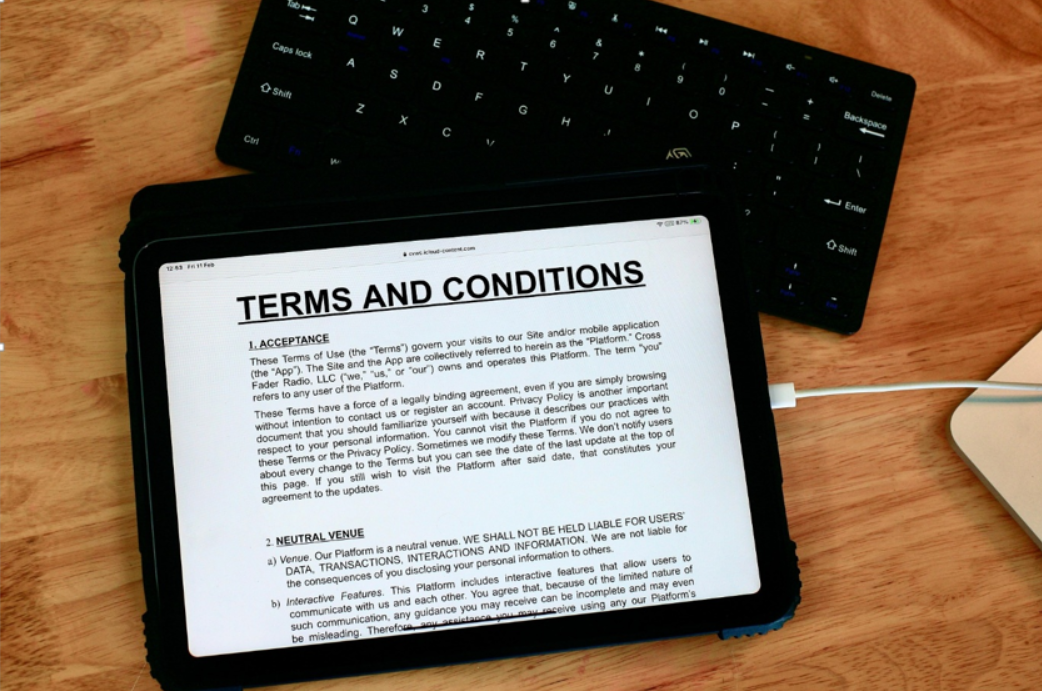
This is why reading the terms and conditions is what gives you the ability to make these decisions after weighing the pluses and minuses. They are binding content that communicates your rights and obligations.
At the same time, they are hard to read, which makes the process of consulting them a genuine chore. If you get the feeling that they are not for a consumer to read, then you’re somewhat correct.
Their purpose is to set up a reality in which any breach of these terms allows them to be right in the case of a legal dispute. If it’s a clause in the term, not respecting it on the user, then there is no liability.
While difficult, going through such a set of fine print is not impossible. It takes a few fundamental principles and patience, both of which can teach discipline. Let’s see how they go.
The method begins with the simplest of actions: actually reading the terms and conditions
The difference between scrolling to the end of the terms to find the agreement button and reading them is immense, not because of the possible drawback of it, but because it shows a lack of importance paid to this process.
As far back as an Obard and Oeldorf-Hirsch study, findings suggested that 98% of those who participated in the test missed planted clauses that were as absurd as handing over their first-born child. The test subjects who actually read the terms of use and privacy policies took 51 seconds to go through the former and 73 seconds to read the latter.

The study was published in 2016 and used a 543-person sample size, all of whom were undergraduate students. Theoretically, they were people who, one could think, would be able to traverse such texts.
What this tells us is that reading the terms and conditions and accompanying policies is far from a given. Naturally, it’s irresponsible to look at one study and use it as an instrument to definitely say that this is how everybody behaves.
However, it is an anecdotal reminder that whenever you skip the terms and conditions, you put yourself in a vulnerable position, especially if there’s a dispute over rules you signed off on.
Assessing face value before embarking on the hunt for details
This is where the concept of ‘dark patterns’ comes in. Per the FTC’s report on dark patterns, they are design practices that manipulate a consumer into choices with harmful effects that the user wouldn’t otherwise make.
It may be textbook manipulation, but the practice itself is not necessarily illegal when considering the active legislation.
For example, in the UK, the Consumer Rights Act of 2015 makes both the price and main subject matter exempt from the fairness test if they’re provided prominently and transparently. A casino bonus of 50 free spins on registration tells you that you get the rounds, their wagering, and cashout, but they may not tell you from the jump that you need to make a verification deposit before you can cash out any winnings.
This is where the practice of reading the terms correctly comes in. You have an idea that you’ve built based on the face value: what you get and how you get it. However, the caveats can go in many different ways. Not all of them are front-and-center, which is the main issue with any endeavor in which the terms and conditions can be deceiving.
So you start looking for any detail and clue. If there are numbers anywhere, then you want to be as careful as possible with the calculations. They may tell you if there are any additional costs that are not necessarily hidden, but they are outright buried within hundreds of lines of written content.
Then you start comparing. If I get the bonus, then do I have to make a payment? If I have an account, will I have to pay administration fees? If I disagree with a decision, do I have any recourse or mechanism to receive proof?
These can be details that make a difference, and making your way methodically through them is how you go from face value to the real meaning behind these miles upon miles of written text that may look like legal gibberish.
Dealing with the boilerplate is the key to understanding the terms
Boilerplate has numerous applications, but its meaning tells the same thing: it’s a standardized method. In our case, it refers to the verbiage used in terms and conditions, most of which are similar or identical across different entities. They say the same thing and follow the same practices, bringing uniform language to these clauses.
For a consumer who goes through these terms, it can turn really tedious because of the repetitiveness. It brings fatigue that grinds patience into a fine powder, which is a reason why it’s not conducive to understanding the terms. It’s also not a deliberate method of redacting these clauses since they are the way they are for legal reasons.
So, in the context of reading the terms, what you need is a mix of patience and experience. You can even say that patience comes from experience. The more you read them, the less tiring these clauses feel once you understand their meaning and learn to go through them quickly.
As you develop your antibodies against this tedium, anything that is outside of the ordinary will stand out and require a more profound level of attention. That’s when you’ll start balancing the effort you put into boilerplate versus the effort you put into priority details.
Following the flow and structure of the terms requires an understanding of what matters in there
Depending on what you’re signing up for, your priorities can differ. The structure and the flow of a page with terms and conditions will begin with the parties involved, the liabilities, and what your obligations are.

As each detail regarding operation receives its own section or paragraph in the terms, you may find that the most consequential entries are not at the start of a section, but somewhere in the middle or toward the end. If the first paragraph bores you, then you might go to the next section and miss the actual details.
The thing with these policies is that you need to recognize that each section has its own flow. It tells you what the company does, what you need to do, and where the conflict may lie, especially if it can cause some form of punishment, such as getting restricted or banned.
Even if you take more time than you’d like, remember what we said about patience. Each section in a privacy policy or terms and conditions is a battle of its own, and an optimal way would be to segment your effort.
Conclusion
That’s about all we wanted to say. Given that we’ve mentioned the gambling angle as an example, we should remind you to gamble only if you are of legal age, to do it responsibly, and to consider seeking help or self-restrict with the help of organizations like BeGambleAware or GamStop.