


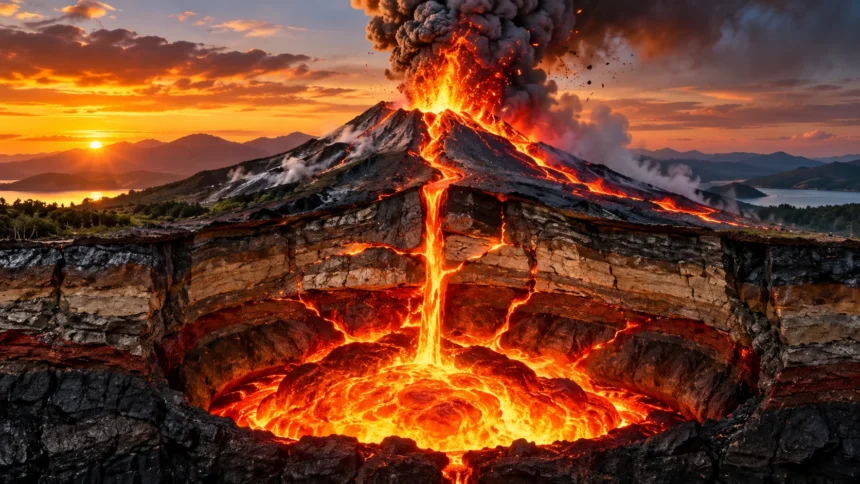
Volcanoes are among the most fascinating natural features on Earth, capable of releasing molten rock, gases, and volcanic ash from deep beneath the surface. Their eruptions can create new landscapes, reshape mountains, and significantly affect surrounding environments. Although volcanic activity may appear sudden, the processes responsible for eruptions often develop underground over extended periods.
Understanding why volcanoes erupt and what happens underground helps explain how Earth’s internal heat, moving tectonic plates, and rising magma interact. Deep beneath volcanic regions, molten rock collects, gases expand, and pressure changes as magma moves toward the surface. These geological processes determine when volcanic activity occurs and whether an eruption produces flowing lava, explosive ash clouds, or a combination of both.
1. What Is a Volcano and Why Does It Erupt?
A volcano is an opening or system of openings in Earth’s crust through which molten rock, volcanic gases, and other materials can reach the surface. Many volcanoes form mountains as erupted material accumulates over time, although some appear as broad slopes or volcanic fields. Their shape depends on the magma involved, eruption history, and surrounding geological conditions.
Volcanoes erupt when magma rises from underground regions and reaches the surface through fractures or volcanic conduits. Changes in pressure, magma supply, and dissolved gases can contribute to this movement. As magma approaches shallower depths, expanding gases may help drive an eruption, while the surrounding rock and magma’s physical properties influence how easily material escapes.
Not every volcano erupts frequently, and some remain inactive for thousands of years between major events. Volcanic activity depends on continued magma production, underground pathways, and changing geological conditions. Scientists study these factors to understand how volcanoes develop and why some experience repeated eruptions while others gradually lose their connection to active magma sources.
2. How Does Magma Form Deep Inside Earth?
Magma forms when certain rocks beneath Earth’s surface partially melt under suitable temperature, pressure, and chemical conditions. Although Earth’s interior contains enormous amounts of heat, most of the mantle remains solid rather than completely molten. Magma develops in specific regions where conditions allow some minerals within the surrounding rock to melt.
One important process is decompression melting, which occurs when hot mantle rock rises and experiences decreasing pressure. This pressure reduction can allow some rock to melt without requiring a major increase in temperature. Decompression melting commonly occurs beneath divergent tectonic boundaries and certain volcanic hotspots, where mantle material moves upward toward shallower regions.
Another important process involves water and other volatile substances entering hot mantle rocks. These substances can lower the temperature at which certain minerals begin melting, allowing magma to form under existing conditions. This process is particularly important in subduction zones, where descending oceanic plates release water into the overlying mantle.
3. How Do Tectonic Plates Cause Volcanic Eruptions?
Earth’s outer rocky shell is divided into tectonic plates that move slowly across the planet’s surface. Their movement creates many of the geological conditions associated with volcanic activity, including crustal stretching and subduction. These processes can encourage magma formation and provide pathways through which molten material eventually reaches the surface.
At divergent plate boundaries, tectonic plates move away from each other, allowing hot mantle material to rise. As the mantle rises, pressure decreases and partial melting can produce magma. This process commonly occurs along mid-ocean ridges, where volcanic activity creates new oceanic crust and gradually changes the structure of the seafloor.
At convergent boundaries, one tectonic plate may descend beneath another in a process called subduction. Water released from the descending plate promotes melting in the mantle above it, generating magma that can feed volcanoes. This explains why many active volcanoes occur around the Pacific Ring of Fire, where several tectonic boundaries interact.
4. What Happens Inside a Volcano Before an Eruption?
Before an eruption, magma may accumulate within underground storage regions located beneath the volcano. These areas are commonly called magma chambers or magma reservoirs, although many contain interconnected pockets of molten and partially solid rock rather than one enormous liquid cavity. Their depth, size, temperature, and composition vary considerably between volcanic systems.
Fresh magma entering a reservoir can change the temperature, chemical composition, and pressure of the existing material. As magma accumulates, surrounding rocks may deform slightly, sometimes causing ground swelling or small earthquakes. These changes can indicate movement within the volcanic system, although they do not always mean an eruption is about to happen.
Magma may also cool, crystallize, or mix with additional molten rock while remaining underground. Crystals forming within the magma can change its physical properties and influence how it eventually erupts. Understanding these processes helps volcanologists explain why some volcanoes produce relatively fluid lava while others generate thick magma associated with more explosive activity.
5. How Do Gas and Pressure Trigger Volcanic Eruptions?
Volcanic magma contains dissolved gases, including water vapor, carbon dioxide, and sulfur dioxide. Deep underground, high pressure allows significant amounts of these gases to remain dissolved within molten rock. As magma moves toward Earth’s surface, the surrounding pressure decreases, allowing dissolved gases to separate and form bubbles.
This process resembles what happens when pressure is released from a carbonated drink, although volcanic systems are much more complicated. Gas bubbles may expand as magma rises, increasing its volume and influencing the movement of molten material. If gases cannot escape easily, the expanding bubbles can contribute to pressure buildup and fragmentation of the magma.
Gas pressure is an important eruption mechanism, but it is not the only factor controlling volcanic activity. Magma viscosity, temperature, chemical composition, and the structure of underground pathways also influence eruption behavior. In some volcanoes, gases escape gradually, allowing relatively gentle lava eruptions, while trapped gases can contribute to violent explosive events.
6. Why Are Some Volcanic Eruptions Explosive?
The intensity of a volcanic eruption depends partly on the viscosity, or resistance to flow, of the magma. Low-viscosity magma generally moves more easily, allowing gases to escape without producing extreme pressure. High-viscosity magma resists movement and can trap expanding gas bubbles, increasing the potential for explosive eruptions when pressure is released.
Magma containing relatively high silica concentrations often has greater viscosity than magma with lower silica content at comparable temperatures. Rhyolitic and some andesitic magmas can therefore produce explosive eruptions, depending on their gas content and other conditions. Basaltic magma is generally more fluid and commonly produces lava flows, although basaltic eruptions can also become explosive.
External water can also influence eruption intensity when it interacts rapidly with hot magma. Under certain conditions, this interaction generates expanding steam and fragments volcanic material, producing explosive activity. Scientists therefore examine magma composition, gas content, temperature, and surrounding groundwater conditions when evaluating the potential behavior of an active volcano.
7. How Does Magma Travel From Underground to the Surface?
Magma usually rises because it is less dense than the surrounding solid rock and because pressure conditions allow it to move. Its journey may involve fractures, narrow conduits, and underground sheets called dikes. These pathways connect deeper magma storage regions with shallower portions of the crust, sometimes allowing molten material to approach the surface.
As magma moves upward, it can fracture surrounding rocks and cause small earthquakes. Some magma travels directly toward a volcanic vent, while other material becomes trapped within underground formations. These intrusions may cool and solidify without erupting, contributing to new geological structures beneath Earth’s surface rather than producing visible volcanic activity.
The final pathway depends on the strength of surrounding rocks, local stresses, and available fractures. Magma may emerge from a central crater or escape through cracks along a volcano’s sides. In some regions, long fissures release lava across the landscape, demonstrating that eruptions do not always occur through a single mountain-shaped opening.
8. What Happens When a Volcano Finally Erupts?
During an eruption, magma reaches Earth’s surface and becomes known as lava when it flows across the ground. Depending on the eruption style, a volcano may release lava, ash, gases, and fragmented volcanic rock. Some eruptions continue relatively steadily, while others involve powerful bursts that send volcanic material high into the atmosphere.
Explosive eruptions can produce ash columns containing tiny fragments of rock, minerals, and volcanic glass. These particles may travel considerable distances depending on atmospheric conditions and eruption strength. Some volcanoes also generate pyroclastic flows, which are rapidly moving mixtures of hot gases and volcanic particles that create serious hazards near affected areas.
Lava flows can cover roads, vegetation, and buildings as molten material moves downhill or across suitable terrain. Their movement depends on temperature, viscosity, eruption rate, and local topography. After an eruption, cooling lava and deposited volcanic materials gradually form new rock, changing the surrounding landscape and sometimes creating entirely new areas of land.
9. What Are the Warning Signs of a Volcanic Eruption?
Many volcanoes show measurable changes before an eruption, although the warning signs differ between volcanic systems. Increased earthquake activity, ground deformation, changes in volcanic gas emissions, and unusual temperature patterns may indicate movement underground. Scientists monitor these signals to understand whether magma is approaching the surface or whether other geological processes are occurring.
Volcanic earthquakes can develop when moving magma fractures surrounding rock or changes underground pressure conditions. Instruments called seismometers help scientists detect these movements, including vibrations that people may not notice. Ground-based sensors and satellite measurements can also identify subtle changes in the volcano’s shape, providing additional evidence about activity beneath the surface.
Gas monitoring offers another important source of information because changing emissions can reflect developments within a magma system. However, no single observation can reliably predict every eruption. Volcanologists combine multiple measurements, historical information, and geological models to assess hazards, recognizing that some volcanoes erupt with limited warning while others show unrest without erupting.
10. How Do Volcanic Eruptions Affect Earth and the Environment?
Volcanic eruptions can transform landscapes by creating mountains, covering existing terrain, and building new land. Repeated eruptions gradually accumulate layers of lava and fragmented volcanic material, producing different volcanic landforms. In some oceanic regions, sustained volcanic activity has created islands, demonstrating how processes originating underground can reshape Earth’s surface over geological timescales.
Volcanic activity can also influence atmospheric conditions, particularly during powerful explosive eruptions. Sulfur dioxide released into the atmosphere may form tiny sulfate particles that reflect some incoming sunlight. When sufficient material reaches the stratosphere, these particles can temporarily cool Earth’s surface, although the overall effect depends on eruption size and atmospheric conditions.
Despite their destructive potential, volcanoes also contribute to important natural processes. Weathered volcanic rocks can provide minerals that support soil development, while geothermal activity offers useful sources of underground heat. Volcanic landscapes may eventually support diverse ecosystems, illustrating how geological processes can create both immediate hazards and long-term environmental opportunities.
11. Can Scientists Predict Volcanic Eruptions and Reduce Their Risks?
Scientists cannot predict the exact time and size of every volcanic eruption, but modern monitoring systems can help identify developing hazards. By analyzing earthquakes, ground movement, gas emissions, and past eruption patterns, volcanologists estimate how a volcanic system is behaving. These assessments can support warnings and preparedness decisions when dangerous activity becomes more likely.
Volcanic hazard maps identify areas potentially affected by lava flows, falling ash, and other eruption-related dangers. Communities use this information to develop evacuation plans, emergency procedures, and public communication systems. The most effective precautions depend on the specific volcano because surrounding geography, eruption history, and local population patterns influence the types of hazards people may face.
People living near active volcanoes should follow guidance from official monitoring agencies and local emergency authorities. Preparing essential supplies, understanding evacuation routes, and paying attention to verified alerts can reduce avoidable risks. Although eruptions cannot be prevented, scientific monitoring and community preparedness can help protect people and reduce the consequences of volcanic emergencies.
Conclusion
Volcanoes erupt because geological processes beneath Earth’s surface allow magma to form, rise, and sometimes escape through openings in the crust. Tectonic plate movement, changes in pressure, dissolved volcanic gases, and underground rock conditions all influence this activity. Understanding these processes explains why volcanoes behave differently and why eruptions can range from flowing lava to powerful explosions.
Deep underground, magma may accumulate in reservoirs, interact with surrounding rocks, and travel through fractures before reaching the surface. As pressure decreases during its journey, dissolved gases can form expanding bubbles that influence eruption behavior. Scientists study these underground changes using monitoring instruments, laboratory analysis, and geological observations to understand how volcanic systems develop over time.
Volcanoes demonstrate the powerful connection between Earth’s internal processes and the landscapes visible at its surface. Although eruptions can create serious environmental and safety challenges, volcanic activity also builds new land and contributes to long-term geological change. Learning why volcanoes erupt helps us appreciate Earth’s dynamic nature while recognizing the importance of scientific research, hazard awareness, and community preparedness.
Frequently Asked Questions (FAQs)
1. Why do volcanoes erupt in simple terms?
Volcanoes erupt when magma rises from underground and reaches Earth’s surface. Pressure changes, expanding gases, and the movement of molten rock can drive eruptions, releasing lava, volcanic ash, and gases.
2. What happens underground before a volcano erupts?
Before an eruption, magma may accumulate in underground reservoirs and move through surrounding rock. Changes in pressure, gas behavior, and rock fractures can cause earthquakes or ground deformation that scientists monitor.
3. Where does the lava inside a volcano come from?
Lava begins as magma formed through partial melting of rocks beneath Earth’s surface. When that magma reaches the surface during an eruption, it is called lava and can cool into solid volcanic rock.
4. Why do some volcanoes explode while others release lava slowly?
Eruption style depends on magma viscosity, gas content, and surrounding conditions. Thick magma can trap expanding gases and produce explosive eruptions, while more fluid magma often allows gases to escape more easily.
5. Can scientists predict exactly when a volcano will erupt?
Scientists can monitor warning signs and estimate eruption likelihood, but they cannot reliably predict the exact timing of every eruption. Earthquakes, ground deformation, and gas measurements help them assess changing volcanic conditions.
