


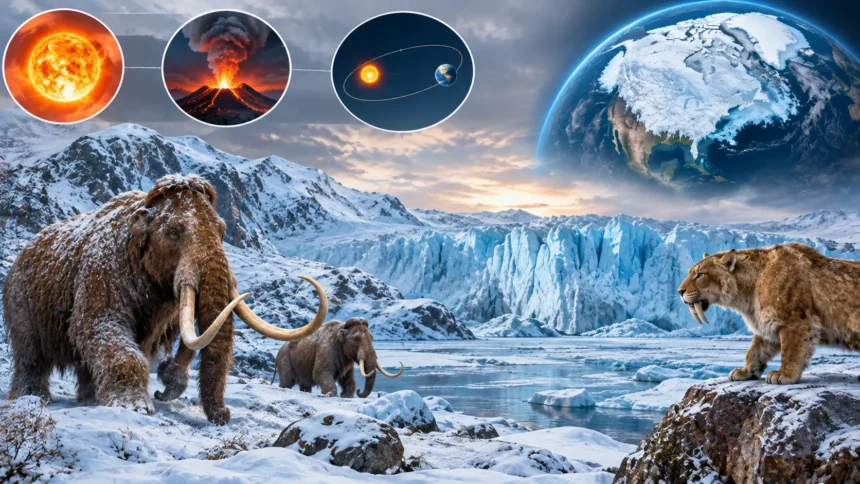
Ice ages are among the most fascinating events in Earth’s history, transforming landscapes, changing sea levels, and influencing the survival of plants and animals. During these long periods, enormous ice sheets spread across continents, covering regions that experience much warmer conditions today. Scientists study ancient rocks, glaciers, and climate records to understand these dramatic changes. Their findings reveal how Earth’s climate has evolved over millions of years.
Understanding what causes ice ages requires looking at several connected factors, including Earth’s orbit, atmospheric gases, ocean circulation, and natural climate feedbacks. These forces influence how much energy the planet receives and how heat moves around the world. Small changes can sometimes trigger much larger effects over thousands of years. Ice ages develop through these complex interactions rather than one isolated event.
Another interesting question is whether Earth could experience another major glacial period in the future. Scientists know that natural climate cycles have repeatedly produced colder conditions, but modern human activities are changing the planet’s climate. This guide explains how ice ages begin, what happened during previous glaciations, and why future cooling remains uncertain. It also explores the scientific evidence behind Earth’s changing climate.
What Is an Ice Age?
An ice age is a long period in Earth’s history when permanent ice sheets exist over substantial areas of the planet. These periods can continue for millions of years and include major changes in global temperatures. Ice ages do not mean that the entire Earth becomes completely frozen. Many regions remain relatively warm even when large continental ice sheets are present.
Scientists distinguish between colder glacial periods and warmer interglacial periods within an ice age. During glacial periods, ice sheets expand as temperatures fall and snow accumulation exceeds melting. Interglacial periods bring warmer conditions, allowing glaciers and ice sheets to retreat. These alternating phases explain why Earth’s climate has repeatedly shifted between colder and warmer conditions.
Interestingly, Earth is technically still experiencing an ice age because permanent ice sheets remain in Antarctica and Greenland. The current warm interval is called the Holocene interglacial, which began approximately 11,700 years ago. This means the last major glacial period ended, but the broader ice age continues. Understanding this distinction helps explain discussions about future glaciation.
What Causes Ice Ages on Earth?
Ice ages develop when long-term changes in Earth’s climate allow large ice sheets to form and persist. Several factors influence this process, including orbital variations, atmospheric carbon dioxide, continental positions, and ocean circulation. These conditions affect how much solar energy reaches different regions. When they combine in certain ways, cooling can become strong enough to support expanding glaciers.
One important factor is the amount of summer sunlight reaching high northern latitudes. When summers become too cool to melt all the snow from previous winters, snow can gradually accumulate. Over time, the accumulated snow compresses into ice and forms larger glaciers. Expanding ice sheets can then influence regional temperatures and atmospheric circulation.
However, cooler summers alone do not explain every part of the climate response. Greenhouse gases, changing oceans, and ice-related feedbacks help determine the strength and duration of glaciation. These processes interact over thousands of years, creating complicated climate patterns. Scientists use multiple types of evidence to understand how these forces produced previous ice ages.
How Earth’s Orbit Triggers Ice Age Cycles
Changes in Earth’s orbit are among the most important influences on the timing of glacial and interglacial periods. These variations are commonly called Milankovitch cycles, named after the scientist who studied their climatic effects. They change how sunlight is distributed across seasons and latitudes. Although they do not greatly alter total annual solar energy, their seasonal effects can be significant.
The first orbital variation involves the shape of Earth’s orbit, known as eccentricity. The orbit changes gradually between more circular and slightly more elliptical forms over cycles that include roughly 100,000-year and 405,000-year components. These changes influence seasonal differences in solar energy. Their climatic effects also depend on interactions with other orbital variations.
The second variation is axial tilt, while the third is precession, which changes the orientation of Earth’s rotational axis. Tilt varies over approximately 41,000 years, and climatic precession has cycles near 19,000 to 23,000 years. Together, these variations influence summer conditions at high latitudes. Their combined effects help explain the timing of many past glacial changes.
The Role of Carbon Dioxide and Greenhouse Gases
Carbon dioxide plays an important role in regulating Earth’s temperature because it traps some of the heat that would otherwise escape into space. During past glacial periods, atmospheric carbon dioxide concentrations were generally lower than during warmer interglacial periods. This reduced greenhouse effect contributed to global cooling. Changes in carbon dioxide also amplified temperature shifts initiated by orbital variations.
When the climate begins cooling, changes in ocean circulation and carbon storage can reduce atmospheric carbon dioxide over long periods. Lower concentrations allow more heat to escape, contributing to further cooling. The opposite process can occur during warming phases, when atmospheric carbon dioxide increases. These interactions create feedbacks between greenhouse gases, oceans, and global temperatures.
Ice core records provide strong evidence that temperature and greenhouse gas concentrations changed together during past glacial cycles. However, the relationship involves several interacting processes rather than a single cause-and-effect sequence. Today, human activities are rapidly increasing greenhouse gas concentrations. This additional warming influence significantly changes the conditions under which future glaciation might occur.
How Ice Sheets Make the Planet Colder
Ice sheets influence Earth’s climate through a process called the ice-albedo feedback. Albedo describes how much incoming sunlight a surface reflects. Snow and ice generally reflect more sunlight than darker land or ocean surfaces. When ice sheets expand, they increase Earth’s reflectivity and reduce the amount of solar energy absorbed near the surface.
This increased reflection can contribute to additional cooling, allowing snow and ice to persist longer. As the ice-covered area grows, the cooling effect may become stronger. The process helps explain how relatively small initial climate changes can develop into much larger glacial shifts. However, other climate factors influence whether ice sheets continue expanding.
The reverse process occurs when warming causes ice and snow to retreat. Darker land and ocean surfaces become exposed and absorb more sunlight, supporting additional warming. This feedback is important in both ancient glacial cycles and present-day climate change. Scientists include these interactions in climate models to better understand temperature changes.
How Oceans and Continents Influence Ice Ages
Oceans play an essential role in Earth’s climate because they store and transport enormous amounts of heat. Ocean currents move warm and cold water between regions, affecting atmospheric temperatures and precipitation. Changes in circulation can influence how much heat reaches high latitudes. These effects may strengthen or weaken conditions favorable for ice-sheet growth.
Continental positions also influence long-term climate patterns because they determine the arrangement of oceans, mountains, and land surfaces. Plate tectonics gradually moves continents over millions of years. These movements can alter ocean gateways, atmospheric circulation, and the availability of land where ice sheets can develop. Such changes help explain why major ice ages occurred during different periods.
For example, Antarctica became increasingly isolated by surrounding ocean circulation as Southern Ocean gateways evolved. This helped create conditions favorable for long-term Antarctic glaciation alongside declining atmospheric carbon dioxide. Northern Hemisphere glaciation developed under a different combination of influences. Understanding continental geography is therefore important when examining Earth’s ancient climate history.
How Long Do Ice Ages Last?
Ice ages can last millions of years because they involve long-term conditions that allow permanent ice sheets to survive. Within these extended periods, colder glacial phases and warmer interglacial phases repeatedly alternate. The timing and duration of these changes have varied throughout Earth’s history. Scientists reconstruct them using geological records and other evidence.
During much of the last 800,000 years, major glacial cycles have occurred at intervals averaging roughly 100,000 years. Earlier during the Pleistocene, cycles near 41,000 years were more prominent. These differences reflect complicated relationships between orbital forcing, ice sheets, and climate feedbacks. Therefore, ice ages do not follow one perfectly predictable timetable.
The last major glacial period reached its greatest global ice extent around 20,000 years ago. Large ice sheets covered substantial portions of North America and northern Europe, while sea levels were much lower than today. Warming eventually caused major ice retreat. The transition into the Holocene interglacial established the relatively warm conditions under which modern civilizations developed.
Major Ice Ages Throughout Earth’s History
Earth has experienced several major episodes of extensive glaciation over its approximately 4.5-billion-year history. Geological evidence indicates that widespread ice formation occurred during different ancient periods. These events varied in duration, geographic extent, and environmental consequences. Studying them helps scientists understand how Earth’s climate system responds to changing conditions.
Some of the most dramatic glaciations occurred during the Cryogenian Period, approximately 720 to 635 million years ago. Evidence suggests that ice may have extended into very low latitudes during these events. Scientists continue debating whether the oceans were almost completely ice-covered or whether substantial areas of open water survived. These episodes are often discussed through the Snowball Earth hypothesis.
Another major glaciation occurred during the late Paleozoic, when large ice sheets developed across parts of the Southern Hemisphere. The current Cenozoic ice age includes Antarctic glaciation beginning around 34 million years ago and major Northern Hemisphere glaciation beginning roughly 2.6 million years ago. Each episode involved different geological and atmospheric conditions. Their history demonstrates that Earth’s climate has changed dramatically over deep time.
How Scientists Know Ice Ages Happened
Scientists investigate ancient ice ages using evidence preserved in rocks, sediments, fossils, and ice cores. Glaciers leave recognizable marks as they move across the landscape, including scratches on rocks and deposits of transported material. These geological features reveal where ice once existed. Their locations help researchers reconstruct the extent of ancient glaciers.
Ice cores from Greenland and Antarctica preserve layers of snow that accumulated over thousands of years. Tiny trapped air bubbles contain samples of ancient atmospheric gases. Chemical and isotopic measurements provide information about past temperatures and climate conditions. These records allow scientists to compare greenhouse gas changes with glacial and interglacial cycles.
Ocean sediments provide another important source of climate information. The remains of tiny marine organisms preserve chemical signals influenced by past ocean temperatures and global ice volume. By examining sediment layers, researchers can reconstruct climate changes over millions of years. Combining several independent records makes scientific conclusions more reliable than relying on one type of evidence.
How Ice Ages Changed Earth’s Landscapes and Life
Glaciers dramatically reshape landscapes by moving slowly across land and carrying rocks and sediment. Their movement can carve valleys, deepen basins, and create distinctive geological formations. Many lakes and landforms in northern regions were influenced by past glaciation. These features remain visible long after the ice sheets have disappeared.
During the last glacial period, large amounts of water were stored in continental ice sheets. Global sea level was approximately 120 meters lower than today near the last glacial maximum. This exposed coastal land and created connections between areas now separated by water. One important example was Beringia, which connected northeastern Asia and northwestern North America.
Ice age climate changes also affected plants, animals, and early human populations. Habitats shifted as temperatures and vegetation patterns changed across continents. Some species adapted, migrated, or experienced population declines, while others eventually became extinct. Human communities also adjusted their movements and survival strategies to changing environments. These effects demonstrate how strongly climate influences ecosystems and geography.
Could Another Ice Age Happen in the Future?
Another major glacial period remains possible in Earth’s distant future because the natural processes responsible for past ice ages still exist. Orbital cycles continue changing the distribution of sunlight across the planet. Under suitable conditions, these variations could eventually support renewed ice-sheet expansion. However, the timing depends on more than orbital patterns alone.
Modern greenhouse gas concentrations complicate predictions about the next glacial period. Human activities have increased atmospheric carbon dioxide substantially above the levels typical of recent preindustrial interglacial periods. This added greenhouse warming can delay the cooling conditions needed for major ice-sheet growth. Some scientific research suggests that elevated carbon dioxide could postpone future glaciation for tens of thousands of years or longer.
Scientists cannot identify a guaranteed date for the next glacial period because future emissions and long-term climate responses remain uncertain. Orbital variations are predictable, but the climate system responds through complicated interactions. Current evidence does not indicate that a major new glacial period is approaching soon. Instead, human-caused global warming is the dominant concern for climate change over the coming decades.
Conclusion
Understanding what causes ice ages reveals how several natural forces interact to change Earth’s climate over long periods. Orbital variations influence seasonal sunlight, while greenhouse gases, oceans, and ice sheets amplify or modify temperature changes. Continental positions also shape the conditions that support widespread glaciation. Together, these processes explain why Earth has experienced repeated cold and warm intervals.
Geological records show that major ice ages have transformed landscapes, lowered sea levels, and influenced the development of ecosystems. Scientists study ice cores, ocean sediments, and glacial landforms to reconstruct these events. Their research demonstrates that climate change has occurred naturally throughout Earth’s history. However, the causes and timescales of past changes differ from those driving modern warming.
Another glacial period could occur in the distant future, but increasing greenhouse gas concentrations are expected to delay its development. Earth remains within a broader ice age despite currently experiencing a warm interglacial interval. Understanding these differences helps explain both ancient climate cycles and modern climate concerns. Scientific research continues improving predictions about how Earth’s climate may evolve.
Frequently Asked Questions
What Is the Main Cause of Ice Ages?
Changes in Earth’s orbit and axial orientation help control the timing of glacial cycles. Greenhouse gases, ice-sheet feedbacks, ocean circulation, and continental geography also influence how strongly the climate cools.
Are We Still Living in an Ice Age?
Yes, Earth remains in a broader ice age because permanent ice sheets exist in Antarctica and Greenland. We currently live in a warmer interglacial period called the Holocene.
When Was the Last Ice Age?
The last major glacial period ended approximately 11,700 years ago, marking the beginning of the Holocene. However, the broader ice age continues because large permanent ice sheets still exist.
Could Another Ice Age Begin Soon?
A major new glacial period is not expected soon. Natural orbital cycles could eventually favor glaciation, but elevated atmospheric carbon dioxide is expected to delay the conditions needed for extensive ice-sheet growth.
How Long Can an Ice Age Last?
An ice age can continue for millions of years and contain many shorter glacial and interglacial periods. Individual glacial cycles vary in duration depending on orbital patterns and climate feedbacks.