


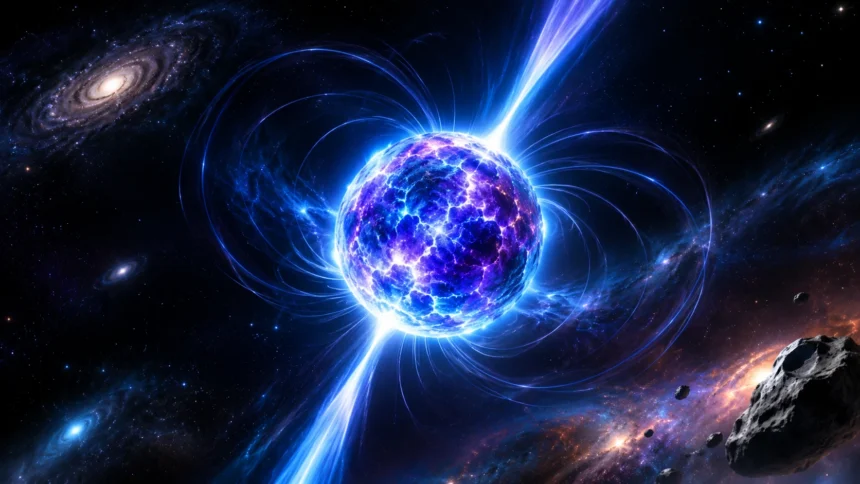
Neutron stars are among the most extraordinary objects in the universe. They contain an enormous amount of matter compressed into a surprisingly small space, creating conditions that cannot be reproduced easily on Earth. Their extreme density, powerful gravity, and unusual magnetic fields make them fascinating subjects for astronomers. But what is a neutron star, and how dense can it actually become?
A neutron star forms when the core of a massive star collapses after exhausting its nuclear fuel. Although these stellar remnants may measure only about 20 to 26 kilometers across, they can contain more mass than our Sun. Understanding their structure and behavior reveals important clues about matter, gravity, and the life cycles of stars.
What Is a Neutron Star?
A neutron star is an extremely dense stellar remnant left behind after certain massive stars reach the end of their lives. During a core-collapse event, gravity compresses the central region until matter reaches extraordinary densities. The resulting object contains mostly neutrons, along with other particles. Despite its compact size, a typical neutron star has a mass greater than the Sun.
Neutron stars represent one of the final stages of stellar evolution. Unlike ordinary stars, they do not maintain their structure through the continuous nuclear fusion that powers the Sun. Instead, pressure from extremely compressed matter helps support them against further gravitational collapse. Their unusual physical conditions make them valuable natural laboratories for studying the fundamental behavior of matter.
These cosmic objects are difficult to observe directly because they are small and often emit relatively little visible light. Astronomers usually detect them through radio signals, X-rays, gravitational effects, or interactions with nearby objects. Some rotate rapidly and produce regular pulses of radiation. Others have exceptionally strong magnetic fields that influence their surroundings in remarkable ways.
How Does a Neutron Star Form?
The formation of a neutron star begins with a massive star that has spent millions of years producing energy through nuclear fusion. Eventually, its central region can no longer generate enough pressure to resist gravity. The core begins collapsing rapidly under its own weight. This process creates extreme temperatures and pressures that dramatically transform the matter inside.
During the collapse, electrons and protons combine through electron capture, producing neutrons and neutrinos. The central region becomes incredibly compressed as the collapse progresses. In many cases, the surrounding stellar layers are expelled during a core-collapse supernova explosion. What remains depends on the original star’s structure, the collapse process, and the mass of the surviving core.
If the remaining core is light enough to be supported by dense matter, it becomes a neutron star. If its mass is too great, continued gravitational collapse may form a black hole instead. Not every massive star leaves behind a neutron star, and not every supernova produces one. The final outcome depends on several complex physical conditions.
How Big and Heavy Is a Neutron Star?
A typical neutron star has a radius of roughly 10 to 13 kilometers, making its diameter around 20 to 26 kilometers. This means the entire object could fit within the area of a large city. However, its compact appearance hides an extraordinary amount of matter. Most neutron stars contain approximately one to two times the mass of the Sun.
To understand this contrast, consider that the Sun has a diameter of approximately 1.39 million kilometers. A neutron star compresses a comparable amount of mass into an object thousands of times smaller across. This concentration produces an extremely powerful gravitational field. It also explains why ordinary comparisons with planets and familiar stars cannot describe neutron stars adequately.
Neutron stars are not all exactly the same size or mass. Their dimensions depend on their mass and the behavior of matter under extreme pressure. Scientists estimate these properties by studying radiation, orbital motion, and other observable effects. Measurements help researchers investigate how much mass neutron stars can contain before their internal support becomes insufficient.
How Dense Can a Neutron Star Become?
Neutron stars are among the densest known objects made of matter outside black holes. Their average density is commonly around several hundred trillion kilograms per cubic meter, or several times 10^17 kilograms per cubic meter. Density can become considerably higher near their centers. These values are far beyond anything found in ordinary materials on Earth.
A familiar comparison involves imagining a teaspoon of neutron star matter. At a representative average neutron star density, five milliliters would contain roughly two billion metric tons of mass. This illustration helps communicate the extraordinary concentration of matter. However, neutron star material would not remain in its original compressed condition if removed from the immense pressure sustaining it.
The exact maximum density inside a neutron star remains uncertain because scientists do not fully understand matter under such extreme conditions. Models suggest that central densities can reach several times the density of atomic nuclei. Some predictions approach or exceed 10^18 kilograms per cubic meter. The actual limit depends on the properties of dense nuclear matter.
What Prevents a Neutron Star From Collapsing?
Gravity constantly pulls neutron star matter inward, creating enormous pressure throughout the object. Without an opposing force, the star would continue collapsing under its own weight. One important source of resistance comes from neutron degeneracy pressure, which arises from quantum physics. Neutrons cannot all occupy identical quantum states, even when gravity compresses them closely together.
Interactions between particles also play a major role in supporting the star. At extremely short distances, the strong nuclear interaction influences how densely matter can be compressed. The balance between gravity and internal pressure determines whether a stable neutron star can exist. Scientists describe this relationship using general relativity and models of dense matter.
There is a maximum mass beyond which these supporting effects can no longer maintain a stable neutron star. This boundary is related to the Tolman–Oppenheimer–Volkoff limit, although its precise value remains uncertain. Current models often place the maximum mass of a nonrotating neutron star somewhere around two to three solar masses. Above the relevant limit, collapse into a black hole becomes possible.
What Is Inside a Neutron Star?
A neutron star has a layered structure that becomes increasingly unusual toward its center. Its outermost region includes a thin atmosphere and a solid crust containing atomic nuclei and electrons. Deeper inside, matter becomes much more compressed, and nuclear structures behave differently. These layers help scientists understand how extreme pressure changes the properties of familiar particles.
Within the inner crust, neutrons can exist outside atomic nuclei and may form a superfluid. A superfluid behaves differently from ordinary liquids because it can flow with extremely unusual properties. Scientists believe this behavior influences how neutron stars rotate and respond to internal disturbances. The crust and interior may also contain other forms of matter with unfamiliar characteristics.
The deepest central region remains one of the greatest mysteries in neutron star research. Some theoretical models predict that unusual particles or forms of quark matter could exist there. Other models describe cores dominated by strongly interacting neutrons and a smaller number of additional particles. Astronomers continue collecting evidence to determine which descriptions are physically realistic.
How Strong Is Gravity on a Neutron Star?
The gravity on a neutron star is dramatically stronger than the gravity experienced on Earth. A typical neutron star can have surface gravity roughly 100 billion times greater than Earth’s. This enormous attraction results from concentrating a stellar mass into a tiny radius. Anything approaching the surface would encounter extremely powerful gravitational effects.
Neutron star gravity is strong enough to significantly influence the behavior of light. Photons traveling away from the surface lose energy as they escape the gravitational field, producing gravitational redshift. The intense gravity also bends light, allowing observers to see portions of the stellar surface that would otherwise remain hidden. These effects provide valuable information about the star’s mass and radius.
Time also behaves differently near a neutron star because of the effects described by Einstein’s general theory of relativity. A clock close to the surface runs more slowly relative to one far away. Astronomers account for these effects when interpreting radiation from compact objects. Studying such environments allows researchers to test gravitational physics under extreme conditions.
Why Do Neutron Stars Spin So Fast?
Many neutron stars rotate rapidly because they inherit angular momentum from the stars that formed them. As a massive stellar core contracts, its rotation can accelerate dramatically. A familiar comparison is an ice skater spinning faster after pulling their arms inward. The same conservation principle helps explain why a compact stellar remnant can rotate so quickly.
Some neutron stars complete several rotations each second, while others spin hundreds of times per second. Their rotation rates depend on their formation history and interactions with nearby matter. Neutron stars in binary systems may spin faster after receiving material from companion stars. This process can transfer angular momentum and produce exceptionally rapid rotation.
Although neutron stars can rotate extremely quickly, their spin rates are not unlimited. Excessive rotation could destabilize the object or cause material near its equator to become gravitationally unbound. The maximum stable rotation rate depends on mass, radius, and internal structure. Measuring neutron star rotation therefore provides additional clues about the physical conditions inside these objects.
What Are Pulsars and Magnetars?
A pulsar is a rotating neutron star that produces beams of electromagnetic radiation from regions associated with its magnetic field. When these beams sweep across Earth, astronomers detect repeating pulses. This behavior is often compared to a lighthouse rotating through the darkness. The regular timing of pulsars makes them especially useful for precise astronomical measurements.
Pulsars can emit radio waves, X-rays, gamma rays, and other forms of radiation. Their signals help scientists investigate stellar rotation, magnetic fields, and the surrounding environment. Some pulsars are so stable that their timing can reveal tiny changes in orbital motion. Researchers also use networks of pulsars to search for extremely low-frequency gravitational waves.
Magnetars are neutron stars with exceptionally powerful magnetic fields. Their magnetic activity can produce dramatic bursts of high-energy radiation and changes in their observable behavior. Scientists believe magnetic stresses within the star contribute to some of these events. Although pulsars and magnetars are often discussed separately, both belong to the broader neutron star family.
How Do Scientists Study Neutron Stars?
Astronomers investigate neutron stars using powerful telescopes that detect different wavelengths of electromagnetic radiation. Radio observatories measure pulsar signals, while X-ray telescopes examine hot regions near stellar surfaces. These observations reveal information about rotation, temperature, magnetic activity, and gravitational effects. Combining measurements from different instruments provides a more complete understanding of each object.
Binary star systems offer another valuable method for measuring neutron star properties. When a neutron star orbits a companion, their gravitational interaction affects orbital motion. Astronomers can analyze these changes to estimate stellar masses with impressive precision. Such measurements are especially important for testing predictions about the maximum mass a neutron star can support.
Scientists also compare observations with computer simulations and theoretical models of dense nuclear matter. These models explore how particles behave under pressures that cannot be recreated directly in ordinary laboratories. Gravitational wave observations provide another way to investigate compact stellar objects. Together, these methods help researchers narrow the possibilities for neutron star interiors and their extreme densities.
What Happens When Neutron Stars Collide?
Some neutron stars exist in binary systems where two compact objects orbit one another. Over time, the system loses orbital energy through gravitational wave emission, causing the stars to move closer together. Eventually, they may collide in a powerful merger. These events release enormous amounts of energy and provide opportunities to study gravity under extreme conditions.
Neutron star mergers can generate gravitational waves, intense electromagnetic radiation, and heavy elements through rapid neutron capture. The radioactive decay of newly formed elements contributes to a bright event called a kilonova. Such explosions help scientists understand how certain heavy elements are produced throughout the universe. They also reveal important information about the behavior of extremely dense matter.
The final object produced by a merger depends on the combined mass and physical conditions involved. Some collisions may briefly create an unusually massive neutron star before further collapse occurs. Others can produce black holes more directly. Observing these outcomes helps astronomers investigate the maximum possible neutron star mass and the transition between different compact objects.
Conclusion
A neutron star is the extraordinarily dense remnant of a massive stellar core that has undergone gravitational collapse. Although its diameter may be only a few dozen kilometers, it can contain more mass than the Sun. Its extreme density results from the enormous gravitational compression of matter. These remarkable properties make neutron stars valuable subjects for understanding the universe.
Neutron star density can reach hundreds of trillions of kilograms per cubic meter on average, with even greater values expected near the center. Quantum effects and nuclear interactions help prevent immediate collapse, but their ability to support matter has limits. Scientists continue investigating the exact maximum density and mass possible. These questions remain closely connected to the physics of black holes.
From rapidly rotating pulsars to powerful magnetars and spectacular stellar mergers, neutron stars display some of nature’s most unusual phenomena. Their gravity, magnetic fields, and internal structures challenge our understanding of matter under extreme conditions. Continued observations and improved theoretical models are helping astronomers uncover their secrets. Each discovery brings us closer to understanding how dense matter can become.
FAQs
What is a neutron star in simple terms?
A neutron star is the extremely dense remains of a massive star’s collapsed core. It contains more mass than the Sun within an object only about 20 to 26 kilometers across.
How dense is a neutron star compared to Earth?
A neutron star is vastly denser than Earth, with an average density often reaching several hundred trillion kilograms per cubic meter. A teaspoon-sized volume at that density would contain billions of metric tons of matter.
Can a neutron star become a black hole?
Yes. If a neutron star becomes too massive for its internal pressure to resist gravity, it can collapse into a black hole. This may happen through additional mass accumulation or stellar mergers.
What is the maximum mass of a neutron star?
The exact maximum mass remains uncertain. Many theoretical models suggest that nonrotating neutron stars can support roughly two to three solar masses, depending on the behavior of matter at extreme densities.
Are neutron stars hotter than the Sun?
Young neutron stars can have surface temperatures far higher than the Sun’s surface temperature. They gradually cool over time, although some remain hot because of internal processes or interactions with surrounding matter.