


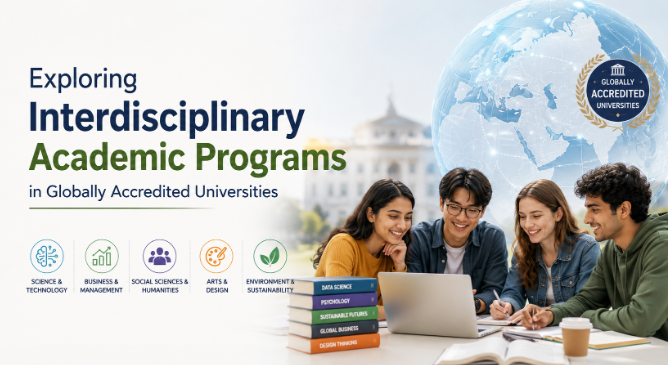
Introduction to Interdisciplinary Programs
Interdisciplinary academic programs represent a modern approach to education that transcends traditional boundaries of distinct academic disciplines. By integrating concepts, theories, and methodologies from multiple fields, these programs aim to provide students with a more holistic and comprehensive learning experience. This approach reflects the complexities of real-world problems, which often do not neatly fit into single disciplines.
The importance of interdisciplinary studies in today’s educational landscape cannot be overstated. As the challenges faced by society continue to evolve, solutions increasingly require insights from various fields. For example, addressing climate change necessitates the expertise of environmental science, political science, economics, and social studies. Interdisciplinary programs empower students to recognize these intersections and develop a multifaceted understanding of issues.
In essence, interdisciplinary studies enroll students into a collaborative learning environment where they can engage with diverse perspectives and methodologies. These programs foster critical thinking, creativity, and problem-solving skills, making graduates well-prepared for the workforce, which increasingly values adaptability. Many globally accredited universities are now offering such programs, reflecting a significant shift towards a more integrative educational framework.
Moreover, this educational trend encourages students to pursue personal interests outside conventional subject lines, promoting a more personalized academic journey. For instance, a student with a passion for technology and environmental conservation may tailor their studies to combine elements from computer science and environmental studies, culminating in innovative solutions for sustainable development.
Overall, interdisciplinary academic programs signify a forward-thinking evolution of higher education, equipping students with the necessary tools to navigate the complexities of today’s world.
Benefits of Interdisciplinary Learning
Interdisciplinary academic programs have emerged as a prominent trend in higher education, offering students a well-rounded approach to learning that transcends traditional disciplinary boundaries. One of the most significant advantages of this educational model is the enhancement of critical thinking skills. By engaging with multiple fields of study, students learn to analyze and synthesize diverse perspectives, thereby cultivating the ability to evaluate problems from various angles. This multifaceted approach prepares graduates to tackle complex issues in a nuanced and informed manner.
Additionally, interdisciplinary programs encourage creativity by blending methodologies and insights from disparate disciplines. This cross-pollination of ideas often leads to innovative solutions and encourages students to think outside the box. For instance, a student combining knowledge from environmental science and economics may develop a unique strategy for sustainability that neither field could produce in isolation. Such creativity is invaluable in a rapidly changing global landscape where traditional solutions may fall short.
Furthermore, interdisciplinary learning equips students with the tools necessary to address real-world problems that are rarely confined to a single field. Many contemporary challenges, such as climate change, public health crises, and social inequalities, require collaborative approaches that draw on expertise from various domains. Graduates of interdisciplinary programs are better prepared to collaborate with peers from different backgrounds, fostering a team-oriented mindset that is essential in the workforce.
Beyond enhancing individual skill sets, these programs also prepare students for a dynamic job market that increasingly values versatility and adaptability. Employers are seeking candidates who can navigate complex environments, making interdisciplinary learning an attractive pursuit for those aiming for a successful career.
Overview of Globally Accredited Universities
Globally accredited universities are educational institutions that have undergone a rigorous evaluation process to ensure their compliance with established academic standards. Accreditation is essential as it signifies that a university meets high-quality benchmarks in terms of faculty qualifications, curriculum rigor, and student services. It plays a crucial role in elevating the institution’s reputation and providing assurance to students regarding the quality of education they can expect to receive.
Attending an accredited university holds significant importance for students. Firstly, it often makes students eligible for financial aid, scholarships, and grants, which may not be available for graduates from non-accredited schools. Secondly, employers typically recognize degrees from accredited institutions, verifying that the education received adheres to rigorous academic standards. This recognition can significantly affect a graduate’s job prospects, underscoring the value of obtaining a degree from an accredited university.
Several renowned universities are at the forefront of offering interdisciplinary programs while maintaining global accreditation. Institutions such as Stanford University, Massachusetts Institute of Technology (MIT), and the University of California, Berkeley have established interdisciplinary studies that connect various fields of knowledge. For instance, Stanford’s interdisciplinary programs combine technology with humanities to forge innovative paths in research and education. Similarly, MIT is acclaimed for integrating engineering with social sciences, promoting a comprehensive understanding of both technical and humanistic aspects within its curriculum. The University of California also encourages students to pursue dual degrees across differing disciplines, fostering a holistic educational experience. These universities exemplify the advantages of attending accredited institutions by offering pioneering interdisciplinary programs that prepare students for the complexities of modern careers.
Popular Interdisciplinary Programs Offered
As an increasing number of universities recognize the value of interdisciplinary studies, various programs are being developed to combine different fields of expertise. One prominent interdisciplinary program is Environmental Studies, which integrates elements of science, policy, and ethics to address ecological challenges. Students enrolled in this program often engage in practical projects that confront real-world environmental issues, allowing them to apply theoretical knowledge to tangible problems. This holistic approach equips graduates with a comprehensive understanding of environmental dynamics and prepares them for careers in sustainability, conservation, and environmental management.
Another notable example is Global Health, a program that converges the fields of medicine, public health, and social sciences. This area of study emphasizes the importance of understanding health issues from a global perspective, taking into account socioeconomic factors and cultural differences. Many universities offer Global Health programs that include components such as epidemiology, healthcare policy, and health promotion strategies. Graduates of this interdisciplinary program are well-prepared for careers in international health organizations, research institutions, and governmental agencies dedicated to addressing health disparities on a global scale.
Digital Humanities is yet another area gaining traction, which merges traditional humanities disciplines, such as history and literature, with digital tools and methods. This program enables students to engage in the analysis, visualization, and dissemination of cultural content using modern technology. Courses often cover topics like data analysis, digital archiving, and online publishing. Professionals trained in Digital Humanities are equipped with unique skills that allow them to work in diverse settings, including academia, museums, and publishing industries, where the fusion of technology and humanities is increasingly relevant.
Success Stories from Interdisciplinary Programs
Interdisciplinary academic programs have proven to be instrumental in fostering innovative solutions and enhancing student success. One prominent example is the Dual Degree Program in Environmental Science and Policy at Stanford University. This program merges insights from environmental science with policy-making, leading to impactful projects such as the “Green Cities Initiative.” This initiative empowered students to collaborate with local governments on sustainable urban planning projects, resulting in significant reductions in carbon footprints and increased community engagement.
Another compelling case study comes from the Massachusetts Institute of Technology (MIT), known for its emphasis on integrating technology and entrepreneurship. The MIT Media Lab’s “Affective Computing” project exemplifies how interdisciplinary collaboration can lead to groundbreaking advancements. Students from diverse backgrounds such as computer science, cognitive psychology, and design worked together to develop technology that recognizes human emotions, which has potential applications in areas ranging from healthcare to education. Their innovative solutions have not only garnered attention in academic circles but have also attracted industry partnerships, illustrating the real-world relevance of such programs.
Furthermore, the University of California, Berkeley has highlighted the advantages of interdisciplinary education through its “Global Health” program. Students from fields including public health, sociology, and engineering have engaged in hands-on projects addressing health disparities in underserved communities. One such project involved the development of low-cost diagnostic tools for remote areas, thus demonstrating how collaborative efforts can create practical solutions to complex health issues.
These case studies collectively illustrate how interdisciplinary programs not only facilitate personal growth for students but also contribute to solving pressing global challenges. As students engage in multidisciplinary projects, they acquire essential skills such as critical thinking, problem-solving, and teamwork, which are vital in today’s interconnected world.
Challenges in Interdisciplinary Education
Interdisciplinary education, while offering numerous benefits, is not without its challenges. One of the primary obstacles faced by institutions is the administrative hurdles that arise from implementing such programs. Traditional university structures often emphasize departmental silos, making collaboration across disciplines difficult. This can lead to a lack of shared resources and limited communication between departments, impeding the smooth integration of interdisciplinary curricula.
Additionally, curriculum development poses significant challenges in interdisciplinary education. Developing a program that effectively incorporates information and methodologies from various fields necessitates a comprehensive understanding of each discipline involved. This complexity can hinder the establishment of cohesive learning outcomes and assessment methods. Furthermore, faculty members may have differing priorities or perspectives on pedagogical approaches, complicating the design of a unified curriculum.
Another considerable challenge is faculty collaboration. For interdisciplinary education to thrive, faculty from different departments must work together seamlessly. However, competing research agendas, varying levels of institutional support, and differing cultural norms within disciplines can create barriers to collaboration. This lack of synergy can result in poorly conceptualized programs that fail to deliver the intended educational outcomes.
Overcoming these challenges requires a concerted effort from all stakeholders. Universities can encourage the development of interdisciplinary programs by fostering an administrative culture that values collaboration and innovation. This may involve restructuring governance models to support cross-departmental initiatives and providing incentives for faculty to engage in interdisciplinary work. Additionally, training and workshops can facilitate understanding and cooperation among faculty from different disciplines. By addressing these challenges proactively, universities can create robust interdisciplinary education programs that enrich the academic experience and prepare students for the complexities of the modern workforce.
Future Trends in Interdisciplinary Studies
The landscape of higher education is evolving rapidly, particularly in the realm of interdisciplinary studies. As global challenges become more complex, universities are increasingly integrating diverse fields to prepare students for a multifaceted world. Among the notable trends shaping this educational approach is the rise of data science as a pivotal element. Data science blends statistics, computer science, and domain-specific knowledge, enabling students to analyze vast datasets to derive meaningful insights. This trend is expected to deepen its roots in academic programs as institutions recognize the importance of data-driven decision-making across various sectors.
Moreover, the integration of artificial intelligence (AI) into interdisciplinary studies is gaining momentum. AI technologies offer innovative tools that can enhance learning experiences and research capabilities. By merging AI with traditional disciplines—such as humanities, social sciences, and engineering—students can explore new methodologies and perspectives. This holistic approach not only equips learners with technical proficiency but also fosters critical thinking and creativity, essential skills for the future workforce.
Another significant trend is the emergence of sustainability studies. As environmental concerns grow, universities are responding by creating programs that address ecological challenges through an interdisciplinary lens. These programs often combine elements of environmental science, economics, and policy studies, encouraging students to develop comprehensive solutions to sustainability issues. This trend reflects a broader societal shift toward understanding the interconnectedness of ecological, economic, and social systems.
Looking ahead, the intersection of these disciplines is poised to redefine academic programs across globally accredited universities. By embracing data science, artificial intelligence, and sustainability studies, educational institutions are preparing students for a dynamic job market that demands versatility and an interdisciplinary approach to complex problems. Such initiatives are not only beneficial for student learning but are crucial for fostering a robust and innovative workforce prepared to tackle future challenges.
Interdisciplinary Programs and Career Outcomes
Graduates of interdisciplinary academic programs often find themselves uniquely positioned to meet the demands of today’s complex job market. These programs, which blend traditional academic disciplines, prepare students with a diverse skill set that is highly valued by employers across various sectors. The ability to think critically, apply multiple perspectives, and solve real-world problems equips graduates with a competitive advantage as they enter the workforce.
Employers are recognizing the importance of skills that arise from interdisciplinary collaboration. They seek candidates who can navigate the intersections of multiple fields, such as technology, business, and the humanities. For instance, a graduate with a background in both data analytics and environmental science can effectively contribute to sustainability efforts in companies pursuing eco-friendly initiatives. This blend of expertise is particularly appealing in industries where innovation and adaptability are essential.
According to a survey conducted by the National Association of Colleges and Employers (NACE), approximately 60% of employers reported a preference for candidates with interdisciplinary skills. Furthermore, alumni from interdisciplinary programs have shown promising employment rates. A recent study highlighted that 75% of graduates from these programs secured employment within six months, with many finding positions that utilize their multifaceted skill sets.
Testimonials from alumni also underscore the positive impact of interdisciplinary education on career outcomes. One graduate noted, “My background in interdisciplinary studies allowed me to work across teams effectively, which has been invaluable in my role as a project manager. I can engage with experts from various fields, translating complex ideas into actionable strategies.” This sentiment echoes among several graduates who attribute their career advancement to the broad perspective and capabilities fostered by their interdisciplinary studies.
Conclusion
In the modern educational landscape, the importance of interdisciplinary academic programs has become increasingly apparent. These programs stand as vital components in preparing students for a complex and interconnected world. By combining multiple disciplines, universities foster a holistic approach to education that enhances critical thinking, creativity, and adaptability. Such qualities are essential for navigating the challenges that individuals encounter in their professional and personal lives.
The blend of varied academic fields equips students with a unique set of skills that are highly regarded in the global job market. Employers often seek individuals who can think critically, collaborate across disciplines, and innovate solutions to complex societal issues. Interdisciplinary programs effectively cultivate these abilities, making graduates exceptionally well-prepared for diverse career paths. Furthermore, they encourage students to engage with real-world problems, thereby promoting social responsibility and active citizenship.
As educational institutions continue to evolve, the value of interdisciplinary programs cannot be overstated. Such programs not only enrich individual learning experiences but also contribute significantly to addressing pressing societal challenges. By embracing interdisciplinary studies, students will not only enhance their academic journey but also positively impact society at large. Therefore, it is highly recommended for prospective students to consider enrolling in these programs as a way to broaden their horizons, develop critical competencies, and prepare themselves for future endeavors in a rapidly changing global environment.