


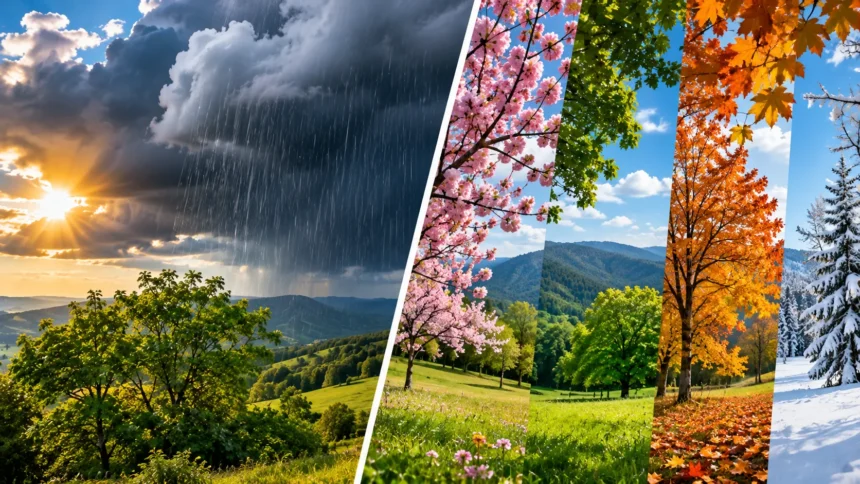
Weather and climate are two important concepts used to describe conditions in Earth’s atmosphere. People often use these terms interchangeably, but they have different meanings. Weather describes atmospheric conditions over a short period, while climate explains the patterns observed over many years. Understanding this distinction helps people interpret forecasts, recognize seasonal changes, and understand long-term environmental trends.
The main difference between weather and climate is time. Weather refers to daily or short-term atmospheric conditions, including temperature, rainfall, wind, and humidity. Climate describes the long-term patterns and statistical characteristics of weather in a particular region, commonly measured over 30 years or more. This guide explains both concepts, their characteristics, examples, causes, and importance in everyday life.
What Is Weather? A Simple Definition
Weather refers to the condition of the atmosphere at a specific place and time. It includes temperature, precipitation, wind speed, humidity, cloud cover, and atmospheric pressure. Weather conditions can change within minutes, hours, or days. For example, a sunny morning may turn into a rainy afternoon when clouds and atmospheric conditions change.
Weather occurs because the atmosphere constantly responds to differences in temperature, pressure, and moisture. Energy from the sun heats Earth’s surface unevenly, creating movement within the atmosphere. These movements contribute to wind, cloud formation, and precipitation. Meteorologists study these processes to understand atmospheric behavior and predict short-term conditions.
Weather forecasts help people plan activities and prepare for changing conditions. Farmers monitor rainfall predictions, travelers check temperatures, and communities follow warnings about severe storms. Forecasts use observations, computer models, and scientific analysis. However, predictions become less certain as the forecast period increases because atmospheric systems are highly complex.
What Is Climate? A Simple Definition
Climate describes the long-term patterns and statistical characteristics of weather in a particular location. Scientists study temperature, precipitation, humidity, and other atmospheric variables over extended periods. A 30-year period is commonly used to calculate standard climate averages. However, climate analysis can also involve shorter or much longer timescales, depending on the research question.
For example, a desert region usually has a dry climate because it receives relatively little rainfall over many years. Tropical regions often experience warm temperatures and substantial seasonal precipitation. Polar regions generally have cold climates because of their geographical location and energy balance. These descriptions represent long-term patterns rather than the weather on a particular day.
Climate includes more than average temperature or rainfall. Scientists also examine seasonal variations, extreme events, and the frequency of different weather conditions. A region’s climate can therefore describe both typical conditions and the range of expected variations. Understanding these patterns helps communities make decisions about agriculture, infrastructure, and environmental planning.
What Is the Main Difference Between Weather and Climate?
The main difference between weather and climate is the period over which atmospheric conditions are considered. Weather describes what is happening now or during a relatively short interval. Climate examines patterns and statistics calculated from observations collected over many years. Both involve similar atmospheric variables but answer different questions.
For example, saying that a city is experiencing heavy rain today describes its weather. Saying that the same city usually receives substantial rainfall during summer describes its climate. One statement refers to a particular event, while the other summarizes repeated patterns. This distinction helps explain why individual weather events do not establish long-term climate conditions.
Weather also tends to change more quickly than climate. Temperatures may rise or fall considerably within a day, while meaningful climate trends are generally evaluated over longer periods. However, long-term climate change can influence the probability and characteristics of certain weather events. Understanding both timescales provides a clearer picture of atmospheric behavior.
Weather vs Climate: Key Differences
Weather and climate differ in duration, measurement, predictability, and practical applications. Weather forecasts concentrate on upcoming atmospheric conditions, while climate information describes long-term patterns and possible future changes. These differences influence how scientists collect data and communicate results. Understanding them helps prevent confusion when discussing forecasts and environmental trends.
| Feature | Weather | Climate |
|---|---|---|
| Meaning | Short-term atmospheric conditions | Long-term weather patterns and statistics |
| Timescale | Minutes, hours, or days | Usually decades or longer |
| Changes | Can change rapidly | Generally changes over longer periods |
| Examples | Today’s rain or temperature | Typical seasonal rainfall |
| Main focus | Current and upcoming conditions | Averages, variability, and long-term trends |
| Scientific study | Meteorology | Climatology |
| Common applications | Daily planning and forecasts | Agriculture, infrastructure, and climate planning |
Both concepts rely on measurements of the atmosphere. The important distinction is how those measurements are interpreted across time. A temperature reading helps describe current weather, while many temperature observations can reveal long-term climate patterns. Scientists use both types of information to understand Earth’s atmospheric system.
Examples of Weather in Everyday Life
Weather examples are easy to recognize because they describe conditions experienced during daily activities. A thunderstorm in the afternoon, a windy morning, or a sudden drop in temperature are all weather events. These conditions may last only a short period. They can also change quickly as atmospheric systems move through an area.
Imagine waking up to clear skies and comfortable temperatures. By midday, clouds may begin developing, and strong winds could arrive before an evening storm. These changes represent different weather conditions during the same day. Meteorologists examine atmospheric observations and forecast models to understand how such changes may develop.
Weather also influences ordinary decisions about clothing, transportation, and outdoor activities. People check forecasts before traveling, attending events, or completing outdoor work. Weather warnings can provide important information about storms, flooding, or extreme temperatures. These practical applications demonstrate why short-term atmospheric information matters to everyday life.
Examples of Climate Around the World
Climate examples describe the usual atmospheric patterns associated with particular regions. Tropical rainforest climates generally experience warm conditions and substantial rainfall throughout much of the year. Desert climates typically receive limited precipitation. Polar climates are characterized by low temperatures and other conditions associated with high latitudes.
Mediterranean climates commonly feature dry summers and wetter winters. Continental climates often experience greater seasonal temperature differences, particularly in regions far from large oceans. Mountain climates can change considerably with elevation. These examples demonstrate how geographical conditions influence long-term temperature and precipitation patterns.
A region’s climate does not determine the exact weather on every day. A desert can occasionally experience heavy rainfall, and a cold region may have unusually warm periods. Such events do not automatically change the region’s climate classification. Climate descriptions summarize typical conditions and variability rather than guaranteeing specific daily outcomes.
How Temperature Relates to Weather and Climate
Temperature is one of the most commonly measured atmospheric variables in both weather and climate studies. For weather, temperature describes current conditions or expected changes over the coming hours and days. A forecast might predict a daytime high or nighttime low. These values help people prepare for short-term temperature variations.
Climate studies examine temperature records collected over much longer periods. Scientists calculate averages, analyze seasonal patterns, and investigate trends across decades. For example, a region may have warm summers and cold winters as part of its typical climate. Long-term records help determine whether those temperature patterns are changing.
Individual temperature readings cannot establish a climate trend by themselves. An unusually cold day can occur during a period of long-term warming. Similarly, one exceptionally hot afternoon does not independently prove climate change. Researchers examine extensive datasets to distinguish short-term variability from persistent temperature trends.
Rainfall and Precipitation in Weather and Climate
Rainfall is another important example of how weather and climate differ. A weather report may predict rain tomorrow or estimate the amount expected during an approaching storm. These forecasts describe short-term precipitation events. They help people prepare for outdoor conditions and potential flooding.
Climate information examines how much precipitation a region typically receives over longer periods. Scientists may calculate average annual rainfall and study which seasons are usually wetter or drier. They also investigate the frequency of heavy rainfall events. These patterns help explain why some regions support rainforests while others experience arid conditions.
Precipitation patterns can vary considerably from one year to another. A normally dry region may experience an unusually wet season, while a wetter area may experience drought. Such differences represent climate variability within the broader long-term pattern. Understanding this variability helps communities prepare for both typical and unusual rainfall conditions.
How Geography Affects Weather and Climate
Geographical location influences both short-term weather and long-term climate patterns. Latitude affects the amount and angle of solar energy reaching Earth’s surface. Areas near the equator generally receive more consistent solar energy throughout the year. Regions farther from the equator often experience greater seasonal differences in daylight and temperature.
Elevation also affects atmospheric conditions because air temperature generally decreases with height in the lower atmosphere. Mountain communities may therefore experience cooler conditions than nearby lowland areas. Mountains can also influence rainfall by forcing moist air upward. These effects contribute to different local weather patterns and long-term climate characteristics.
Large bodies of water influence temperature and moisture because oceans and lakes absorb and release heat differently from land. Coastal areas often experience moderated temperatures compared with inland regions at similar latitudes. Ocean currents and prevailing winds also influence regional conditions. Together, these factors help explain why climates vary across the world.
What Causes Weather to Change?
Weather changes because the atmosphere is constantly moving and exchanging energy and moisture. Uneven heating of Earth’s surface creates temperature and pressure differences. Air moves between regions with different atmospheric conditions, producing wind and influencing cloud development. These processes contribute to the daily changes people observe.
Weather fronts are another important cause of changing conditions. A front forms where air masses with different characteristics meet. Their interactions can lead to cloud formation, precipitation, and changes in temperature or wind direction. Meteorologists track these systems to understand how weather may develop across different regions.
Local features can also influence weather conditions. Mountains, coastlines, cities, and vegetation affect heating, airflow, and moisture. For example, coastal breezes can develop because land and sea surfaces warm at different rates. These smaller-scale processes interact with larger atmospheric systems to create the weather experienced in a particular location.
What Causes Climate to Change Over Time?
Climate can change when factors influencing Earth’s long-term energy balance or atmospheric circulation are altered. Natural influences include volcanic activity, changes in solar energy, and variations in Earth’s orbit over very long periods. These processes have contributed to climate changes throughout Earth’s history. Their effects occur over different timescales.
Human activities have become the dominant cause of observed global warming since the industrial era. Burning fossil fuels, changing land use, and certain industrial processes increase greenhouse gas concentrations in the atmosphere. These gases reduce the rate at which heat escapes to space. The resulting energy imbalance contributes to rising global temperatures.
Climate change can influence rainfall patterns, extreme heat, sea levels, and other environmental conditions. However, impacts differ between regions and individual weather events. Scientists use observations, physical understanding, and climate models to study these changes. Long-term research helps distinguish human influences from natural variability.
How Weather Forecasting Works
Weather forecasting involves predicting atmospheric conditions over the coming hours and days. Meteorologists collect information from weather stations, satellites, radar systems, balloons, and other observation sources. These measurements provide information about temperature, pressure, humidity, and wind. Computer models then use this information to simulate how atmospheric conditions may develop.
Forecast accuracy depends on available observations, model quality, and the complexity of the weather system. Short-term forecasts are generally more reliable than predictions covering longer periods. Small uncertainties in initial atmospheric conditions can grow over time. This is why a detailed forecast several days ahead may change as new information becomes available.
Weather services also provide warnings about potentially dangerous conditions. Forecasting systems help identify developing storms, heatwaves, and heavy precipitation events. However, predictions contain uncertainty and should be updated regularly. Understanding how forecasts work helps people use weather information appropriately without expecting perfect accuracy.
How Scientists Study and Measure Climate
Climate scientists examine observations collected over long periods to understand atmospheric patterns. Historical weather station records provide valuable information about temperature, rainfall, and other conditions. Satellite measurements and ocean observations add broader geographical coverage. Researchers combine these sources to develop a more complete understanding of Earth’s climate system.
Climate normals commonly use 30-year observation periods to describe typical conditions in a particular location. Scientists may calculate average temperatures, rainfall totals, and other statistics across these periods. They also examine variability and extremes rather than focusing only on averages. This information supports comparisons between different locations and time periods.
Climate models help scientists explore how the atmosphere, oceans, land, and ice interact. These models use physical principles to simulate climate processes and investigate possible future changes. Their results depend on assumptions and different scenarios. Combining model simulations with observations helps researchers evaluate long-term climate behavior.
Weather vs Climate Change: Understanding the Difference
Weather and climate change are related but distinct concepts. Weather describes short-term atmospheric conditions, while climate change refers to persistent changes in long-term climate patterns. These changes may involve temperature, precipitation, and the frequency of certain extremes. Understanding the distinction prevents individual weather events from being mistaken for complete evidence of long-term trends.
A particularly cold winter does not automatically disprove global warming. Natural weather variability continues even as the global climate changes. Similarly, one unusually hot day cannot establish the entire pattern of climate change. Scientists evaluate long-term observations across multiple regions to understand broader changes.
Climate change can nevertheless influence the likelihood or intensity of certain weather events. For example, a warmer atmosphere can contribute to more extreme heat and affect some heavy rainfall patterns. The relationship differs by event type and location. Scientists use attribution studies to investigate how climate change influences the probability or severity of particular events.
Why Weather and Climate Matter for Agriculture
Agriculture depends on both short-term weather conditions and long-term climate patterns. Farmers monitor weather forecasts to plan planting, irrigation, harvesting, and other activities. Rainfall, frost, wind, and temperature can affect crops within a short period. Accurate forecasts help reduce certain operational risks.
Climate information is useful for selecting crops suited to regional conditions. Long-term temperature and rainfall patterns influence growing seasons and water availability. Farmers may also consider typical drought risks and seasonal variability. These factors help guide decisions about agricultural practices and resource management.
Climate change can introduce additional challenges when temperature and precipitation patterns shift over time. Some growing regions may experience different risks or changing seasonal conditions. Agricultural adaptation may involve improved water management, suitable crop varieties, and revised farming practices. Understanding both weather and climate supports more informed planning.
How Weather and Climate Affect Travel
Weather forecasts are useful when planning travel because they describe conditions expected during a particular trip. Travelers may check temperatures, rainfall chances, wind, and severe weather alerts before departure. These details help guide packing and activity decisions. Forecasts should be reviewed again as the travel date approaches.
Climate information helps travelers choose destinations and seasons according to their preferences. A region’s typical temperatures and rainfall patterns can indicate whether a particular month is usually warm, cool, wet, or dry. However, climate averages cannot guarantee perfect weather during a vacation. Daily conditions may differ substantially from historical patterns.
For example, a destination known for dry summers may still experience an unexpected storm. Similarly, tropical destinations can have occasional sunny days during wetter seasons. Using both climate information and current forecasts provides a more complete travel planning approach. The combination helps travelers prepare without assuming that seasonal averages predict every day’s weather.
Weather, Climate, and Natural Disasters
Weather-related hazards include severe thunderstorms, heavy rainfall, heatwaves, and certain forms of flooding. These events can develop over relatively short periods and may require immediate warnings. Meteorological agencies monitor atmospheric conditions to identify potential threats. Timely information helps communities prepare for dangerous weather.
Climate influences the longer-term likelihood and characteristics of some environmental hazards. For example, regions with particular rainfall patterns may face recurring flood or drought risks. Long-term temperature trends can also affect the frequency and severity of extreme heat. However, local geography and infrastructure influence how hazards affect communities.
Not every natural disaster is caused by weather or climate. Earthquakes and volcanic eruptions are primarily geological events. Climate and weather information is most relevant to hazards involving atmospheric or related environmental conditions. Understanding these distinctions helps communities develop appropriate preparedness strategies.
Common Misconceptions About Weather and Climate
One common misconception is that weather and climate mean the same thing. Although both describe atmospheric conditions, they operate on different timescales. Weather refers to short-term changes, while climate summarizes long-term patterns. Confusing these concepts can lead to incorrect conclusions about environmental conditions.
Another misconception is that a single unusual weather event proves or disproves climate change. A cold day can occur during a long-term warming trend, and a hot day can occur within normal climate variability. Scientists need extensive records to understand persistent changes. Individual events must be evaluated within a broader scientific context.
Some people also assume climate averages describe the weather that occurs every day. In reality, climate includes variability, seasonal changes, and extremes. An average annual temperature does not mean the same temperature occurs continuously. Recognizing this difference improves understanding of weather forecasts and climate statistics.
Why Understanding Weather and Climate Is Important
Understanding weather and climate helps people make better decisions in daily life. Weather forecasts support choices about travel, clothing, outdoor activities, and safety. Climate information helps explain the typical environmental conditions of different regions. Both types of knowledge contribute to practical planning.
Businesses and governments also use atmospheric information for long-term decisions. Infrastructure design, agricultural planning, water management, and emergency preparedness depend on relevant weather and climate data. Different decisions require different timescales. Selecting the appropriate information improves planning and reduces avoidable misunderstandings.
Environmental education benefits from a clear understanding of these concepts. Knowing the distinction makes it easier to interpret climate research and recognize the limitations of daily weather observations. It also encourages more accurate conversations about long-term environmental changes. Scientific literacy helps people evaluate information without confusing temporary conditions with persistent trends.
Conclusion
The difference between weather and climate is mainly the timescale used to describe atmospheric conditions. Weather explains what is happening over minutes, hours, or days, while climate describes long-term patterns and statistical characteristics. Both involve temperature, rainfall, wind, humidity, and other atmospheric variables. However, they answer different questions and support different types of decisions.
Weather forecasts help people prepare for upcoming conditions, while climate information supports longer-term planning. Farmers, travelers, businesses, and communities use both types of information in different ways. Weather can change quickly, but climate patterns are studied across many years. Understanding this distinction helps explain why individual storms or temperature changes do not define an entire climate.
Climate change adds another important dimension because long-term changes can influence the conditions under which weather events occur. Scientists examine extensive observations and models to understand these relationships. Recognizing the difference between short-term variability and persistent trends supports more accurate environmental understanding. Together, weather and climate information provide valuable insight into Earth’s atmosphere and changing conditions.
Frequently Asked Questions (FAQs)
What Is the Difference Between Weather and Climate in Simple Words?
Weather describes atmospheric conditions over a short period, such as today’s temperature or rainfall. Climate describes the usual weather patterns of a region over many years, commonly using 30-year periods.
What Are Three Examples of Weather?
Three examples of weather are heavy rain during the afternoon, strong winds in the morning, and a sudden temperature drop. Each describes atmospheric conditions occurring over a relatively short period.
What Are Three Examples of Climate?
Three examples include the hot and dry climate of many deserts, the warm and wet climate of tropical rainforests, and the cold climate of polar regions. These describe long-term patterns.
Can Weather Change Without Climate Changing?
Yes, weather changes constantly as atmospheric conditions develop. A region can experience unusual storms, cold days, or heatwaves without those individual events necessarily indicating a change in its long-term climate.
How Is Climate Change Different From Weather Change?
Weather change refers to short-term variations in atmospheric conditions. Climate change involves persistent changes in long-term patterns, including temperature, rainfall, and certain extreme events, measured across decades or longer.