


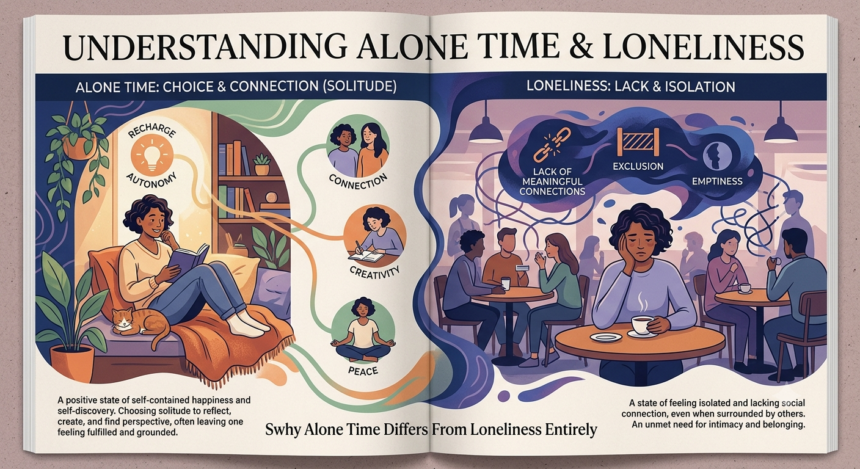
Why Alone Time Is Not the Same as Loneliness
Society has long treated solitude with suspicion. Spending time without company often raises eyebrows, as though choosing to be alone signals something broken. Yet psychological research paints a completely different picture. Solitude, when chosen deliberately, functions as a restorative practice that sharpens creativity, deepens self-awareness, and strengthens emotional regulation. Loneliness, by contrast, carries an entirely different emotional weight. It emerges not from physical isolation but from the perceived absence of meaningful connection, even when surrounded by others. Understanding this distinction reshapes how people relate to time spent on their own.
The Psychology Behind Chosen Solitude
Deliberate solitude is an active choice. It involves stepping away from external stimulation to create space for reflection, rest, or focused work. Psychologists have long recognized that the capacity to be alone comfortably is a marker of emotional maturity. British psychoanalyst Donald Winnicott argued that the ability to enjoy solitude develops in early childhood and remains essential throughout life. When someone seeks quiet hours for reading, walking, or journaling, the experience tends to reduce cortisol levels and restore cognitive resources depleted by constant social interaction.
The critical element is agency. People who choose solitude typically report higher satisfaction compared to those who feel forced into it. This voluntary nature transforms what could otherwise feel like deprivation into something nourishing. Introverts may naturally gravitate toward these periods, but extroverts benefit equally when they allow themselves unstructured time away from social obligations.
How Loneliness Operates Differently
Loneliness functions as an emotional signal rather than a physical condition. A person can feel profoundly lonely at a crowded dinner party or entirely content spending a weekend without seeing anyone. Loneliness arises when the quality or quantity of social connections falls short of what an individual needs. It triggers the same neural pathways associated with physical pain, which explains why chronic loneliness carries significant health consequences, including elevated blood pressure, weakened immune function, and increased risk of depression.
| Aspect | Chosen Solitude | Loneliness |
| Origin | Voluntary decision | Perceived lack of connection |
| Emotional tone | Peaceful, energizing | Sad, anxious, hollow |
| Effect on health | Lowers cortisol, restores focus | Raises blood pressure, weakens immunity |
| Social outcome | Enhances later interactions | Makes social situations feel exhausting |
| Self-esteem impact | Remains stable or improves | Gradually erodes confidence |
Recreational activities that people enjoy during solitude sometimes mirror those pursued to escape loneliness, which is why the two states get confused. Someone might explore online entertainment purely for relaxation during quiet evenings. Services similar to Icecasino and other gaming environments attract players who enjoy the experience on their own terms, treating it as leisure rather than a substitute for human connection.
The motivation behind the activity determines whether the experience is restorative or compensatory. What makes loneliness particularly insidious is its tendency to distort perception. Lonely individuals often interpret neutral social cues as negative, creating a feedback loop that makes reaching out feel increasingly risky.
Recognizing the Difference in Daily Life
Distinguishing between productive solitude and creeping loneliness requires honest self-assessment. The emotional tone surrounding time alone serves as the most reliable indicator. Solitude that feels peaceful or creatively stimulating generally falls on the healthy side. Time alone that consistently produces rumination or a gnawing sense of disconnection points toward loneliness. Several markers help clarify which state someone is experiencing:
- Chosen solitude typically ends when the person feels ready to reconnect, without anxiety about doing so.
- Loneliness persists even after social interaction because the underlying need for deeper connection remains unmet.
- Solitude enhances subsequent social engagement by making interactions feel more intentional.
- Loneliness tends to make social situations feel performative, increasing the desire to withdraw further.
These markers provide a useful framework for reflection. Paying attention to the emotional residue left by time alone reveals whether solitude is serving its intended purpose. Journaling after periods of solitude can help track patterns over time, making it easier to notice when healthy alone time begins shifting toward isolation. Similarly, checking in with trusted friends or family members offers an external perspective that cuts through the self-deception loneliness often encourages.
Building a Healthier Relationship With Solitude
The goal is not to avoid being alone or to force constant social engagement. Rather, it involves cultivating awareness of personal needs that shifts with circumstances, energy levels, and life stages. Someone recovering from burnout may need weeks of relative isolation. A person navigating grief might oscillate between craving company and needing silence within the same day. Flexibility matters more than rigid rules.
Societies that normalize solitude without romanticizing isolation create better conditions for mental health. When being alone stops carrying moral judgment, people become more willing to seek connection when they genuinely need it and to protect their solitude when it serves them. Neither state is inherently superior, and the wisdom lies in knowing which one is present at any given moment.
Solitude as a Skill, Not a Symptom
The conversation around alone time benefits from reframing. Solitude is not a problem to solve but a capacity to develop. Loneliness, meanwhile, deserves attention and compassion rather than dismissal. By treating these as distinct experiences with different causes and remedies, individuals gain clarity about what they actually need. The quiet hours spent in genuine solitude remain among the most undervalued resources for maintaining emotional balance and intellectual vitality.