


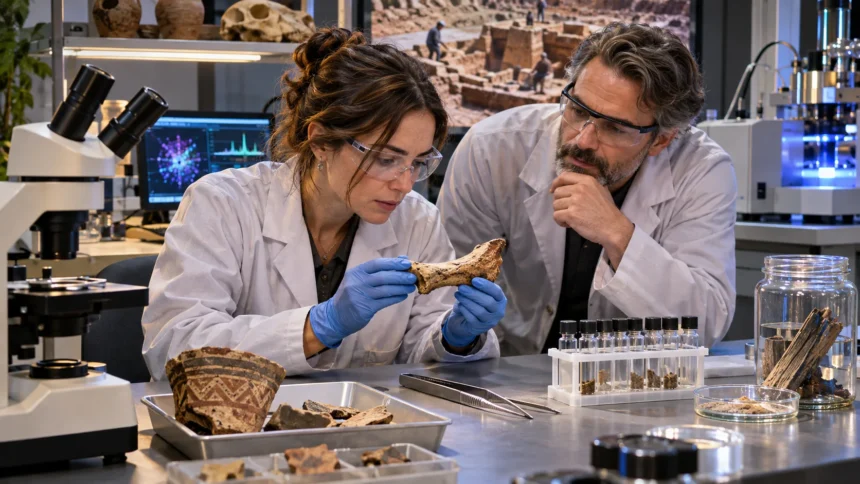
Carbon dating is one of the most important scientific methods used to understand the age of ancient objects and archaeological discoveries. Scientists use this technique to estimate when once-living materials, such as wood, bones, and plant remains, stopped exchanging carbon with their surroundings. Understanding how scientists use carbon dating to determine age helps explain how researchers investigate human history, ancient environments, and prehistoric life.
Also called radiocarbon dating, this method measures a radioactive form of carbon known as carbon-14. Because carbon-14 gradually breaks down over time, the amount remaining in an organic sample provides clues about its age. However, accurate results require careful laboratory analysis, calibration, and an understanding of the method’s limitations. This guide explains how carbon dating works and why it matters.
What Is Carbon Dating and How Does It Work?
Carbon dating is a scientific technique used to estimate the age of materials that were once part of living organisms. It works by measuring the amount of radioactive carbon-14 remaining in a sample. Scientists compare this measurement with known patterns of radioactive decay. The results help estimate how long ago the material stopped exchanging carbon with its environment.
Living organisms continually exchange carbon with their surroundings through processes such as eating, breathing, and photosynthesis. This carbon includes small amounts of naturally occurring carbon-14. When an organism dies, the exchange of carbon generally stops. The carbon-14 already present then gradually decreases through radioactive decay.
Scientists measure the remaining carbon-14 to estimate the time that has passed since this exchange ended. However, carbon dating does not directly measure the age of every object or event associated with a sample. Researchers must consider the material’s history and archaeological context. Careful interpretation helps produce meaningful estimates of the past.
The Science Behind Carbon-14 and Radioactive Decay
Carbon exists in several forms called isotopes, which contain different numbers of neutrons. Carbon-12 and carbon-13 are stable isotopes, while carbon-14 is radioactive. Carbon-14 forms naturally in the upper atmosphere through interactions involving cosmic radiation and nitrogen. It then becomes part of the Earth’s carbon cycle.
Plants absorb carbon from atmospheric carbon dioxide during photosynthesis. Animals obtain carbon by consuming plants or other animals, allowing carbon-14 to enter food chains. While organisms remain alive, carbon exchange helps maintain a relationship with environmental carbon levels. After death, radioactive carbon-14 continues decaying without being replenished through normal biological processes.
Carbon-14 decays into nitrogen-14 through a process known as beta decay. This transformation happens at a predictable statistical rate, making it useful for scientific dating. Researchers can estimate how much carbon-14 should remain after a particular period. Understanding radioactive decay is therefore essential for calculating radiocarbon ages.
How Do Scientists Use Carbon Dating to Determine Age?
Scientists begin carbon dating by selecting a suitable organic sample, such as charcoal, wood, bone collagen, or plant fibers. They carefully examine the material and remove potential contaminants that could affect the measurement. The prepared sample is then analyzed using specialized laboratory equipment. These steps help determine the amount of carbon-14 remaining.
The laboratory measurement is used to calculate a conventional radiocarbon age. Scientists apply the known decay behavior of carbon-14 and compare the results with an established measurement standard. Because atmospheric carbon-14 concentrations have changed over time, this calculation alone does not always provide an accurate calendar age. Additional calibration is usually required.
Researchers compare the radiocarbon measurement with calibration curves developed from independently dated materials. These curves help convert radiocarbon years into estimated calendar dates. Results are often presented as probability ranges rather than one exact year. This approach reflects measurement uncertainty and natural variations in historical carbon-14 levels.
What Is the Half-Life of Carbon-14?
The half-life of carbon-14 is approximately 5,730 years. A half-life represents the time required for half of the radioactive atoms in a sample to decay. After one half-life, approximately half of the original carbon-14 remains. After another half-life, roughly one-quarter remains.
This predictable process allows scientists to estimate the age of ancient organic materials. For example, a sample containing approximately half its original carbon-14 may have a radiocarbon age near 5,730 years under simplified assumptions. A sample containing one-quarter would be approximately two half-lives old. Real laboratory dating requires additional adjustments and calibration.
Radioactive decay does not mean every carbon-14 atom disappears at the same moment. Instead, each atom has a probability of decaying over time. Large collections of atoms follow predictable statistical patterns. These patterns make radiocarbon dating possible even though the behavior of an individual atom cannot be predicted precisely.
What Materials Can Be Tested Using Carbon Dating?
Carbon dating works primarily on materials that contain carbon derived from living organisms. Common examples include wood, charcoal, seeds, bones, leather, and natural textile fibers. Archaeologists frequently select these materials because they can preserve evidence of past human activity. The sample must contain enough suitable carbon for reliable analysis.
Wood and charcoal are commonly tested because they often survive in archaeological environments. Animal bones may also be dated when sufficient preserved collagen remains. Plant fibers from ancient fabrics and baskets can provide useful information about historical objects. Each material requires preparation methods suited to its chemical composition.
However, carbon dating cannot directly determine the age of most rocks, metals, or manufactured objects containing no suitable organic carbon. Scientists may instead date associated materials found in the same archaeological layer. Such relationships must be evaluated carefully. An associated sample does not automatically establish the exact manufacturing date of another object.
How Scientists Collect and Prepare Carbon Dating Samples
Accurate carbon dating begins with careful sample collection. Archaeologists document where an object was discovered, its surrounding soil layers, and its relationship to nearby materials. This information helps explain the significance of the eventual date. Poor documentation can make even an accurate laboratory measurement difficult to interpret.
Researchers take precautions to reduce contamination during collection and storage. Modern carbon from handling materials, adhesives, conservation treatments, or surrounding environments can alter results. Suitable containers and appropriate sampling techniques help preserve the material. Laboratories also examine samples for evidence of contamination before measuring their carbon content.
Preparation methods vary depending on the sample type. Charcoal may undergo chemical treatments to remove unwanted substances, while bones require procedures designed to isolate suitable collagen. Laboratories use established quality-control processes to evaluate material preservation. Thorough preparation improves the reliability of radiocarbon measurements and helps identify unsuitable samples.
How Carbon Dating Is Measured in Laboratories
Modern radiocarbon laboratories frequently use accelerator mass spectrometry, commonly called AMS. This technology measures the relative abundance of carbon isotopes in carefully prepared samples. AMS can work with relatively small quantities of carbon. Its sensitivity makes it valuable for archaeological materials that cannot easily provide large samples.
Earlier radiocarbon methods often measured radioactive emissions produced during carbon-14 decay. These techniques include gas proportional counting and liquid scintillation counting. Although they remain important in the history of radiocarbon science, AMS is widely used for modern archaeological dating. Different measurement techniques have distinct preparation requirements and practical advantages.
Laboratories compare measurements with reference standards and background samples to evaluate accuracy. They also report measurement uncertainty because the results involve statistical variation and technical limitations. A radiocarbon result is therefore not simply a number produced by a machine. Reliable dating depends on sample preparation, calibration, and careful scientific interpretation.
Why Carbon Dating Results Need Calibration
Carbon dating calculations initially rely on assumptions about historical carbon-14 concentrations. However, atmospheric carbon-14 levels have changed because of natural processes and other influences. These variations mean radiocarbon years do not always match calendar years directly. Calibration is necessary to account for this difference.
Scientists develop calibration curves using independently dated materials, including tree rings and other natural records. Tree-ring sequences are particularly useful because individual rings can be assigned calendar years. Researchers measure radiocarbon concentrations in these known-age materials. The resulting data help connect radiocarbon measurements with calendar dates.
Calibration can produce a range of possible calendar ages rather than one exact result. Some portions of a calibration curve contain irregular patterns that create broader date ranges. Researchers report these outcomes using probability intervals. This approach helps communicate uncertainty instead of suggesting a level of precision that the evidence cannot support.
How Accurate Is Carbon Dating?
Carbon dating can provide highly useful age estimates when samples are properly selected, prepared, and calibrated. However, accuracy depends on sample quality, contamination, measurement uncertainty, and historical carbon conditions. Some samples produce relatively narrow date ranges, while others have greater uncertainty. There is no universal accuracy level suitable for every material.
Contamination is one of the main factors affecting results. Modern carbon introduced into an ancient sample can make it appear younger than its actual age. Older carbon from certain environmental sources may produce misleadingly old results. Laboratories use specialized treatments and quality checks to reduce these problems.
Researchers improve confidence by comparing radiocarbon dates with archaeological evidence and other dating methods. Multiple samples from the same context may provide additional information about the timing of events. However, agreement between measurements must still be interpreted carefully. Scientific accuracy depends on evaluating all available evidence rather than trusting one result automatically.
How Far Back Can Carbon Dating Measure?
Radiocarbon dating is generally most useful for organic materials up to approximately 50,000 years old. Beyond this range, so little carbon-14 remains that reliable measurement becomes increasingly difficult. The practical limit depends on laboratory methods, contamination, and sample preservation. Some specialized measurements may extend slightly beyond the usual range.
Very recent samples also present challenges because relatively little radioactive decay has occurred. Changes in atmospheric carbon-14 from industrial activity and nuclear testing complicate the interpretation of modern materials. However, these changes can sometimes provide useful dating information for certain recent samples. Scientists select methods according to the expected age.
Carbon dating is therefore not suitable for determining the age of dinosaurs or ancient geological formations millions of years old. Researchers use other techniques for those investigations. Potassium-argon, uranium-lead, and related radiometric methods can measure much older geological materials. Choosing the correct dating technique depends on the material and expected timescale.
How Carbon Dating Helps Archaeologists Study History
Archaeologists use carbon dating to establish chronological information about past human activities. Organic remains found near ancient settlements, tools, and structures can provide evidence about when people occupied a location. These dates help researchers organize discoveries into historical sequences. They can also support comparisons between different archaeological sites.
Charcoal from an ancient fireplace may provide information about when wood was burned. Seeds recovered from storage areas can help researchers investigate agricultural activities. Organic fibers from textiles may reveal when their source plants were harvested. However, the relationship between the dated material and human activity must be carefully established.
Carbon dating is especially valuable when written historical records are unavailable or incomplete. It allows researchers to investigate prehistoric societies using scientific measurements. Combined with excavation records and material analysis, radiocarbon dates contribute to a more detailed understanding of human history. The method has transformed archaeological research around the world.
Carbon Dating in Environmental and Climate Research
Carbon dating is also used to investigate environmental changes that occurred in the past. Scientists examine organic remains preserved in sediments, peat deposits, and other natural materials. These samples can provide age information for environmental records. Researchers use this evidence to reconstruct changes in landscapes, vegetation, and ecosystems.
For example, plant remains preserved in sediment layers may help establish when certain environmental conditions existed. Researchers can compare radiocarbon dates with pollen records and other indicators of past vegetation. These relationships provide information about long-term ecological changes. Accurate interpretation requires an understanding of how the sediments were formed.
Radiocarbon measurements can also help researchers investigate carbon movement through natural systems. Oceans, soils, and other environments exchange carbon at different rates. These differences can influence the apparent radiocarbon age of collected materials. Understanding environmental carbon cycles is important for both dating accuracy and broader scientific research.
Limitations and Challenges of Carbon Dating
One major limitation of carbon dating is that it works only with suitable carbon-containing materials. Most rocks, metals, and fossils that have lost their original organic carbon cannot be directly dated using this method. Researchers must identify appropriate samples or use alternative techniques. Selecting the wrong material can lead to misleading conclusions.
Another challenge involves contamination and the original source of carbon. For example, certain aquatic organisms may contain carbon that appears older because of environmental reservoir effects. Wood can also present an old-wood problem when inner portions of long-lived trees are dated. In these situations, the measured age may predate the event being investigated.
Carbon dating also provides estimates rather than exact historical timestamps. Measurement uncertainty, calibration patterns, and sample history all affect the final interpretation. Scientists must communicate these limitations when presenting results. Understanding uncertainty makes radiocarbon dating more useful because it prevents misleading claims about precision.
Carbon Dating vs. Other Scientific Dating Methods
Carbon dating is one of several scientific techniques used to investigate the age of materials. Its main advantage is its suitability for many organic remains from the relatively recent geological past. However, it has a limited age range and specific material requirements. Other methods are necessary for older or non-organic objects.
Potassium-argon dating is commonly used to investigate certain volcanic rocks and geological events. Uranium-lead dating can provide information about very old minerals and rock formations. Dendrochronology uses tree-ring patterns to establish chronological information. Each method relies on different scientific principles and has particular applications.
Scientists often combine dating techniques when investigating complex sites or geological histories. For example, tree-ring records help calibrate radiocarbon dates, while geological methods may establish the ages of surrounding formations. Comparing independent evidence improves confidence in chronological interpretations. The most appropriate technique depends on the research question and available material.
Common Misconceptions About Carbon Dating
A common misconception is that carbon dating can determine the age of any object. In reality, it generally applies to suitable materials that contain carbon associated with once-living organisms. A stone tool cannot usually be dated directly using carbon-14. Researchers may instead analyze related organic remains discovered in a reliable context.
Another misunderstanding is that carbon dating always provides an exact year. Radiocarbon measurements involve uncertainty, and calibration can produce several possible calendar ranges. Scientists report results using established statistical methods. This does not make the technique unreliable; it reflects responsible interpretation of scientific evidence.
Some people also assume carbon dating can measure objects millions of years old. However, the relatively short half-life of carbon-14 limits its usefulness to much younger materials. Older geological samples require different radiometric methods. Understanding these distinctions helps prevent confusion about how scientists establish the ages of ancient discoveries.
Why Carbon Dating Remains Important in Modern Science
Carbon dating remains an essential scientific method because it connects measurable physical processes with historical evidence. Researchers can analyze suitable organic materials and estimate when biological carbon exchange ended. This creates opportunities to investigate events that occurred long before written records. The method continues supporting archaeological and environmental research.
Technological improvements have made radiocarbon measurements possible using smaller samples and increasingly refined laboratory procedures. Accelerator mass spectrometry has expanded the range of materials that can be studied. Updated calibration datasets also improve chronological interpretation. However, scientific judgment remains essential when selecting samples and evaluating results.
The value of carbon dating extends beyond producing numerical ages. It helps scientists build chronological frameworks, test historical interpretations, and compare evidence from different locations. When combined with careful excavation and environmental analysis, it provides a deeper understanding of the past. Its continued development demonstrates the importance of reliable measurement in scientific discovery.
Conclusion
Understanding how scientists use carbon dating to determine age reveals the important relationship between radioactive decay and historical investigation. Scientists measure the remaining carbon-14 in suitable organic materials to estimate when they stopped exchanging carbon with their environment. Laboratory preparation and isotope measurements support this process. Calibration helps convert the results into meaningful calendar-age estimates.
Carbon dating is widely used in archaeology, environmental science, and studies of prehistoric human activity. It can provide valuable information about ancient settlements, organic artifacts, and natural changes. However, contamination, sample selection, and age limitations can influence accuracy. Researchers must evaluate these factors carefully to produce reliable interpretations.
Ultimately, radiocarbon dating remains one of the most influential methods for investigating the relatively recent past. Its scientific foundation, laboratory techniques, and calibration procedures allow researchers to estimate ages with measurable uncertainty. By combining radiocarbon evidence with other research methods, scientists can build more accurate historical timelines. This helps us understand how human societies and natural environments developed over thousands of years.
Frequently Asked Questions (FAQs)
How do scientists use carbon dating to determine age?
Scientists measure the amount of radioactive carbon-14 remaining in suitable organic materials. They calculate a radiocarbon age using its known decay rate and then apply calibration curves to estimate the material’s calendar age.
What is the half-life of carbon-14?
The half-life of carbon-14 is approximately 5,730 years. This means that half of the radioactive carbon-14 atoms in a sample decay during that period. Scientists use this predictable rate to estimate radiocarbon ages.
How accurate is carbon dating?
Carbon dating can provide reliable age estimates when samples are properly prepared and calibrated. Accuracy depends on contamination, sample preservation, laboratory measurements, and calibration uncertainty. Results are generally reported as estimated date ranges.
Can carbon dating determine the age of dinosaurs?
No. Dinosaurs lived millions of years ago, far beyond the useful range of radiocarbon dating. Scientists use other geological dating methods, including radiometric analysis of suitable rocks, to investigate such ancient periods.
What materials can be tested with carbon dating?
Carbon dating commonly works with suitable organic materials such as wood, charcoal, seeds, bones, and natural fibers. Most rocks and metals cannot be directly dated with carbon-14 because they lack appropriate organic carbon.