

Introduction to Artificial Intelligence in Academia
Artificial intelligence (AI) has emerged as a pivotal discipline within academia, garnering an increasing level of significance in educational institutions worldwide. The rising demand for AI technologies in various industries underscores the necessity for educational programs that equip students with relevant knowledge and skills. As businesses and organizations seek to leverage AI for automation, data analysis, and decision-making, universities are proactively adapting their curricula to meet this evolving need.
AI education has transcended traditional boundaries, forming interdisciplinary programs that blend computer science, mathematics, ethics, and domain-specific knowledge. This shift reflects a broader recognition of AI’s potential to transform fields including healthcare, finance, transportation, and the environment. As a response, universities are not only enhancing their core computer science programs but also integrating AI concepts into diverse academic disciplines.
The increasing role of AI in shaping job markets has further propelled academic institutions to prioritize AI research. Universities are investing in state-of-the-art research centers and engaging in collaborative projects that push the boundaries of AI technology. Through grant-funded initiatives and partnerships with industry leaders, faculties are focusing on groundbreaking research that addresses real-world challenges, thus reinforcing the value of an AI-infused education.
In conclusion, the integration and importance of artificial intelligence in academia are becoming ever more apparent. Educational institutions are recognizing the urgency to innovate and adapt their offerings to prepare students for a knowledge-driven economy that hinges on computational intelligence. Through comprehensive AI education and cutting-edge research, universities are positioning themselves as integral players in the future landscape of technology and innovation.
Overview of University Rankings
University rankings serve as essential tools for prospective students, researchers, and educational institutions seeking to evaluate performance across various parameters. Different rankings employ diverse methodologies, incorporating a range of indicators that reflect the academic landscape of universities globally. Prominent ranking bodies, such as QS World University Rankings, Times Higher Education, and Academic Ranking of World Universities (ARWU), utilize distinct criteria in their assessments.
Research output is often a cornerstone in these evaluations; it measures the quantity and quality of scholarly publications contributed by faculty members. Some rankings further assess citation impacts, emphasizing influence within the academic community. Another vital aspect is faculty qualifications, looking at the percentage of faculty holding advanced degrees or distinguished accolades, which indicates the caliber of education students receive.
The student-to-faculty ratio is another metric that these rankings consider. A lower ratio generally signifies a more personalized educational experience, allowing students more direct access to faculty support and resources. Additionally, university rankings may include parameters related to international diversity, examining the percentage of international faculty and students as indicators of a global perspective.
Moreover, employability of graduates is frequently included in such analyses, reflecting the success of institutions in preparing their students for the job market. The methodologies behind these rankings frequently evolve, adjusting to incorporate new educational trends and societal expectations. Therefore, it is vital to understand that while rankings provide valuable insights, they should be interpreted with due diligence, recognizing both their strengths and limitations.
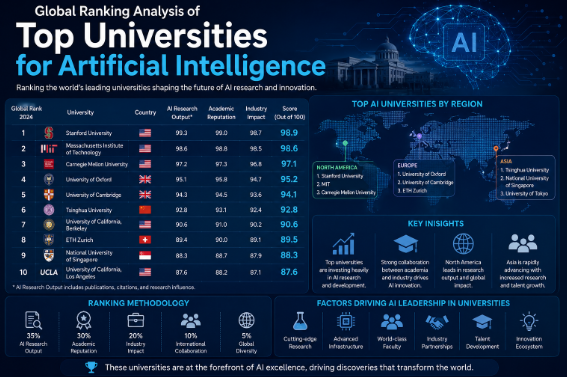
Top 10 Universities for Artificial Intelligence
When it comes to excelling in artificial intelligence (AI) research and education, several universities stand out on the global stage. Below is a detailed analysis of the top 10 institutions known for their exceptional programs and innovative contributions to the field of artificial intelligence.
1. Massachusetts Institute of Technology (MIT) – Renowned for pioneering AI research, MIT offers a comprehensive curriculum focusing on machine learning and robotics. Notable faculty includes the Turing Award winner, Eugene Charniak, who has significantly impacted AI development.
2. Stanford University – This university is home to leading AI research groups, including the Stanford AI Lab. Its curriculum emphasizes real-world applications, with course offerings like natural language processing and computer vision spearheaded by expert faculty such as Fei-Fei Li.
3. Carnegie Mellon University (CMU) – CMU is recognized as a pioneer in AI, especially in the fields of robotics and machine learning. The university’s School of Computer Science is led by industry experts and has contributed immensely to AI advancements through research and technology transfer.
4. University of California, Berkeley – Known for its dynamic AI initiative, UC Berkeley integrates cutting-edge research with interdisciplinary studies. With faculty members like Trevor Darrell, the university excels in training the next generation of AI researchers.
5. University of Washington – This institution emphasizes collaboration in AI research and offers programs focusing on human-centered AI. Its faculty is renowned for contributions to areas such as robotics and AI ethics.
6. University of Toronto – As a leader in deep learning research, the University of Toronto has significantly influenced AI advancements, particularly through notable faculty like Geoffrey Hinton, who is often referred to as one of the ‘Godfathers of Deep Learning.’
7. Oxford University – Oxford’s Machine Learning Research Group plays a crucial role in AI development in areas like medical AI and ethical considerations surrounding AI technology.
8. University of Cambridge – This university is acclaimed for its research into the implications of AI, particularly in the social and ethical domains, providing a well-rounded education in technology.
9. Harvard University – Harvard combines interdisciplinary approaches with AI, emphasizing applications in fields such as health and security, led by expert faculty members with robust research portfolios.
10. ETH Zurich – Known for its strong emphasis on engineering and technology, ETH Zurich is a top institution in Europe for AI research, notable for work in robotics and data science.
Comparing these top universities highlights their strengths and unique contributions to the field of artificial intelligence, illustrating different approaches, areas of expertise, and collaborative opportunities in AI research and application.
Factors Contributing to AI Excellence in Universities
The field of artificial intelligence (AI) is rapidly evolving, and universities play a pivotal role in fostering advancements in this domain. Several factors contribute to a university’s success in AI, including faculty research output, investment in AI technology, industry partnerships, and availability of cutting-edge facilities.
Firstly, the research output of faculty members is a significant indicator of an institution’s strength in AI. Professors who are active in publishing innovative research papers and contributing to reputable journals enhance the academic reputation of their universities. Their efforts in cutting-edge AI research not only elevate the institution’s profile but also attract top talents, funding, and collaborations.
Investment in AI technology is another critical factor that institutions must prioritize. A university that allocates substantial resources to develop its AI infrastructure, tools, and software will better equip its students and faculty to excel. Such investments allow for the implementation of state-of-the-art teaching methodologies and research initiatives, which lead to significant strides in AI advancements.
Partnerships with industry players are also instrumental in enhancing a university’s AI capabilities. Collaborations with tech companies provide students and researchers with real-world experience, access to proprietary technologies, and opportunities for internships. These relationships not only bridge the gap between academia and the industry but also ensure that the educational programs remain aligned with current market demands.
Finally, the availability of advanced facilities, such as research labs equipped with high-performance computing resources, is vital for fostering innovation. Facilities that support experimental learning and interdisciplinary collaboration will greatly benefit students pursuing careers in AI and further strengthen the university’s position in the field. Together, these factors create a nurturing environment that promotes AI excellence and prepares graduates for successful careers in this rapidly advancing field.
Emerging Trends in AI Education
As artificial intelligence (AI) continues to evolve, so does the landscape of education surrounding it. Today, numerous universities across the globe are implementing interdisciplinary programs that integrate AI with other fields such as ethics, healthcare, and robotics. This fusion not only cultivates a more holistic understanding of the implications of AI technology but also prepares students for diverse career pathways where AI is becoming increasingly relevant.
In the realm of ethics, for instance, educators are emphasizing the moral implications of AI deployment in society. Courses now include discussions on bias in algorithms, privacy concerns, and the broader societal impacts of machine learning. This focus on ethical considerations ensures that future professionals are not only technically proficient but also socially responsible.
Another significant trend is the expansion of AI in the healthcare sector. Universities are developing specialized curricula that combine AI with medical training, equipping future healthcare professionals with the skills needed to utilize AI for diagnostics, patient care, and predictive analytics. This interdisciplinary approach aims to improve patient outcomes while preparing graduates for an industry that increasingly relies on AI technologies.
Online learning initiatives have also gained momentum, enabling access to AI education on a global scale. Through massive open online courses (MOOCs) and digital platforms, learners from diverse backgrounds can acquire knowledge and skills in AI without the constraints of traditional classroom settings. This democratization of AI education allows for a wider pool of talent to enter the field.
Additionally, collaborations between academia and industry are becoming more prevalent. Partnerships with tech companies provide students with real-world experience through internships, projects, and research opportunities. These collaborations strengthen the link between theoretical knowledge and practical application, ensuring that graduates are well-prepared for the workforce.
Finally, the rise of specialized AI certificates has made it easier for professionals to upskill. Certificates allow individuals to gain targeted knowledge in AI areas, catering to those who seek to enhance their career prospects without enrolling in a full degree program. As these trends continue to shape AI education, the focus remains on developing well-rounded professionals equipped to meet the challenges of an AI-driven future.
Regional Insights: Global Distribution of Top AI Universities
The geographical landscape of top universities specializing in artificial intelligence (AI) presents a vivid picture of innovation and research concentration across various regions. North America, particularly the United States, continues to dominate the field, hosting many prestigious universities recognized for their AI programs. Institutions such as Stanford University and MIT lead the way with their cutting-edge research facilities and collaborations with industry leaders, significantly contributing to advancements in AI technology.
Europe is another pivotal region in the global distribution of top AI universities. Countries like the United Kingdom, Germany, and France have established themselves as key players in AI research. The University of Oxford and ETH Zurich exemplify the high-quality education and innovative research taking place in Europe. Moreover, the European Union’s investment in AI strategies demonstrates a collective effort to foster an environment conducive to AI development, leading to increased collaborations among academic institutions and research bodies.
In contrast, Asia is rapidly emerging as a powerhouse in AI education and research. Notable institutions in countries such as China, Japan, and South Korea are gaining recognition for their robust AI programs. The Tsinghua University and the National University of Singapore are prime examples of this trend, attracting international students and researchers alike. This shift signifies not only a growing commitment to technology within these nations but also a broader shift in global dynamics in the field of artificial intelligence.
Overall, the distribution of top AI universities highlights a competitive landscape where regions vie for leadership in research and innovation. Understanding these regional insights allows stakeholders to appreciate the diversity and dynamism within the AI academic community, paving the way for future advancements and collaborations in this vital field.
Impact of AI Education on Job Market
The rapid evolution of artificial intelligence (AI) has not only transformed various industries but has also significantly impacted the job market for graduates in this field. Universities that feature prominently in global rankings for AI programs tend to produce graduates with high employability rates, as these institutions often have robust relationships with leading tech companies and access to advanced research facilities. The reputation of a university can greatly enhance a graduate’s prospects, serving as a marker of quality education and training in AI technologies.
A notable correlation exists between the ranking of universities offering AI education and the job opportunities available in the AI sector. Graduates from top-tier institutions often find themselves in high demand across industries that are increasingly incorporating AI into their operations. Employers are frequently on the lookout for candidates who possess not only theoretical knowledge but also practical experience and innovative problem-solving skills developed through cutting-edge academic programs.
The AI job market is diverse, spanning domains such as healthcare, finance, and robotics, which further amplifies the prospects for well-educated applicants. Graduate pathways in AI commonly include roles such as data scientist, machine learning engineer, and AI researcher, which are crucial for driving innovation. Additionally, firms value graduates from esteemed universities for their ability to contribute effectively to interdisciplinary teams and navigate complex AI challenges.
In summary, the alignment between the educational credentials of AI graduates and employer expectations underscores the importance of university pedigree in navigating the burgeoning job market for artificial intelligence specialists. The trend suggests that attending a university recognized for its AI programs can significantly enhance a graduate’s career trajectory within this dynamic and competitive field.
Challenges Facing AI Programs in Institutions
As artificial intelligence (AI) continues to grow in significance, universities striving to implement robust AI programs encounter a myriad of challenges. One of the most pressing issues is funding constraints. The establishment and maintenance of AI programs require substantial financial investment in research, infrastructure, and technology. Many institutions struggle to allocate sufficient resources necessary to support these initiatives, particularly in an environment where other academic programs also compete for funding.
Moreover, the rapid pace of technological advancements in AI presents another significant challenge for universities. The field of AI is constantly evolving, making it crucial for institutions to keep their curricula updated and relevant. As new methods, tools, and research emerge, universities need to adapt quickly to integrate these advancements into their academic offerings. This ongoing need for curriculum evolution can strain resources and lead to delays in delivering quality education in AI.
Additionally, a notable shortage of skilled educators also hampers the development of AI programs. There is a growing demand for professionals who possess both industry experience and academic expertise in artificial intelligence. As the field expands, the competition for qualified faculty members intensifies. Universities often find it challenging to recruit and retain talented educators capable of teaching advanced AI concepts and conducting impactful research.
In summary, universities face numerous challenges, including funding limitations, the need to adapt to rapid technological change, and a shortage of qualified educators when establishing AI programs. Addressing these challenges is essential for institutions aiming to excel in this vital area of study and research, ensuring they can provide students with a comprehensive education in artificial intelligence.
Conclusion and Future Perspectives
The analysis of the top universities for Artificial Intelligence (AI) not only highlights their current standings but also reveals significant trends underlying their success. Institutions leading the global rankings incorporate a blend of intensive research initiatives, cutting-edge technology, and comprehensive educational programs tailored towards advancing AI. Such universities often enhance their curriculum to include hands-on experience with AI applications across various disciplines, thereby equipping students with both theoretical knowledge and practical skills essential for a career in Informatics or AI.
As we look to the future, it is evident that the landscape of AI education is on the brink of transformation. With rapid advancements in technology, it is likely that universities will adapt their offerings to meet new industry demands. The integration of interdisciplinary studies, such as engineering, neuroscience, and ethics with AI, could become a standard approach in academic curriculums. Furthermore, universities may begin to leverage partnerships with tech companies to provide students with real-world experience, thus enhancing employability upon graduation.
In addition to educational adaptations, the methodologies for ranking universities may also evolve. As AI research progresses, factors such as collaboration with industry, innovation outputs, and the societal impact of research will likely play a larger role in future rankings. The emphasis on sustainability and responsible AI will drive institutions to develop programs that not only focus on technological advancement but also address the ethical implications surrounding AI technologies.
In conclusion, the insights gathered from the current global rankings of universities for AI underscore their pivotal role in shaping the field’s future. As the demand for AI expertise continues to grow, it is imperative for academic institutions to adapt their strategies to maintain relevancy and excellence in education and research. Monitoring these developments will be crucial as the next generation of AI professionals emerges from these esteemed programs.