


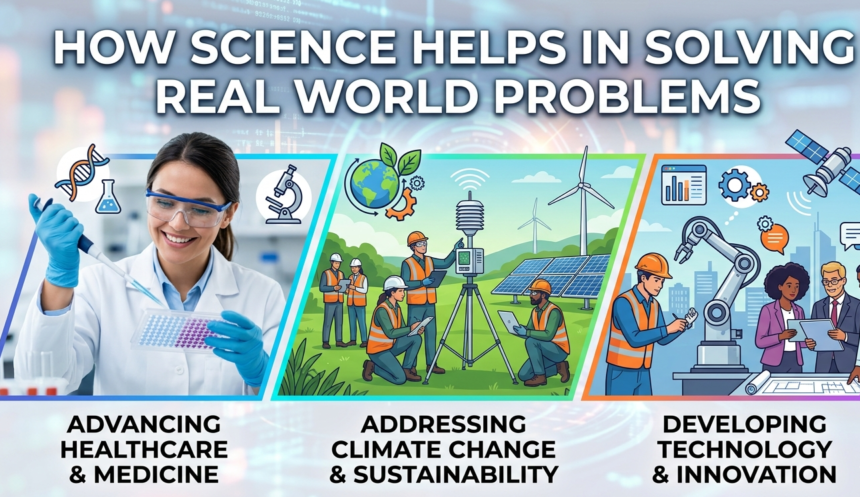
Introduction to the Role of Science
Science is an essential tool that facilitates a profound understanding of the complexities inherent in the world around us. At its core, science is rooted in systematic observation, experimentation, and theoretical analysis, which together contribute to a comprehensive exploration of various phenomena. The rigorous methodologies employed in scientific inquiry allow for the investigation of problems that affect societies across different layers, from environmental and health issues to technological advancements and social challenges.
The importance of scientific thinking cannot be overstated. It involves critical reasoning and analytical skills that enable individuals and groups to objectively assess situations and data. This mindset is crucial for addressing real-world problems, as it fosters a culture of inquiry and challenges assumptions. Rather than accepting information at face value, scientific thinking promotes skepticism and thorough examination, thereby enhancing our ability to devise effective solutions.
Furthermore, the application of scientific methods empowers decision-makers with the tools required to navigate uncertainties and complexities. For example, in public health, scientific research underpins strategies to combat diseases and improve health outcomes. Similarly, environmental science plays a pivotal role in informing policy decisions related to climate change and conservation efforts. Each of these fields exemplifies how science acts as a bridge between theoretical knowledge and practical application, ultimately leading to tangible benefits in society.
As we delve deeper into the role of science in solving particular challenges, it becomes evident that interdisciplinary approaches are often necessary. By integrating knowledge from various scientific domains, we enhance our understanding and ability to tackle multifaceted issues effectively. This interconnectedness showcases the power of science as not only a means for understanding the world but also as a catalyst for innovative solutions.
Identifying Global Challenges
In today’s world, we are confronted with a myriad of pressing global challenges that require urgent attention and innovative solutions. Climate change stands at the forefront of these issues, presenting a significant threat to ecosystems, economies, and human health. The scientific community plays a vital role in understanding the mechanisms behind climate change and devising strategies to mitigate its impacts. From improving renewable energy technologies to enhancing carbon capture methods, scientific research is essential in the fight against this global crisis.
Moreover, health crises, such as pandemics and antibiotic resistance, pose serious risks to public health worldwide. The COVID-19 pandemic, for instance, has underscored the necessity for robust scientific inquiry and interdisciplinary approaches to develop effective vaccines and treatments. Addressing these health emergencies not only requires immediate action but also a commitment to long-term health research, which can facilitate preparedness for future outbreaks.
Resource depletion is another significant challenge as the demand for natural resources continues to escalate. Scientific exploration into sustainable resource management and alternative materials is critical. It encompasses areas such as agricultural innovation, water conservation techniques, and the development of biodegradable materials, all aimed at ensuring the sustainability of our planet’s resources.
Lastly, social inequality presents a complex challenge that intersects with various scientific fields, including economics, sociology, and public policy. Disparities in education, healthcare, and economic opportunities need to be examined through rigorous scientific research in order to formulate equitable solutions. By addressing these global challenges through science, we are better equipped to create a more sustainable, healthy, and equitable world for future generations.
Case Study: Climate Change Mitigation
Climate change presents one of the most pressing challenges of our time, necessitating significant action through scientific advancements. Various initiatives focused on renewable energy, carbon capture technology, and ecological conservation strategies demonstrate how science aids in mitigating this global issue. The deployment of renewable energy sources such as solar, wind, and hydroelectric power has gained traction, allowing countries to reduce their reliance on fossil fuels. For instance, Germany’s Energiewende initiative has effectively increased renewable energy’s contribution to its national grid, showcasing a successful transition toward sustainable energy production.
Carbon capture and storage (CCS) technology has also emerged as a crucial scientific innovation in the fight against climate change. This approach involves capturing carbon dioxide emissions from industrial processes and securely storing it underground, thus preventing it from entering the atmosphere. An exemplary project is Norway’s Sleipner field, which has been operating since the 1990s, successfully capturing and storing approximately one million tonnes of CO2 annually. Such projects not only exemplify the potential of CCS technology but also drive policy changes, encouraging governments to invest in sustainable practices.
Furthermore, ecological conservation strategies, such as reforestation and wetland restoration, play a vital role in combatting climate change by enhancing biodiversity and sequestering carbon. Initiatives like the Bonn Challenge aim to restore 150 million hectares of degraded and deforested landscapes by 2020, thus contributing significantly to carbon reduction. Scientists and environmentalists actively engage in these projects, advocating for legislative measures that facilitate restoration efforts and bolster funding for sustainable initiatives.
Overall, scientific advancements provide the necessary tools and frameworks for effectively addressing climate change. Through collaborative efforts, innovative technologies, and evidence-based policies, experts in the field are driving meaningful change toward achieving sustainability goals and enhancing planetary health.
Advancements in Medical Science
Medical science has made unprecedented progress over the past few decades, transforming healthcare and disease prevention. The impact of scientific research on medicine is immeasurable, leading to breakthroughs that have greatly improved patient outcomes. One of the most significant advancements in recent history is the development of vaccines. Vaccination programs have successfully eradicated or significantly reduced the incidence of various infectious diseases, such as polio and measles, thereby saving countless lives and preventing widespread outbreaks.
The field of epidemiology plays a crucial role in understanding and controlling disease spread. By analyzing data on infection rates, health conditions, and population behaviors, epidemiologists can identify risk factors and develop strategies for prevention and containment. During outbreaks, such as the COVID-19 pandemic, rapid scientific responses based on epidemiological data have been essential in guiding public health decisions and informing vaccination efforts. Investigative studies help ascertain the effectiveness of vaccines and treatments, emphasizing the need for a science-based approach to managing health crises.
Moreover, advancements in medical technologies, such as diagnostic imaging, telemedicine, and personalized medicine, have revolutionized patient care. These innovations enable healthcare providers to deliver tailored treatments based on individual patient characteristics, enhancing the efficacy of interventions. Additionally, artificial intelligence and machine learning are now being employed to analyze vast amounts of medical data, aiding in early detection and improving treatment plans.
In summary, the impact of advancements in medical science is profound, driving forward the public health agenda and enhancing the quality of life. The integration of scientific methods into healthcare not only chases the horizon of disease prevention but also fortifies the global response to health challenges. As research progresses, the promise of medical science will continue to unfold, fostering a healthier society in the years to come.
Technological Innovations and Their Impact
Technological innovations, fundamentally underpinned by scientific research, play a vital role in addressing some of the most pressing global challenges. One prominent area where technology has made an enormous impact is in clean water access. Innovations such as solar water purification systems and advanced filtration technologies have been developed to provide safe drinking water in regions plagued by contamination or scarcity. These breakthroughs not only reduce the incidence of waterborne diseases but also empower communities by improving health and productivity.
In agricultural practices, scientifically-driven innovations like genetically modified organisms (GMOs) have significantly enhanced food production. By enabling crops to withstand adverse environmental conditions, pest infestations, and diseases, GMOs contribute to food security in light of a growing global population. Furthermore, precision agriculture leverages technology such as satellite imagery and IoT devices to optimize resource use, leading to increased crop yields and minimized waste, thereby promoting sustainable farming practices.
Moreover, technological advancements in communication have revolutionized the ability to respond to emergencies and crises. In disaster-stricken areas, technologies like mobile apps and real-time data sharing facilitate efficient coordination among responders, ensuring that aid reaches those in need promptly. Drones and satellite imagery have also been utilized to assess damage and deliver supplies in hard-to-reach locations, demonstrating how integrated technologies can save lives and mitigate the impact of natural disasters.
Thus, it is evident that technological innovations, encouraged by scientific research, substantially influence many dimensions of contemporary society, applying novel solutions to age-old challenges. By harnessing the potential of technology, we pave the way for a future that effectively addresses issues such as water scarcity, food insecurity, and disaster response.
Science in Environmental Conservation
Environmental conservation is a pressing concern in today’s world, and science plays a pivotal role in addressing the myriad challenges posed by environmental degradation. One essential area of research focuses on biodiversity, which refers to the variety of life forms within a particular habitat. Scientific studies are crucial in identifying and cataloging species, helping to understand the interdependencies within ecosystems and the significant role each species plays in maintaining ecological balance.
Furthermore, scientific inquiry informs the understanding of ecosystem services, which are the benefits that humans derive from the natural environment. These services include clean water, pollination of crops, and climate stabilization. Through extensive research, scientists can assess the value of these services and advocate for their preservation. This knowledge is fundamental when formulating conservation strategies that not only protect wildlife but also ensure sustainable resources for future generations.
Conservation strategies rooted in scientific knowledge have led to various successful initiatives, such as the establishment of protected areas, reforestation projects, and wildlife corridors. Additionally, science contributes to the development of sustainable practices by promoting eco-friendly agriculture, renewable energy sources, and waste management technologies. By utilizing data and evidence-based approaches, conservationists can craft policies that mitigate harmful activities, such as deforestation and pollution, thereby allowing ecosystems to recover and thrive.
Moreover, advancements in technology have revolutionized environmental monitoring, enabling scientists to track climate change effects, assess wildlife populations, and evaluate habitat destruction in real time. This data-driven model ensures that conservation efforts are adaptable and responsive to the dynamically changing environmental conditions.
Community Engagement and Citizen Science
In recent years, the concept of citizen science has gained momentum as a vital component in tackling various environmental and social challenges. Citizen science involves the active participation of non-professional scientists—community members who contribute to scientific research projects. This collaborative approach democratizes the scientific process, allowing individuals from diverse backgrounds to engage in data collection and analysis, thereby enhancing the depth of research.
The integration of community engagement in scientific endeavors often leads to significant local benefits. For instance, grassroots initiatives can address specific regional challenges, such as biodiversity loss or pollution control. By harnessing the observations and experiences of local residents, scientific projects benefit from an intimate understanding of the area’s issues. This localized knowledge is invaluable in refining research hypotheses and improving the effectiveness of problem-solving strategies.
Moreover, citizen science fosters community empowerment, encouraging individuals to take an active role in the stewardship of their environment. Participation in such projects can instill a sense of ownership and responsibility among community members, leading to more informed and sustainable decision-making in local governance. The engagement of citizens in scientific research also has the potential to pave the way for greater public support of science, as individuals feel a personal connection to the research process and its outcomes.
Additionally, the data collected by community members can be invaluable in various scientific fields, particularly ecology and environmental health. This collaboration not only aids researchers in gaining access to large datasets in a cost-effective manner but also promotes scientific literacy among participants. Through education and active involvement, community members become more knowledgeable about scientific practices and principles, which can foster a culture of inquiry and critical thinking.
Future Trends in Science and Problem Solving
Emerging trends in science are beginning to play a vital role in addressing some of the most pressing global challenges of our time. Among these, artificial intelligence (AI), nanotechnology, and biotechnology stand out as innovative fields driving significant progress. Each of these scientific domains is not only pushing the boundaries of knowledge but also offering practical solutions that can contribute to solving urgent issues such as medical deficiencies, environmental degradation, and resource scarcity.
Artificial intelligence, for instance, has the potential to revolutionize various sectors, including healthcare and environmental science. By analyzing large datasets, AI can help in early disease detection, optimize energy consumption, and streamline supply chain processes, leading to improved efficiency and reduced waste. Moreover, AI-driven predictive models can assist in addressing climate change by identifying patterns and suggesting mitigation strategies based on comprehensive climate data.
Similarly, nanotechnology is increasingly recognized for its promise in multiple applications, ranging from medicine to materials science. At the nanoscale, materials can exhibit unique properties that can enhance drug delivery systems, making treatments more effective. Furthermore, nanotechnology can contribute to the development of new materials that are lighter, stronger, and more sustainable, which is critical in addressing material shortages and advancing renewable energy technologies.
Biotechnology, too, emerges as a transformative force in solving global problems. Innovations in genetic engineering, synthetic biology, and microbiome research hold the potential to tackle agricultural inefficiencies and develop more resilient crops. However, alongside these advancements, ethical considerations must be taken into account. The implications of manipulating genetic structures and the environmental impacts of nanomaterials demand careful scrutiny to ensure that the benefits outweigh potential risks. Therefore, a collaborative approach involving scientists, ethicists, and policymakers is essential to navigate these innovations responsibly.
Conclusion: The Path Forward
Throughout this blog post, we have examined the crucial role that science plays in addressing some of the most pressing challenges of our time. By leveraging scientific inquiry and methodologies, researchers have successfully tackled complex issues ranging from climate change and public health crises to food security and technological advancements. It is evident that the interdisciplinary approach in scientific research has yielded significant benefits; collaboration between various fields fosters innovation and accelerates problem-solving capabilities.
The importance of continued investment in scientific research cannot be overstated. As society grapples with multifaceted dilemmas, such as resource scarcity and environmental degradation, the insights provided by scientific investigation serve as a guiding light. Encouraging interdisciplinary collaboration among scientists, policymakers, and practitioners enhances the potential for impactful solutions. In doing so, we not only create a sustainable future but also ensure equitable access to the benefits derived from scientific advancements.
Moreover, the ability to adapt and apply scientific knowledge fosters resilience in communities facing challenges. The history of scientific achievement demonstrates that when disciplines unite—whether it be biology, engineering, social sciences, or environmental studies—breakthroughs manifest that profoundly change lives. As citizens, engaging with scientific discourse and advocating for research funding is pivotal. The collective effort to prioritize science and innovation creates a robust foundation for addressing the myriad issues that confront our global society.
In conclusion, the journey towards addressing real-world problems through science is ongoing. By nurturing a culture of collaboration, remaining committed to research, and promoting the importance of science in society, we can collectively work towards a more sustainable and equitable future for all.